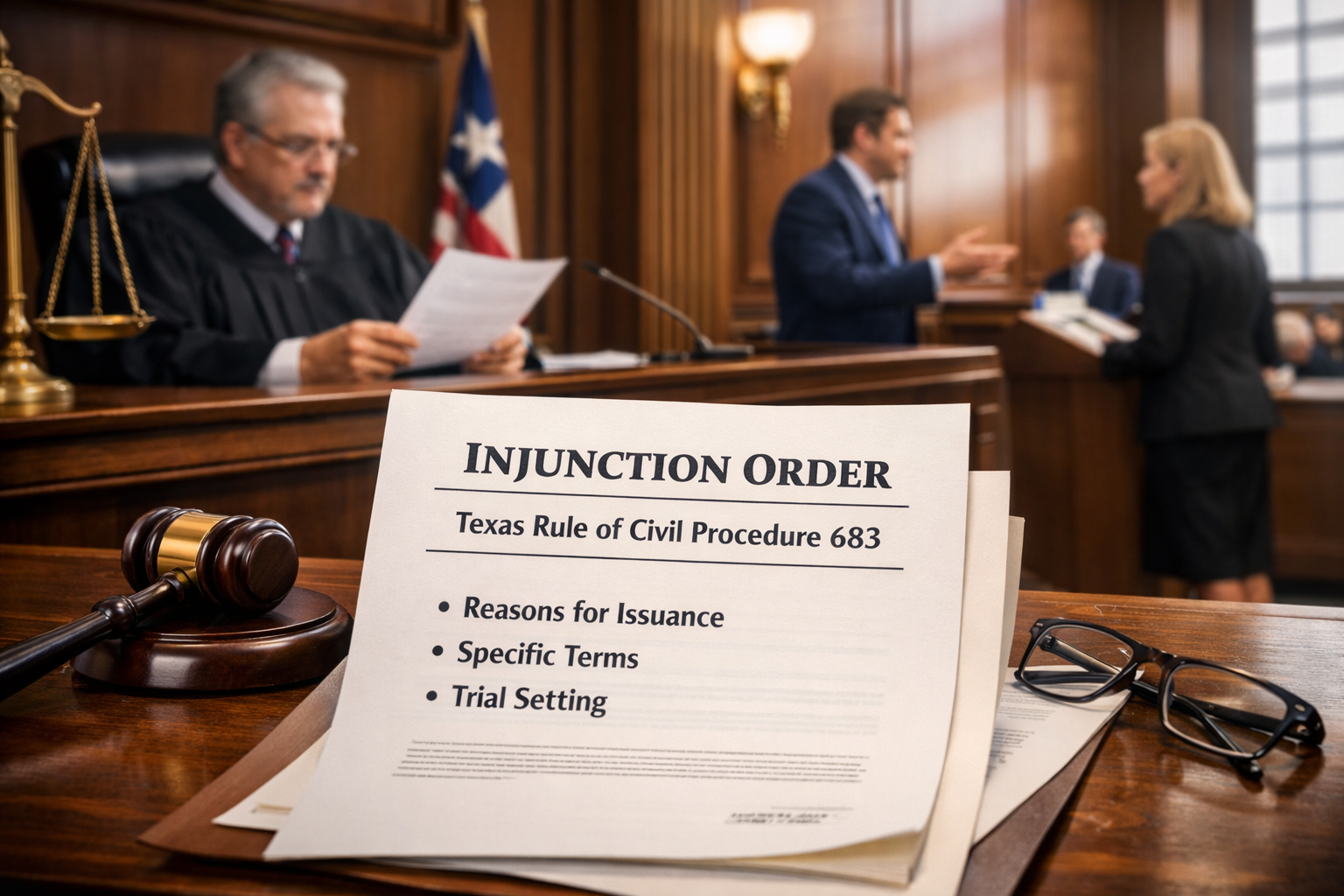
Temporary injunctions are powerful tools in Texas litigation. They allow a court to immediately stop conduct that may cause irreparable harm before a full trial occurs. However, Texas courts strictly enforce the technical requirements governing injunction orders, and many otherwise valid injunctions are reversed on appeal because they fail to comply with Texas Rule of Civil Procedure 683.
Understanding Rule 683 is essential for litigants, attorneys, and businesses seeking emergency court relief.
What Is a Temporary Injunction in Texas?
A temporary injunction is an equitable remedy issued by a court to preserve the status quo until the case can be resolved on the merits.
Texas courts typically require the applicant to prove:
- A cause of action against the defendant
- A probable right to recovery
- A probable, imminent, and irreparable injury without the injunction
Temporary injunctions are common in cases involving:
- Business disputes
- Real estate conflicts
- Non-compete agreements
- Trade secrets
- Property rights
However, even when these elements are proven, the injunction must still comply with strict procedural requirements.
Texas Rule of Civil Procedure 683
Texas Rule of Civil Procedure 683 governs the form and content of injunction orders. The rule provides:
“Every order granting an injunction and every restraining order shall set forth the reasons for its issuance; shall be specific in terms; shall describe in reasonable detail and not by reference to the complaint or other document, the act or acts sought to be restrained.”
— Tex. R. Civ. P. 683
The rule also requires that:
“Every such order shall include an order setting the cause for trial on the merits with respect to the ultimate relief sought.”
— Tex. R. Civ. P. 683
These requirements are mandatory, not discretionary.
Why Rule 683 Is So Important
Texas appellate courts repeatedly hold that failure to comply with Rule 683 makes an injunction order void.
Even if the trial court had good reasons for granting the injunction, the order can be reversed if it:
- Fails to explain why the injunction was issued
- Is too vague or overly broad
- Merely refers to the petition instead of describing prohibited acts
- Fails to set the case for trial
This strict enforcement exists because injunctions can significantly restrict a person’s rights before a full trial.
Common Rule 683 Mistakes
Courts frequently invalidate injunctions for the following reasons:
1. No Explanation of the Reasons for Issuance
Rule 683 requires the order itself—not the pleadings—to state why the injunction is necessary.
A simple statement such as “irreparable harm will occur” is often insufficient.
2. Vague or Overly Broad Orders
An injunction must clearly identify what conduct is prohibited.
For example, an order stating:
“Defendant shall not interfere with Plaintiff’s business.”
may be too vague because it does not describe specific conduct.
3. Incorporating Other Documents by Reference
Rule 683 explicitly prohibits describing the prohibited conduct by referencing pleadings.
For example:
“Defendant is enjoined from conduct described in Plaintiff’s Petition”
is typically defective.
The order must stand on its own.
4. Failure to Set the Case for Trial
Rule 683 requires the injunction order to set the case for trial on the merits.
Many courts reverse injunctions that omit this requirement.
Temporary Restraining Orders vs. Temporary Injunctions
Texas courts distinguish between temporary restraining orders (TROs) and temporary injunctions.
Temporary Restraining Orders
TROs are short-term emergency orders issued without notice to the opposing party.
Under Texas Rule of Civil Procedure 680, a TRO typically lasts no longer than 14 days unless extended.
Temporary Injunctions
Temporary injunctions:
- Require notice and a hearing
- Remain in effect until trial or further court order
- Must comply strictly with Rule 683
Because they last much longer, courts demand greater procedural precision.
Why Appeals of Injunctions Are Common
Texas law allows interlocutory appeals of temporary injunction orders.
This means a party can immediately challenge the order without waiting for the entire lawsuit to finish.
Because injunction orders must strictly follow Rule 683, appellate courts frequently reverse them for technical defects—even when the trial court’s reasoning may have been sound.
Practical Lessons for Texas Litigants
If you are seeking or defending against an injunction in Texas, several practical lessons apply:
First, the injunction order itself must contain detailed findings and specific instructions.
Second, attorneys should carefully draft proposed orders rather than relying on generic templates.
Third, parties facing an injunction should review the order closely—many defective injunctions can be overturned on appeal.
Final Thoughts
Temporary injunctions are powerful litigation tools, but Texas courts demand strict compliance with Texas Rule of Civil Procedure 683. Even small drafting errors can invalidate an injunction order and undo the relief a party fought hard to obtain.
For businesses and individuals involved in disputes involving property rights, contracts, or unfair competition, understanding the technical requirements of Rule 683 can make the difference between preserving your rights and losing critical leverage in a lawsuit.
At David C. Barsalou, Attorney at Law, PLLC, we help clients navigate business, family, tax, estate planning, and real estate matters ranging from document drafting to litigation with clarity and confidence. If you’d like guidance on your situation, schedule a consultation today. Call us at (713) 397-4678, email barsalou.law@gmail.com, or reach us through our Contact Page. We’re here to help you take the next step.