When most people think about an injunction, they picture a judge ordering someone to stop doing something immediately. What many litigants do not realize is that obtaining a temporary injunction in Texas often requires more than proving a legal claim. In many cases, the party seeking the injunction must also post a bond.
This requirement can be a major obstacle in litigation and can significantly affect settlement leverage, business disputes, real estate litigation, and family-related property disputes.
What Is an Injunction Bond?
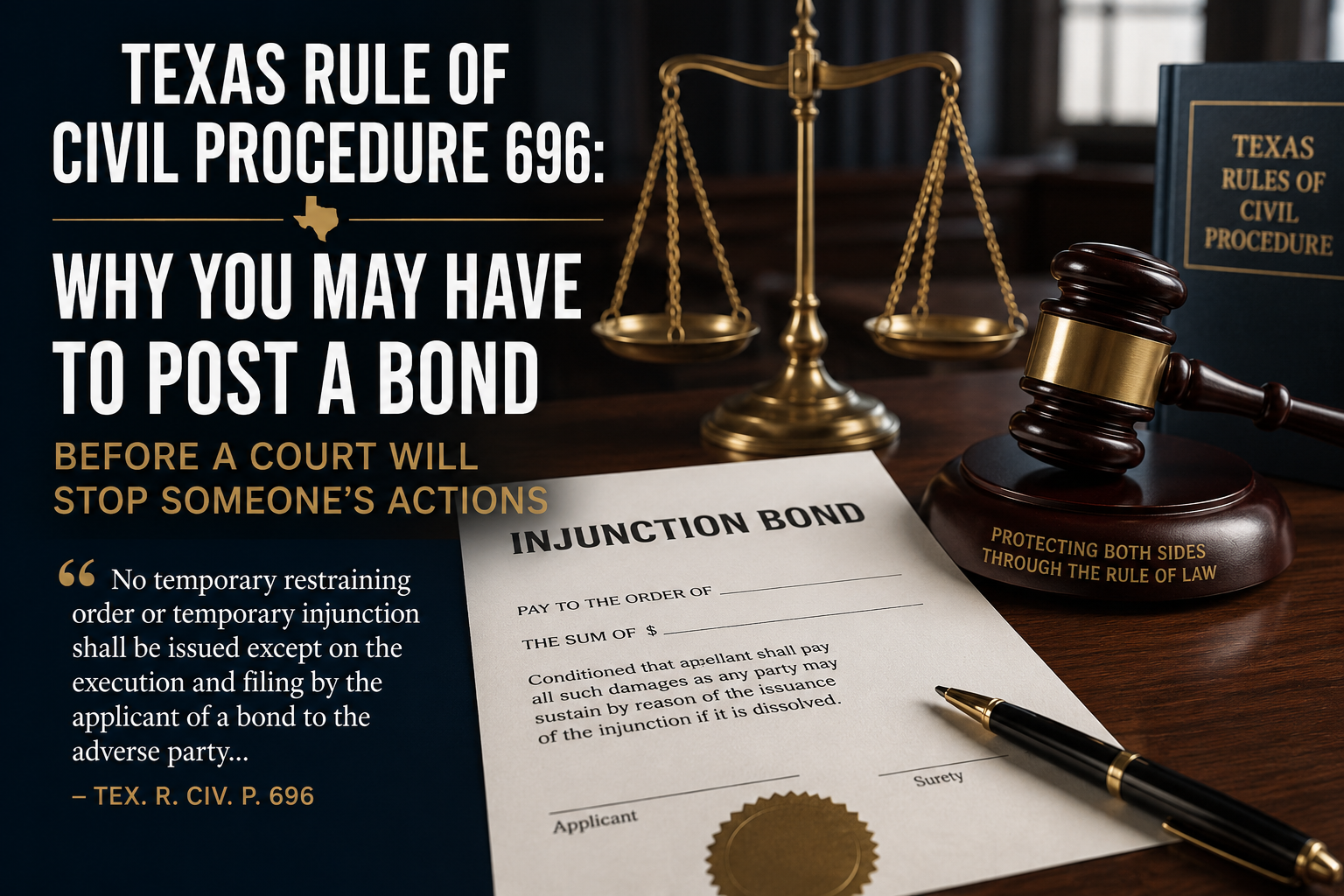
Texas Rule of Civil Procedure 696 provides:
"No temporary restraining order or temporary injunction shall be issued except on the execution and filing by the applicant of a bond to the adverse party..."
The bond serves a simple purpose: if the injunction later turns out to have been wrongfully issued, the restrained party may have suffered damages. The bond provides a source of recovery for those damages.
In other words, Texas law generally requires the person asking the court to stop someone else's conduct to put some money at risk.
Why Does Texas Require a Bond?
Courts recognize that injunctions are powerful remedies.
Unlike a money judgment entered after trial, an injunction can immediately disrupt:
- Businesses;
- Construction projects;
- Real estate transactions;
- Employment relationships;
- Contract performance; and
- Property use.
Because an injunction may be issued before the final merits of the case are decided, Texas requires applicants to provide security in case the injunction is later dissolved.
The bond requirement helps balance the interests of both parties.
How Much Must the Bond Be?
Rule 696 does not establish a fixed dollar amount.
Instead, the trial court determines the amount of security that is sufficient to protect the restrained party from probable damages if the injunction was wrongfully granted.
The amount can vary dramatically depending upon the circumstances.
For example:
- A neighborhood property dispute may require only a modest bond.
- A commercial construction dispute could require a substantial bond.
- A business interruption case may justify a significantly larger amount.
The court has discretion, but the amount must have a reasonable relationship to potential damages.
What Happens if the Bond Is Not Filed?
The bond requirement is not merely a technicality.
Texas appellate courts have repeatedly treated compliance with injunction rules as extremely important. Failure to comply with procedural requirements can result in dissolution or reversal of an injunction.
This principle is consistent with Texas courts' long-standing insistence that injunction rules be followed strictly because injunctions are extraordinary remedies.
A party who obtains an injunction without satisfying applicable procedural requirements may discover that the order is vulnerable on appeal.
What Damages Can Be Recovered Against the Bond?
If a temporary injunction is later dissolved and determined to have been wrongfully issued, the restrained party may seek damages.
Potential damages may include:
- Lost profits;
- Additional operating expenses;
- Delay damages;
- Property-related losses; and
- Other damages directly caused by the injunction.
The exact recoverable damages depend on the facts of the case and applicable Texas law.
Strategic Considerations
The bond requirement creates important strategic considerations for both sides.
For Plaintiffs
Before seeking a temporary injunction, plaintiffs should consider:
- Whether they can afford the required bond;
- The likelihood that the court will require substantial security;
- The potential damages exposure if the injunction proves wrongful; and
- Whether alternative remedies may be available.
For Defendants
Defendants should carefully examine:
- Whether the bond amount is adequate;
- Whether procedural requirements have been satisfied;
- Whether the injunction order complies with Texas procedural rules; and
- Whether appellate remedies are available.
In many cases, challenging the adequacy of the bond can become an important part of the defense strategy.
The Bottom Line
Temporary injunctions are among the most powerful tools available in Texas civil litigation. However, obtaining one usually requires more than convincing a judge that immediate relief is necessary. Texas Rule of Civil Procedure 696 generally requires the applicant to post a bond that protects the opposing party from damages caused by a wrongful injunction.
For litigants involved in business disputes, real estate conflicts, probate litigation, contract cases, or other civil matters, understanding the bond requirement can be just as important as understanding the injunction itself.
As is often the case in Texas litigation, procedural rules can determine the outcome long before a jury ever hears the evidence.
At David C. Barsalou, Attorney at Law, PLLC, we help clients navigate business, family, tax, estate planning, and real estate matters ranging from document drafting to litigation with clarity and confidence. If you’d like guidance on your situation, schedule a consultation today. Call us at (713) 397-4678, email barsalou.law@gmail.com, or reach us through our Contact Page. We’re here to help you take the next step.
