Most people assume that if a legal document has the wrong title, it is automatically defective. Surprisingly, Texas law often takes a much more practical approach.
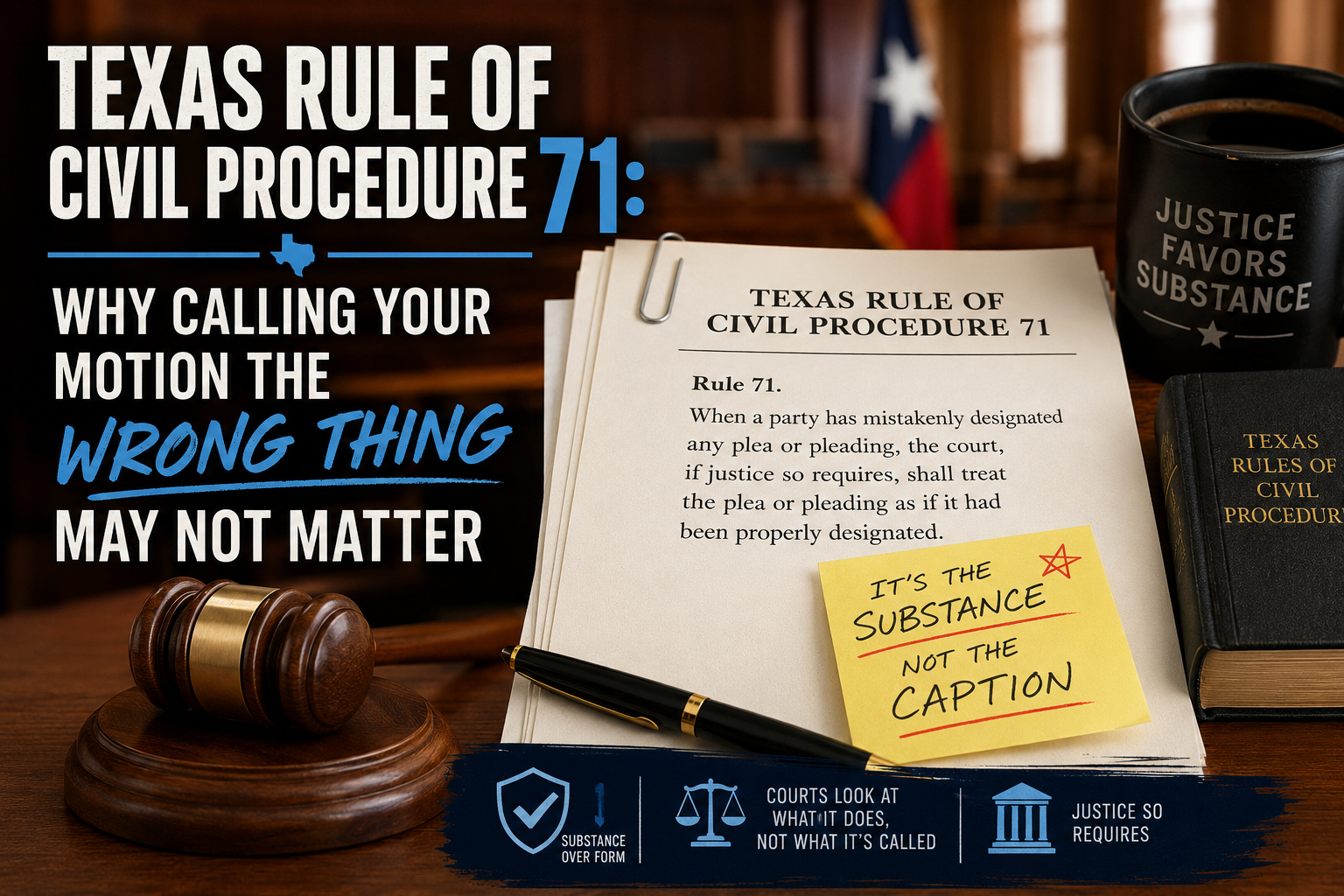
Texas Rule of Civil Procedure 71 provides that courts generally look at what a pleading or motion actually does—not merely what it is called.
Although only one sentence long, Rule 71 has prevented countless procedural mistakes from becoming fatal.
If you are involved in Texas litigation, understanding this rule can help explain why courts sometimes overlook technical labels while still enforcing substantive legal requirements.
What Does Rule 71 Say?
Texas Rule of Civil Procedure 71 provides:
"When a party has mistakenly designated any plea or pleading, the court, if justice so requires, shall treat the plea or pleading as if it had been properly designated."
This deceptively simple rule reflects one of the core philosophies of Texas civil procedure:
Substance generally controls over form.
Instead of asking:
"What is this document called?"
Texas courts often ask:
"What relief is this document actually requesting?"
Why Does This Rule Exist?
Lawsuits are complicated.
Lawyers—and especially self-represented litigants—sometimes file documents under the wrong title.
Examples include:
- Calling a pleading a "Motion" when it is actually an Answer.
- Filing a document labeled "Response" that actually requests affirmative relief.
- Mislabeling a plea to the jurisdiction.
- Mistakenly filing what amounts to an amended petition under another name.
Without Rule 71, these technical errors could unnecessarily derail litigation.
Instead, Texas courts generally focus on the document's substance.
The Rule Does Not Excuse Bad Pleadings
Rule 71 is often misunderstood.
It does not mean that courts ignore procedural rules.
Instead, it merely allows courts to classify documents according to their true legal effect.
For example:
A document labeled:
"Motion for Relief"
might actually function as:
- a motion for new trial,
- a plea in abatement,
- a special appearance,
- or another procedural vehicle.
The court may treat the document according to what it actually seeks.
Courts Look at Substance Over Caption
Texas appellate courts have repeatedly emphasized that courts examine:
- the contents,
- the allegations,
- the requested relief,
- and the practical effect
rather than simply the title printed at the top of the page.
This prevents parties from winning cases merely because an opponent chose an imperfect caption.
Common Examples
Rule 71 frequently appears in situations involving:
Misnamed Answers
A filing may not be labeled "Original Answer," yet clearly denies liability and appears before default judgment.
The court may treat it as an answer.
Post-Judgment Filings
A party may file something called:
"Motion to Reconsider"
Texas procedure may instead treat it as:
- a motion for new trial,
- a motion to modify the judgment,
- or another post-judgment motion,
depending upon its substance and the relief requested.
Those distinctions can significantly affect appellate deadlines.
Pleadings by Self-Represented Litigants
Texas courts often construe pro se pleadings liberally.
Rule 71 allows courts to evaluate what the filing actually attempts to accomplish rather than penalizing litigants solely because they selected the wrong legal terminology.
This does not excuse failure to comply with substantive law, but it can prevent needless procedural dismissals.
Limits of Rule 71
Rule 71 is not a magic cure.
It cannot:
- create jurisdiction where none exists;
- extend jurisdictional deadlines;
- excuse failure to timely file required pleadings;
- replace statutory requirements;
- cure missing evidence;
- avoid mandatory procedural prerequisites.
Likewise, courts generally cannot rewrite a filing into something fundamentally different from what it actually requests.
Practical Advice for Lawyers
Even though Rule 71 offers flexibility, attorneys should never rely on it.
Properly captioning pleadings remains important because:
- judges understand documents more quickly;
- opposing counsel better understands the requested relief;
- appellate courts encounter fewer ambiguities;
- unnecessary procedural disputes are avoided.
Rule 71 serves as a safety net—not a drafting strategy.
Practical Advice for Clients
Clients occasionally worry after discovering that a filing appears to have the "wrong name."
In many situations, that concern may be unfounded.
Texas courts usually examine what the document actually says and what relief it requests rather than focusing exclusively on the title.
That does not mean every mistake is harmless, but it does reflect Texas courts' preference for resolving disputes on their merits whenever possible.
Conclusion
Texas Rule of Civil Procedure 71 embodies a practical principle that runs throughout Texas litigation:
Courts generally decide cases based upon substance rather than labels.
While lawyers should always strive for accurate drafting, Rule 71 helps ensure that justice is not defeated merely because someone selected the wrong caption for an otherwise proper filing.
Like many procedural rules, it rarely attracts public attention—but in the right case, it can determine whether a party's filing is considered or ignored.
At David C. Barsalou, Attorney at Law, PLLC, we help clients navigate business, family, tax, estate planning, and real estate matters ranging from document drafting to litigation with clarity and confidence. If you’d like guidance on your situation, schedule a consultation today. Call us at (713) 397-4678, email barsalou.law@gmail.com, or reach us through our Contact Page. We’re here to help you take the next step.