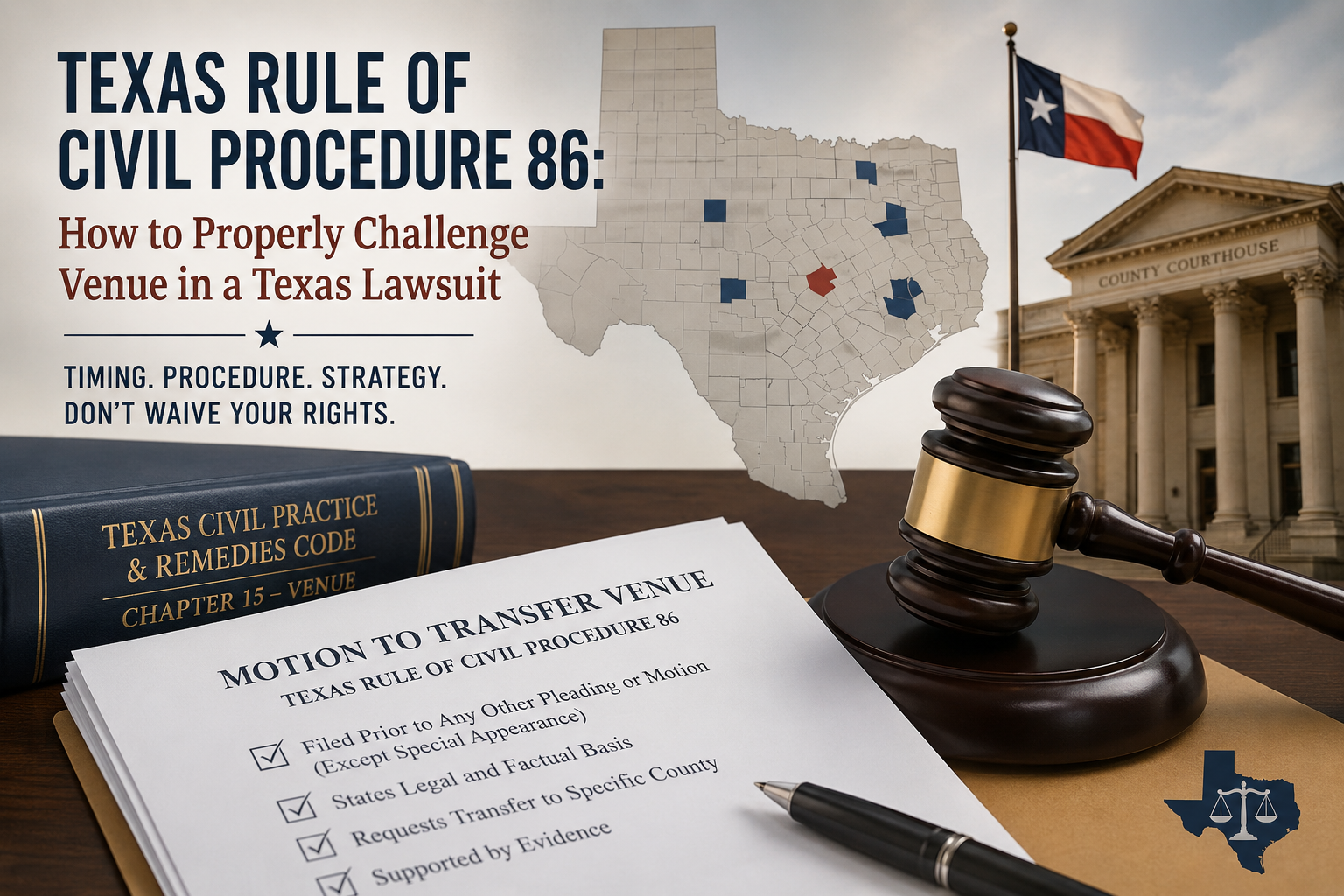
When lawyers talk about where a lawsuit should be filed, they are talking about venue. While many people focus on whether a court has jurisdiction, venue determines which county is the proper location for the lawsuit. A party who ignores venue rules may find themselves litigating hundreds of miles from home—or may lose the right to challenge venue altogether.
One of the most important procedural rules governing venue challenges is Texas Rule of Civil Procedure 86, which establishes the procedure for filing a motion to transfer venue.
Because venue objections are highly technical and subject to strict deadlines, Rule 86 can determine the outcome of a case before any evidence is ever presented.
What Is Venue?
Venue concerns the proper county in which a lawsuit should proceed. Venue rules are primarily governed by Chapter 15 of the Texas Civil Practice and Remedies Code.
Texas Civil Practice and Remedies Code § 15.001(a) provides:
"Except as otherwise provided by this subchapter or Subchapter B or C, all lawsuits shall be brought:
(1) in the county in which all or a substantial part of the events or omissions giving rise to the claim occurred;
(2) in the county of defendant's residence at the time the cause of action accrued if defendant is a natural person;
(3) in the county of the defendant's principal office in this state, if the defendant is not a natural person; or
(4) if Subdivisions (1), (2), and (3) do not apply, in the county in which the plaintiff resided at the time of the accrual of the cause of action."
A lawsuit filed in the wrong county may be subject to transfer if the defendant properly preserves the issue.
Rule 86: The Exclusive Method for Challenging Venue
Texas Rule of Civil Procedure 86 provides in relevant part:
"An objection to improper venue is waived if not made by written motion filed prior to or concurrently with any other plea, pleading or motion except a special appearance motion."
This language creates one of the most significant procedural traps in Texas litigation.
A defendant who files an answer, special exceptions, counterclaim, motion to dismiss, or virtually any other pleading before filing a venue challenge may unintentionally waive the objection.
Timing Is Everything
Rule 86 generally requires a motion to transfer venue to be filed:
- Before any other pleading or motion; or
- Simultaneously with the first responsive pleading.
Many litigants mistakenly assume they can challenge venue later in the case after learning more facts. In most situations, that opportunity disappears once the deadline passes.
Venue challenges are often lost not because the defendant lacks a valid argument, but because counsel failed to follow Rule 86's timing requirements.
What Must the Motion Contain?
A motion to transfer venue must identify the legal basis for transfer and the county to which transfer is sought.
Rule 86 requires that the motion state:
"the legal and factual basis for the transfer of the action and request transfer of the action to a specific county of mandatory or proper venue."
Simply claiming that the plaintiff filed in the wrong county is not enough.
The motion should include:
- The applicable venue statute;
- Supporting facts;
- Verification when required;
- Identification of the correct county; and
- Supporting evidence when appropriate.
The Plaintiff Must Respond
After a motion to transfer venue is filed, the burden frequently shifts to the plaintiff to establish that venue is maintainable in the county where suit was originally filed.
Texas Civil Practice and Remedies Code § 15.064(a) states:
"In determining whether venue was or was not proper, the court shall consider the entire record, including the evidence."
This often turns venue disputes into mini-trials before the actual case begins.
Common Venue Mistakes
Filing the Motion Too Late
The most common mistake is waiver.
Once venue is waived, the case generally remains in the chosen county regardless of whether another county would have been more appropriate.
Failing to Identify the Correct County
A motion that merely attacks the plaintiff's chosen county without specifying a proper alternative venue may fail.
Confusing Jurisdiction and Venue
Jurisdiction concerns a court's power to hear a case.
Venue concerns where the case should be heard.
A court may have jurisdiction even if venue is improper.
Relying on Conclusions Instead of Evidence
Venue disputes often require affidavits, contracts, property records, or other evidence showing why a different county is proper.
Strategic Considerations
Venue can dramatically affect litigation costs and outcomes.
Factors that frequently influence venue strategy include:
- Travel expenses;
- Availability of witnesses;
- Jury demographics;
- Local court procedures;
- Docket congestion; and
- Convenience for parties and counsel.
For businesses operating statewide, venue can become one of the most important early battlegrounds in a lawsuit.
Appeals and Venue Rulings
Venue rulings are generally not immediately appealable.
Instead, most venue complaints must be raised after final judgment.
Texas Civil Practice and Remedies Code § 15.064(b) provides:
"An interlocutory appeal may not be taken from a trial court determination that:
(1) grants or denies a motion to transfer venue..."
As a result, parties often must litigate the entire case before obtaining appellate review of a venue decision.
Final Thoughts
Texas Rule of Civil Procedure 86 is a deceptively simple rule with enormous consequences. A party who fails to timely challenge venue may permanently lose the right to litigate in the proper county. Conversely, a properly filed motion to transfer venue can significantly alter the trajectory of a case before discovery even begins.
Whether you are pursuing a contract dispute, real estate matter, business lawsuit, probate controversy, or other civil claim, understanding Rule 86 is essential. Venue objections are among the few procedural rights that can disappear entirely through inaction, making early legal analysis critical.
At David C. Barsalou, Attorney at Law, PLLC, we help clients navigate business, family, tax, estate planning, and real estate matters ranging from document drafting to litigation with clarity and confidence. If you’d like guidance on your situation, schedule a consultation today. Call us at (713) 397-4678, email barsalou.law@gmail.com, or reach us through our Contact Page. We’re here to help you take the next step.