What Is a General Denial in Texas?
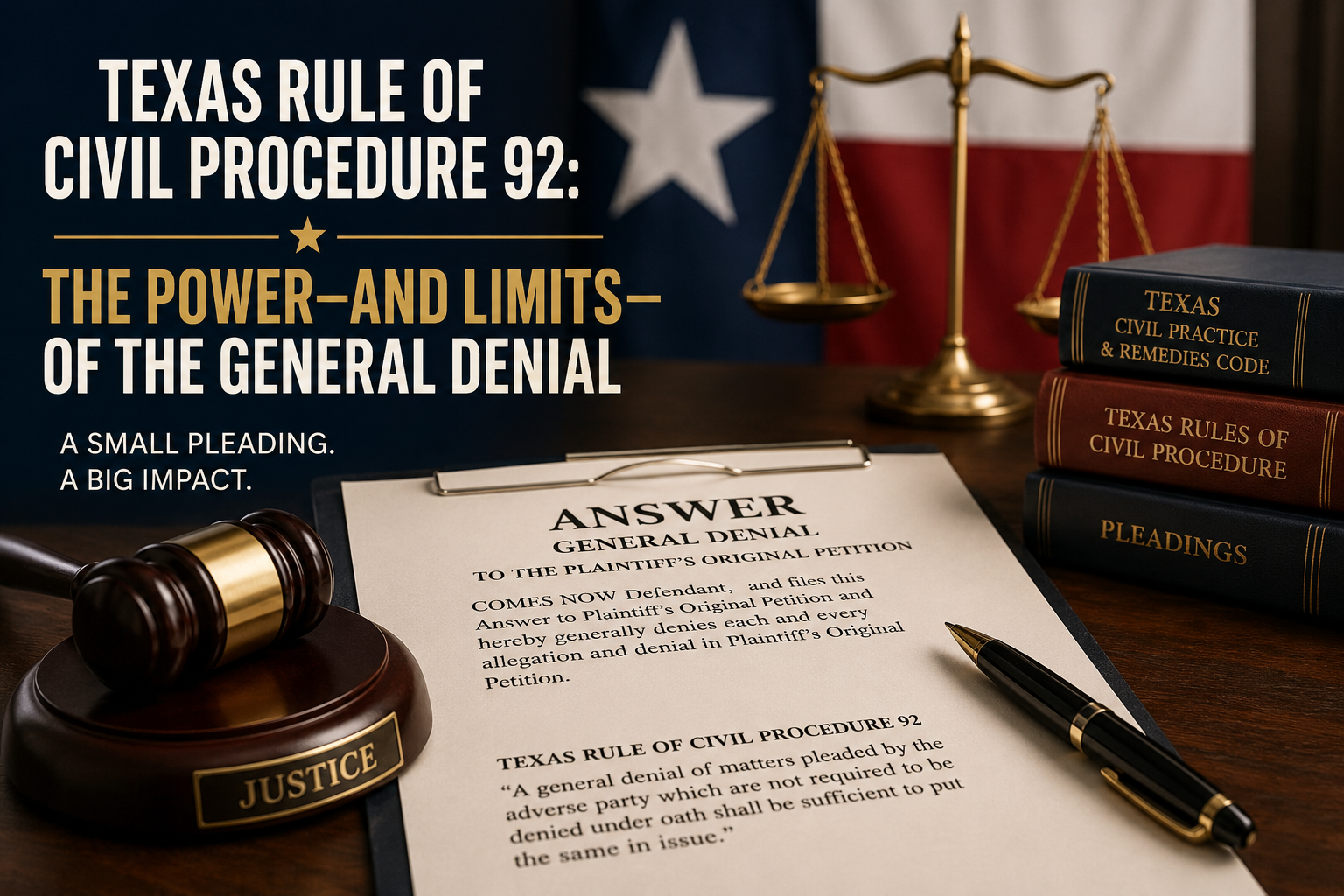
Many people are surprised to learn that a defendant in a Texas lawsuit can often file a relatively short pleading that places nearly every allegation in dispute. This pleading is called a general denial, and it is authorized by Texas Rule of Civil Procedure 92.
For defendants, the general denial is one of the most important procedural tools in Texas litigation. For plaintiffs, understanding its effect is critical because it immediately changes what must be proven at trial.
Whether you are involved in a business dispute, real estate lawsuit, family-related property dispute, probate litigation, or contract case, understanding Rule 92 can help you better appreciate how Texas lawsuits actually work.
The Text of Rule 92
Texas Rule of Civil Procedure 92 provides:
"A general denial of matters pleaded by the adverse party which are not required to be denied under oath shall be sufficient to put the same in issue."
This deceptively simple rule has enormous consequences.
In practical terms, a properly filed general denial generally forces the plaintiff to prove the allegations contained in the petition rather than simply relying on the pleadings.
Why Does Rule 92 Matter?
A lawsuit is not won merely because allegations are made.
Anyone can file a petition alleging:
- Breach of contract;
- Fraud;
- Property damage;
- Unpaid debts;
- Conversion;
- Fiduciary misconduct; or
- Numerous other causes of action.
The filing of a general denial signals that the defendant disputes those allegations and requires the plaintiff to prove them through admissible evidence.
Without evidence, allegations alone are generally insufficient to support a judgment.
What a General Denial Actually Does
A properly filed general denial typically:
- Denies the factual allegations in the petition;
- Requires the plaintiff to prove liability;
- Preserves ordinary defenses;
- Allows the defendant to challenge the plaintiff's evidence; and
- Prevents the plaintiff from obtaining judgment merely because allegations were made.
For many lawsuits, filing a general denial is the first step in mounting a defense.
What a General Denial Does NOT Do
One of the biggest misconceptions among litigants is that a general denial preserves every possible defense.
It does not.
Certain defenses and matters must be specifically pleaded.
For example, Texas Rule of Civil Procedure 94 provides:
"In pleading to a preceding pleading, a party shall set forth affirmatively" various defenses, including accord and satisfaction, arbitration and award, estoppel, failure of consideration, fraud, payment, release, res judicata, statute of frauds, statute of limitations, waiver, and other affirmative defenses.
As a result, a defendant who intends to rely on an affirmative defense should generally plead it specifically rather than assuming a general denial is enough.
Verified Denials Are Different
Some matters require more than a general denial.
Texas Rule of Civil Procedure 93 requires verified denials in numerous situations.
Examples include challenges involving:
- Capacity to sue;
- Capacity to be sued;
- Certain ownership allegations;
- Execution of written instruments;
- Partnership allegations; and
- Other matters specifically identified in Rule 93.
If a verified denial is required but not filed, a party may unintentionally admit an issue that otherwise could have been contested.
This is one reason procedural rules matter so much in Texas litigation.
Can a Defendant Win with Only a General Denial?
Sometimes.
A general denial may be sufficient where the defendant's primary strategy is simply forcing the plaintiff to prove the case and highlighting weaknesses in the evidence.
For example:
- A plaintiff may be unable to prove damages.
- A witness may lack credibility.
- Key documents may not exist.
- Limitations may bar recovery if properly pleaded.
- The plaintiff may fail to establish an essential element of the claim.
However, many cases benefit from additional pleadings, affirmative defenses, counterclaims, or discovery strategies.
Default Judgments Are Different
Rule 92 protects defendants only if it is actually filed.
A defendant who ignores a lawsuit entirely risks a default judgment.
Texas Rule of Civil Procedure 99 requires a defendant to file an answer by the applicable deadline after service.
Failing to answer can allow the plaintiff to obtain judgment without a trial on liability.
For this reason, anyone served with a lawsuit should take the matter seriously and consult counsel promptly.
Practical Example
Suppose a contractor sues a homeowner alleging that $25,000 remains unpaid under a remodeling contract.
If the homeowner files a general denial, the contractor must prove:
- A valid contract existed;
- The contractor performed as required;
- The homeowner breached the agreement; and
- The contractor suffered recoverable damages.
The contractor cannot simply point to the petition and demand judgment.
Evidence becomes necessary.
That is the practical power of Rule 92.
Final Thoughts
Texas Rule of Civil Procedure 92 is one of the shortest rules in Texas civil procedure, yet it has a profound impact on litigation. A general denial forces a plaintiff to prove the case, preserves many ordinary defenses, and serves as the foundation of countless litigation strategies.
At the same time, litigants should remember that a general denial is not a substitute for affirmative defenses, verified denials, or other specialized pleadings required by the Texas Rules of Civil Procedure.
The difference between a proper answer and an incomplete one can significantly affect the outcome of a case, making procedural compliance every bit as important as the underlying facts.
At David C. Barsalou, Attorney at Law, PLLC, we help clients navigate business, family, tax, estate planning, and real estate matters ranging from document drafting to litigation with clarity and confidence. If you’d like guidance on your situation, schedule a consultation today. Call us at (713) 397-4678, email barsalou.law@gmail.com, or reach us through our Contact Page. We’re here to help you take the next step.