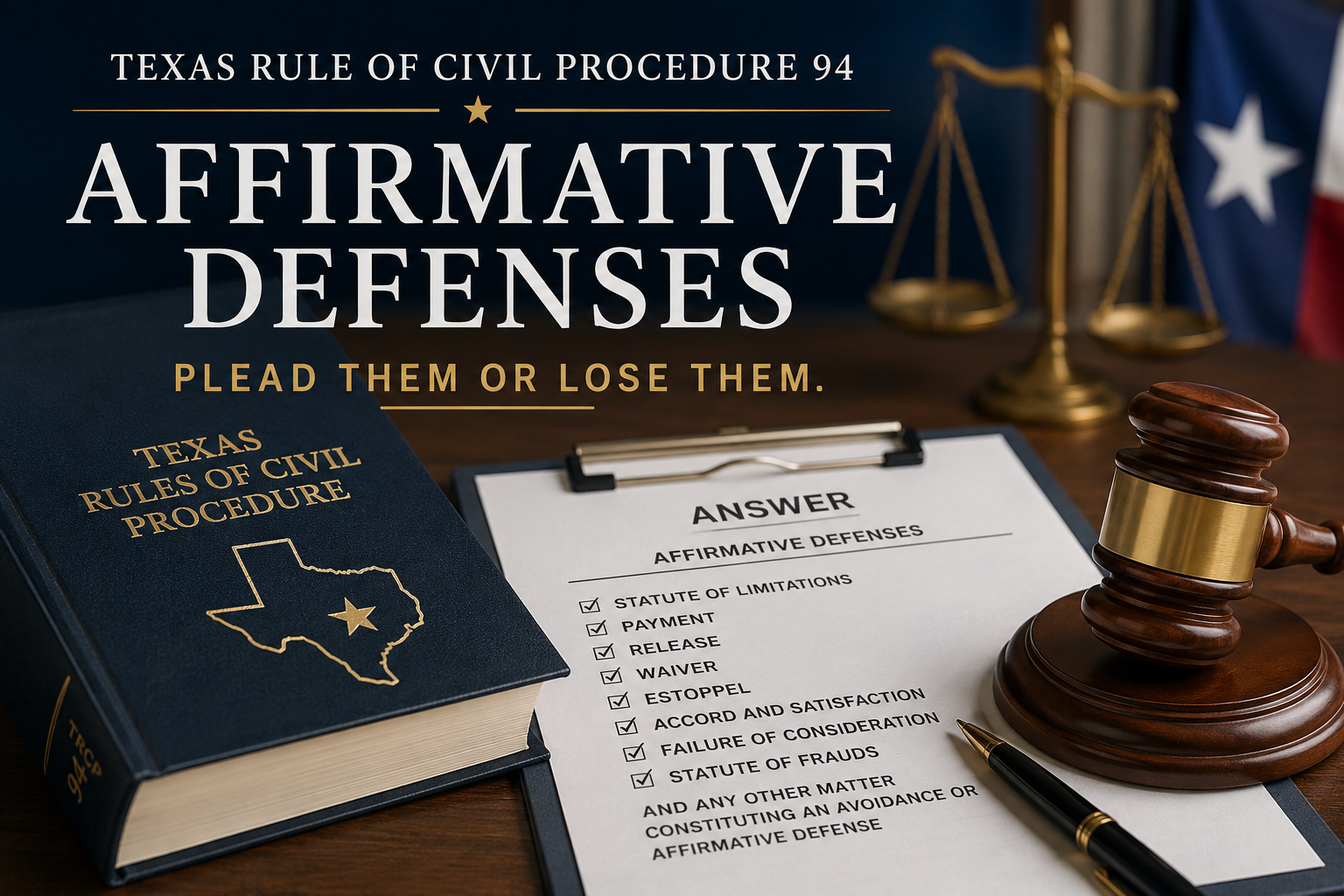
When most people think about defending a lawsuit, they assume that simply denying the allegations is enough. Under Texas law, however, that assumption can be disastrously wrong.
Some defenses are so important that they must be specifically pleaded, or they are generally considered waived. These are known as affirmative defenses, and they are governed by Texas Rule of Civil Procedure 94.
Understanding Rule 94 is critical for plaintiffs, defendants, and business owners alike because a perfectly valid defense may never be considered if it is omitted from the pleadings.
What Is an Affirmative Defense?
An affirmative defense does not merely deny that the plaintiff can prove the case. Instead, it introduces additional facts or legal doctrines that prevent or limit recovery even if many of the plaintiff's allegations are true.
For example, a defendant might admit signing a contract but argue that:
- the claim is barred by limitations;
- the debt has already been paid;
- the plaintiff released the claim;
- the parties reached an accord and satisfaction; or
- the plaintiff waived the right to enforce the contract.
These defenses do not simply contradict the plaintiff's allegations—they provide an independent legal reason why the plaintiff should not recover.
What Does Rule 94 Say?
Texas Rule of Civil Procedure 94 provides, in relevant part:
"In pleading to a preceding pleading, a party shall set forth affirmatively accord and satisfaction, arbitration and award, assumption of risk, contributory negligence, discharge in bankruptcy, duress, estoppel, failure of consideration, fraud, illegality, injury by fellow servant, laches, license, payment, release, res judicata, statute of frauds, statute of limitations, waiver, and any other matter constituting an avoidance or affirmative defense."
The final phrase—"any other matter constituting an avoidance or affirmative defense"—is especially important because the list is not exclusive. Texas courts have recognized numerous affirmative defenses beyond those expressly listed in Rule 94.
Why Does Rule 94 Matter?
The purpose of Rule 94 is fairness.
If a defendant intends to rely upon a defense that would surprise the plaintiff, the plaintiff deserves notice early enough to conduct discovery and prepare evidence.
Without this rule, a defendant could wait until trial to reveal a defense that fundamentally changes the issues in dispute.
Common Affirmative Defenses
Some of the affirmative defenses most frequently encountered in Texas civil litigation include:
- Statute of limitations
- Statute of frauds
- Payment
- Release
- Waiver
- Estoppel
- Accord and satisfaction
- Failure of consideration
- Laches
- Res judicata
- Arbitration agreements
- Bankruptcy discharge
Each requires different evidence and legal analysis, but they generally share one characteristic—they should ordinarily be pleaded affirmatively.
What Happens If You Forget?
One of the most significant consequences of Rule 94 is waiver.
Generally speaking, if an affirmative defense is not pleaded, the court may refuse to allow the defendant to rely upon it later.
Although Texas courts sometimes allow amendment of pleadings or find that an issue was tried by consent, those outcomes should never be assumed. Waiting until summary judgment or trial to raise an omitted affirmative defense can create unnecessary—and sometimes fatal—procedural problems.
Rule 94 and Summary Judgment
Affirmative defenses frequently become the basis for traditional summary judgment motions.
For example:
- A defendant may move for summary judgment based upon the statute of limitations.
- A defendant may prove payment through business records.
- A defendant may establish release through a signed settlement agreement.
However, before those defenses can usually support summary judgment, they should first be properly pleaded.
Plaintiffs Should Pay Attention Too
Rule 94 is not just for defendants.
Plaintiffs should carefully review every answer filed in their case to determine:
- whether affirmative defenses have actually been pleaded;
- whether the defenses are legally sufficient;
- whether discovery should be directed toward those defenses; and
- whether unsupported affirmative defenses can be challenged later in the litigation.
Many defenses appear formidable when first pleaded but ultimately fail because the supporting evidence never materializes.
Practical Takeaway
Texas Rule of Civil Procedure 94 reminds litigants that civil procedure is not merely technical—it often determines substantive outcomes.
A party may possess an excellent legal defense, but if it is never properly pleaded, that defense may never be considered.
Whether you are pursuing a breach of contract claim, defending a business lawsuit, litigating a real estate dispute, or handling other civil litigation, understanding affirmative defenses is an essential part of effective case strategy.
Need Help With a Texas Civil Lawsuit?
At David C. Barsalou, Attorney at Law, PLLC, I represent individuals and businesses in civil litigation throughout Texas, including contract disputes, real estate litigation, business disputes, landlord-tenant matters, and related legal issues. If you have been sued—or are considering filing suit—obtaining sound legal advice early can make a significant difference in protecting your rights and preserving important legal defenses.
At David C. Barsalou, Attorney at Law, PLLC, we help clients navigate business, family, tax, estate planning, and real estate matters ranging from document drafting to litigation with clarity and confidence. If you’d like guidance on your situation, schedule a consultation today. Call us at (713) 397-4678, email barsalou.law@gmail.com, or reach us through our Contact Page. We’re here to help you take the next step.