Introduction
Many people assume that a lawsuit begins when a petition is filed with the court. In reality, filing a lawsuit is only the first step. Before a Texas court can exercise authority over a defendant, the defendant generally must be served with citation and a copy of the petition in accordance with Texas law.
This requirement is not a mere technicality. Texas courts have repeatedly held that proper service of process is fundamental to due process. A plaintiff may have a strong claim, but if service is defective, the entire case can be delayed—or in some situations, a judgment can be set aside years later.
Texas Rule of Civil Procedure 99 provides the framework for citations in Texas civil cases.
What Is a Citation?
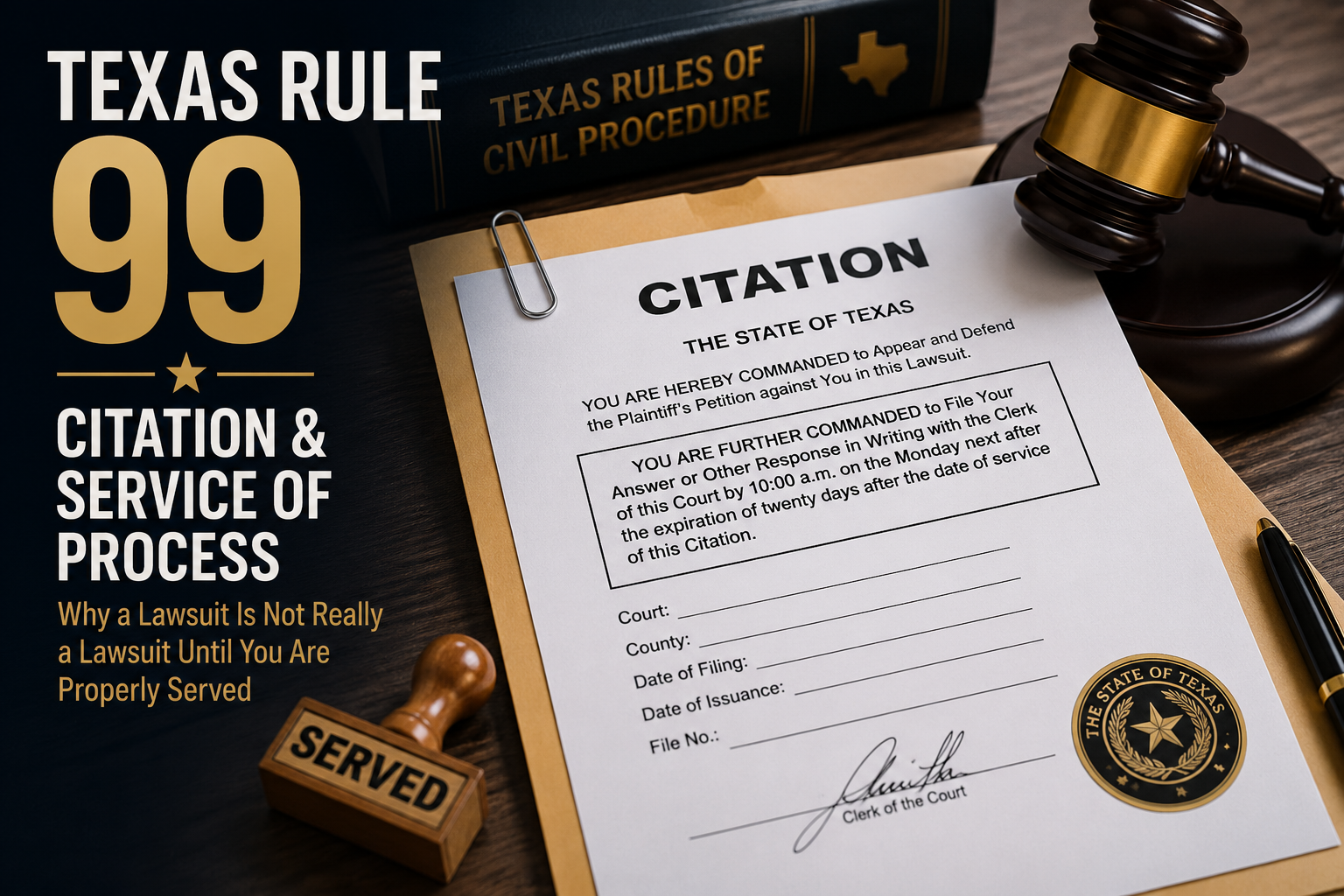
A citation is the formal document issued by the clerk that notifies a defendant that a lawsuit has been filed against them and instructs them regarding the deadline for filing an answer.
Rule 99(b) provides in part:
"The citation shall (1) be styled 'The State of Texas,' (2) be signed by the clerk under seal of court, (3) contain name and location of the court, (4) show date of filing of the petition, (5) show date of issuance of citation, (6) show file number, (7) show names of parties, and (8) be directed to the defendant."
The rule contains numerous additional requirements designed to ensure that defendants receive sufficient notice of the claims asserted against them.
Why Service of Process Matters
The United States Constitution and the Texas Constitution both require due process of law. At its core, due process means that a person must receive notice and an opportunity to be heard before a court can enter a judgment affecting that person's rights.
Without proper service:
- The court may lack personal jurisdiction over the defendant;
- A default judgment may be vulnerable to attack;
- Appeals and bills of review may become available;
- Litigation costs can increase substantially.
For that reason, Texas courts generally require strict compliance with service rules when a default judgment is involved.
The Monday-After-Twenty-Days Answer Deadline
One of the most distinctive features of Texas practice is the answer deadline.
Rule 99(b) states that the citation must notify the defendant that an answer is due:
"by 10:00 a.m. on the Monday next after the expiration of twenty days after the date of service."
This means the answer deadline is not simply twenty days after service. Instead, Texas uses a formula that frequently surprises litigants.
For example:
- Service on June 1;
- Twenty days expires on June 21;
- The next Monday becomes the answer date.
Missing that deadline can expose a defendant to a no-answer default judgment.
Who Can Serve Citation?
Service is generally accomplished by:
- A sheriff;
- A constable;
- A certified process server;
- Any person authorized by law or court order.
Texas permits private process servers, but they must be properly certified or otherwise authorized under applicable rules.
Improper service by an unauthorized individual may render service defective.
Common Service Problems
Several recurring mistakes appear in Texas litigation:
Incorrect Defendant
Serving the wrong entity is more common than many people realize.
For example:
- Serving an employee instead of the company;
- Serving a dissolved entity;
- Serving an affiliated company rather than the named defendant.
These mistakes can create significant jurisdictional issues.
Defective Return of Service
Even when service itself is proper, the return may contain errors.
The return must accurately reflect:
- Who was served;
- When service occurred;
- Where service occurred;
- The manner of service.
A seemingly minor omission can create major problems when a plaintiff later seeks a default judgment.
Outdated Addresses
Businesses move, registered agents resign, and individuals relocate. Service at an obsolete address frequently results in delays and additional expense.
What Happens If Someone Avoids Service?
Many people believe they can defeat a lawsuit simply by refusing to answer the door.
That is generally not true.
When traditional service proves unsuccessful, Texas law provides alternative methods, including substituted service under Rule 106. Courts may authorize service through alternative means when the plaintiff demonstrates diligent but unsuccessful attempts to complete traditional service.
However, a plaintiff must first establish compliance with the applicable procedural requirements before alternative service will be authorized.
Can a Judgment Be Reversed for Bad Service?
Yes.
Texas appellate courts routinely reverse default judgments when service defects appear in the record.
The reasoning is straightforward: a defendant who was not properly served may never have received legally sufficient notice of the lawsuit.
As a result, service defects remain one of the most common grounds for attacking default judgments in Texas courts.
Practical Lessons
For plaintiffs:
- Verify the correct legal name of the defendant.
- Confirm the proper service address.
- Review returns carefully before seeking default judgment.
- Keep detailed records of service efforts.
For defendants:
- Do not ignore citations.
- Calculate answer deadlines immediately.
- Consult counsel promptly.
- Investigate whether service was properly completed.
Conclusion
Texas Rule of Civil Procedure 99 may appear procedural, but it sits at the heart of every civil lawsuit. A case cannot move forward properly unless the defendant receives legally sufficient notice. Whether you are filing a lawsuit or defending one, understanding citation and service requirements can mean the difference between a valid judgment and years of avoidable litigation.
Because service of process implicates constitutional due process rights, Texas courts continue to scrutinize compliance with Rule 99 carefully. In many cases, the outcome of a lawsuit may depend less on the merits and more on whether the parties followed the service rules correctly from the beginning.
At David C. Barsalou, Attorney at Law, PLLC, we help clients navigate business, family, tax, estate planning, and real estate matters ranging from document drafting to litigation with clarity and confidence. If you’d like guidance on your situation, schedule a consultation today. Call us at (713) 397-4678, email barsalou.law@gmail.com, or reach us through our Contact Page. We’re here to help you take the next step.