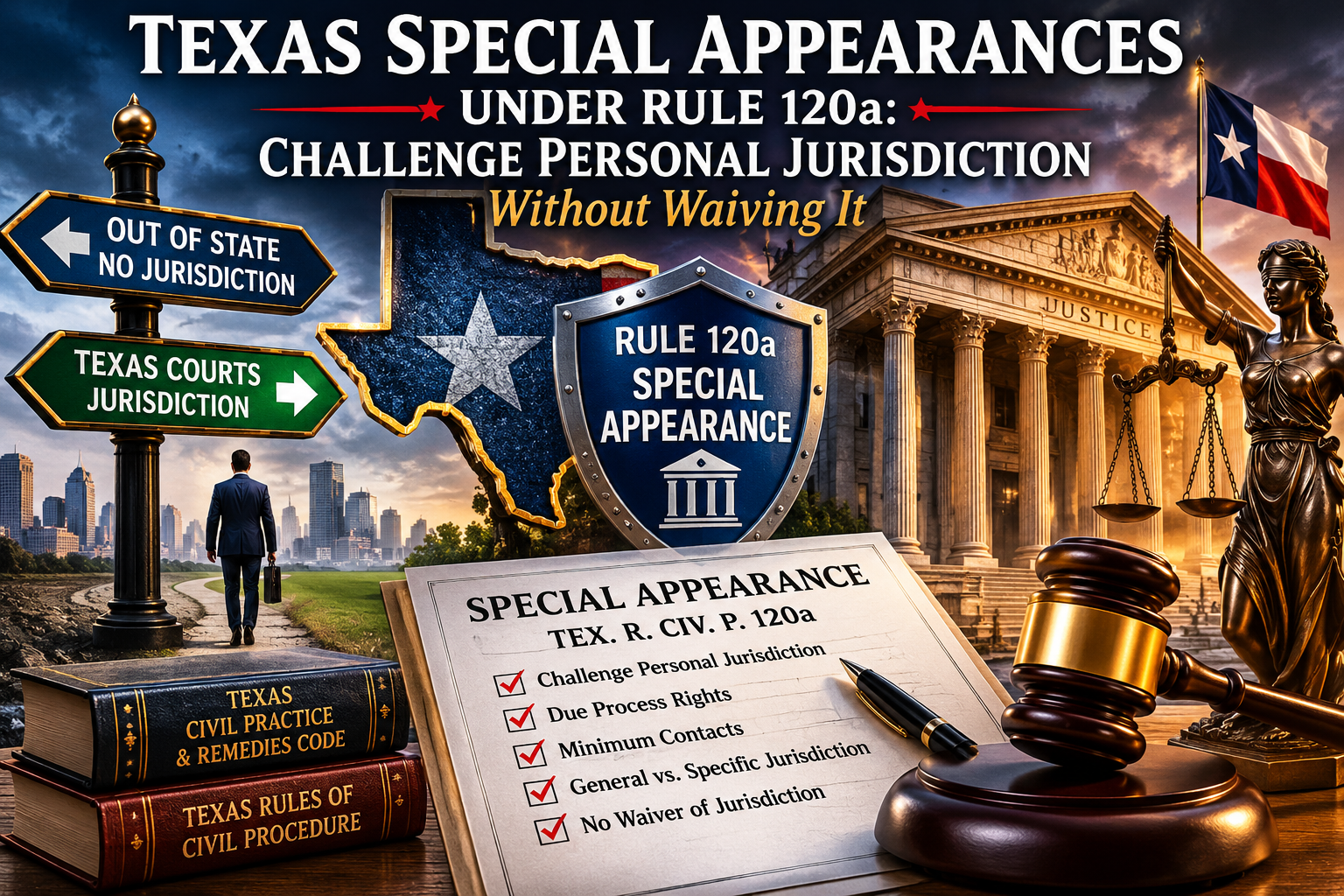
When a lawsuit is filed in Texas against an out-of-state individual or business, one of the first questions is whether a Texas court has the authority to exercise jurisdiction over that defendant. Texas courts cannot simply exercise power over anyone, anywhere. Instead, constitutional due process and Texas procedural rules impose limits on when a Texas court may require a nonresident defendant to defend a lawsuit in the state.
The primary procedural vehicle for challenging personal jurisdiction in Texas is the special appearance under Texas Rule of Civil Procedure 120a.
Understanding how special appearances work is critical because procedural mistakes can result in a defendant inadvertently submitting to Texas jurisdiction and losing the ability to challenge the lawsuit on jurisdictional grounds.
What Is a Special Appearance?
Texas Rule of Civil Procedure 120a provides:
"A special appearance may be made by any party either in person or by attorney for the purpose of objecting to the jurisdiction of the court over the person or property of the defendant..."
— Tex. R. Civ. P. 120a(1)
A special appearance is a procedural motion asserting that the Texas court lacks personal jurisdiction over the defendant.
Unlike a challenge to subject-matter jurisdiction, which concerns the court's authority to hear a type of case, a special appearance concerns whether the court may exercise authority over a particular defendant.
Why Personal Jurisdiction Matters
The Due Process Clause of the Fourteenth Amendment limits a state's ability to exercise jurisdiction over nonresident defendants.
The United States Supreme Court has long held that a defendant must have sufficient "minimum contacts" with the forum state such that maintaining the lawsuit does not offend:
"traditional notions of fair play and substantial justice."
This standard originates from the landmark case of International Shoe Co. v. Washington, 326 U.S. 310 (1945).
Texas courts therefore engage in a constitutional analysis whenever a nonresident challenges personal jurisdiction.
Texas's Long-Arm Statute
Texas's long-arm statute is codified in Chapter 17 of the Texas Civil Practice and Remedies Code.
Section 17.042 provides that a nonresident does business in Texas if the person:
"(1) contracts by mail or otherwise with a Texas resident and either party is to perform the contract in whole or in part in this state;
(2) commits a tort in whole or in part in this state; or
(3) recruits Texas residents, directly or through an intermediary located in this state, for employment inside or outside this state."
Tex. Civ. Prac. & Rem. Code § 17.042.
Importantly, the Texas Supreme Court has repeatedly recognized that the statute reaches as far as federal due process allows. Consequently, the practical analysis usually centers on constitutional minimum contacts rather than the text of the statute itself.
General Jurisdiction vs. Specific Jurisdiction
Texas courts generally recognize two forms of personal jurisdiction.
General Jurisdiction
General jurisdiction exists when a defendant's contacts with Texas are so continuous and systematic that the defendant is essentially "at home" in Texas.
For individuals, this is typically their domicile.
For corporations, it is usually their state of incorporation or principal place of business.
When general jurisdiction exists, a defendant may be sued in Texas even for claims unrelated to Texas activities.
Specific Jurisdiction
Specific jurisdiction is narrower.
Specific jurisdiction exists when:
- The defendant purposefully avails itself of conducting activities in Texas; and
- The plaintiff's claims arise from or relate to those Texas contacts.
Most special appearance litigation focuses on specific jurisdiction.
The Procedural Trap: Timing Matters
Rule 120a contains one of the most dangerous procedural requirements in Texas litigation.
The rule provides that:
"Every appearance, prior to judgment, not in compliance with this rule is a general appearance."
Tex. R. Civ. P. 120a.
In practical terms, if a defendant seeks affirmative relief before filing a special appearance, the defendant may waive the jurisdictional challenge entirely.
Examples that can create problems include:
- Seeking substantive rulings from the court;
- Filing certain motions before the special appearance;
- Requesting relief inconsistent with a jurisdictional objection.
Because waiver issues are highly fact-specific, defendants should proceed carefully when challenging jurisdiction.
Who Has the Burden of Proof?
The burden-shifting framework is important.
Initially, the plaintiff must plead allegations sufficient to invoke Texas's long-arm jurisdiction.
Once that occurs, the defendant bears the burden of negating all pleaded bases of personal jurisdiction.
This frequently requires:
- Affidavits;
- Corporate records;
- Contracts;
- Jurisdictional discovery; and
- Testimony.
Special appearances are often evidence-heavy proceedings.
Jurisdictional Discovery
Parties frequently conduct limited discovery focused solely on jurisdictional facts.
Examples include:
- Communications with Texas residents;
- Business operations in Texas;
- Texas-based customers;
- Travel into Texas;
- Marketing efforts directed at Texas; and
- Contract performance occurring in Texas.
Jurisdictional discovery can become extensive in commercial litigation and often determines the outcome of the special appearance.
The Consequences of Winning
If the defendant successfully proves that Texas lacks personal jurisdiction, the claims against that defendant are dismissed.
The dismissal is generally without prejudice, meaning the plaintiff may be able to refile the lawsuit in a state where jurisdiction properly exists.
A successful special appearance can therefore end expensive litigation before merits discovery even begins.
The Consequences of Losing
If the special appearance is denied, the defendant must continue defending the lawsuit in Texas.
However, the jurisdictional issue is often preserved for appellate review.
In significant commercial disputes, appellate courts regularly address personal-jurisdiction questions because they involve constitutional rights and interstate commerce concerns.
Practical Considerations
Special appearances are among the most technical motions in Texas civil practice.
The governing law involves a blend of:
- Texas procedural rules;
- Texas Supreme Court precedent;
- Federal constitutional due process principles; and
- Fact-intensive jurisdictional analysis.
A defendant who genuinely lacks meaningful Texas contacts may have a powerful defense available. Conversely, waiting too long or filing the wrong pleading first can unintentionally waive the challenge.
Because jurisdictional mistakes can determine where an entire lawsuit is litigated, early analysis by experienced counsel is often essential.
Conclusion
Texas Rule of Civil Procedure 120a provides a powerful mechanism for challenging a Texas court's exercise of personal jurisdiction over a nonresident defendant. Whether jurisdiction exists depends on constitutional due process principles, the defendant's contacts with Texas, and strict compliance with procedural requirements.
For businesses and individuals sued in Texas despite limited connections to the state, a properly presented special appearance may provide an opportunity to defeat the lawsuit before it ever reaches the merits.
At David C. Barsalou, Attorney at Law, PLLC, we help clients navigate business, family, tax, estate planning, and real estate matters ranging from document drafting to litigation with clarity and confidence. If you’d like guidance on your situation, schedule a consultation today. Call us at (713) 397-4678, email barsalou.law@gmail.com, or reach us through our Contact Page. We’re here to help you take the next step.