It also gives us unusually clean statutory language to quote. I think this is a strong SEO topic because people routinely search variations of “How fast can I get divorced in Texas?” and “Do I really have to wait 60 days for a Texas divorce?”
How Fast Can You Get Divorced in Texas? Understanding the 60-Day Waiting Period and Its Exceptions
Two spouses agree that their marriage is over.
They have divided their property. They have signed the necessary documents. Perhaps they have no children, no significant assets, and nothing left to fight about.
Can they file for divorce on Monday and ask a Texas judge to sign the decree on Friday?
Usually, no.
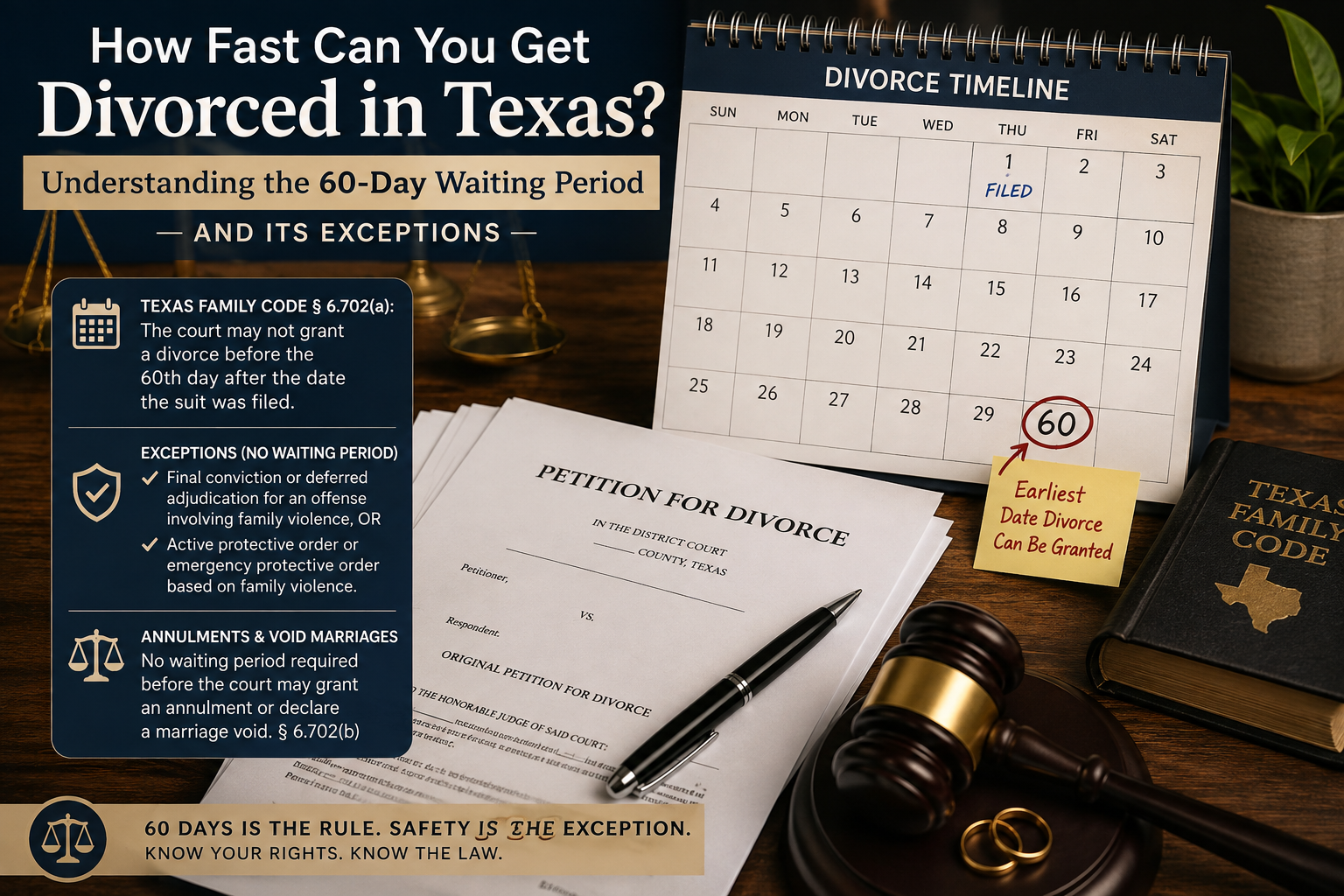
Texas law imposes a statutory waiting period before most divorces can be granted. Under Texas Family Code § 6.702, a Texas court generally cannot grant a divorce until at least the 60th day after the divorce suit was filed.
But there is an important—and sometimes misunderstood—exception.
In certain cases involving family violence, Texas law eliminates the 60-day waiting period entirely.
Understanding the distinction is important because the 60-day rule is not merely a customary court practice. It is written directly into the Texas Family Code.
Texas Generally Requires a 60-Day Waiting Period for Divorce
Texas Family Code § 6.702(a) establishes the basic rule:
“the court may not grant a divorce before the 60th day after the date the suit was filed.”
Tex. Fam. Code § 6.702(a). (Texas Legislature Online)
That means the relevant date is generally the date the divorce lawsuit is filed, not the date the spouses separated, decided to divorce, hired attorneys, or reached an agreement.
Suppose a married couple has lived separately for six months before either spouse files for divorce.
Those six months do not satisfy the statutory waiting period.
The clock begins when the divorce suit is filed.
Likewise, the fact that both spouses want the divorce does not ordinarily eliminate the waiting period.
An uncontested divorce may be considerably easier and faster to complete than a contested divorce, but agreement between the spouses does not itself create an exception to § 6.702.
The 60-Day Rule Is a Minimum, Not a Promise
One of the most important practical distinctions is between the earliest date on which a divorce may legally be granted and the date on which the divorce will actually be completed.
The statute does not say that a Texas divorce must be completed within 60 days.
It says the court ordinarily may not grant one before the 60th day.
A contested divorce involving children, property, discovery, business interests, real estate, temporary orders, or other disputed issues can remain pending far longer.
Even an uncontested case may take longer depending on whether the paperwork is complete and when the court can consider the final decree.
Thus, “Texas has a 60-day divorce period” should not be understood to mean that every Texas divorce takes 60 days.
It means that 60 days is ordinarily the statutory floor.
Can the Spouses Agree to Waive the 60 Days?
Generally, no.
This is where people sometimes confuse the divorce waiting period with other procedural rights.
The statute directs the court that it “may not grant a divorce” before the prescribed time. The spouses cannot ordinarily eliminate that statutory restriction merely by agreeing with one another.
Even if both spouses sign a proposed final decree on the day the case is filed, their agreement does not itself authorize the court to grant the divorce immediately.
Texas law does, however, provide specific exceptions.
And those exceptions are quite narrow.
Family Violence Can Eliminate the Waiting Period
Texas Family Code § 6.702(c) provides that the normal waiting period is not required in two categories of cases involving family violence. (Texas Legislature Online)
The first applies when the respondent has been:
“finally convicted of or received deferred adjudication for an offense involving family violence”
against the petitioner or a member of the petitioner's household. Tex. Fam. Code § 6.702(c)(1). (Texas Legislature Online)
This is significantly narrower than simply alleging cruelty, abuse, or family violence in the divorce petition.
The statute specifically refers to a final conviction or deferred adjudication for an offense involving family violence.
When the statutory conditions are met, however, the ordinary 60-day waiting period is not required.
An Active Protective Order Can Also Eliminate the Waiting Period
The second exception concerns certain protective orders.
Section 6.702(c)(2) eliminates the waiting period when the petitioner has an active protective order under Title 4 of the Family Code—or an active magistrate's order for emergency protection under the Code of Criminal Procedure—against the respondent based on a finding of family violence committed during the marriage. (Texas Legislature Online)
That distinction matters.
The statute does not simply say that a spouse may skip the waiting period whenever that spouse alleges that family violence occurred.
The Legislature tied the exception to specific legal circumstances involving a qualifying protective order or criminal disposition.
Texas law separately provides that a court shall render a protective order when the required finding of family violence has been made. Tex. Fam. Code § 81.001. (Texas Legislature Online)
For someone attempting to leave a dangerous marriage, therefore, the existence and nature of a protective order can affect not only immediate protection but also how quickly the divorce itself may legally be completed.
Annulments and Void Marriages Are Treated Differently
There is another interesting wrinkle hidden in § 6.702.
The 60-day waiting period specifically governs divorce.
Subsection (b) states:
“A waiting period is not required before a court may grant an annulment or declare a marriage void”
other than whatever requirements apply in civil cases generally. Tex. Fam. Code § 6.702(b). (Texas Legislature Online)
That does not mean an annulment is automatically faster or easier to obtain.
An annulment and a suit to declare a marriage void involve their own substantive legal requirements. A person cannot simply choose an annulment instead of a divorce because the person would prefer to avoid waiting 60 days.
But when a marriage actually qualifies for annulment or is legally void, § 6.702 does not impose the same statutory waiting period applicable to an ordinary divorce.
Texas Has Another Waiting Period After the Divorce
Texas law contains a second timing rule that sometimes causes confusion.
Even after the divorce becomes final, a divorced person generally cannot immediately marry someone else.
Texas Family Code § 6.801 provides a separate 30-day remarriage restriction, subject to the court's authority to waive it for good cause.
That rule is distinct from the 60-day period discussed here.
In other words, Texas law potentially places timing restrictions on both ends of the divorce:
60 days after filing before most divorces may be granted, followed by a general 30-day restriction on marrying a third person after the divorce is finalized.
You recently covered the separate 30-day remarriage rule, so these two articles would also cross-link nicely. Your index lists that article on August 27.
What Happens If a Divorce Is Granted Too Early?
Here is perhaps the strangest sentence in the entire statute.
Immediately after establishing the 60-day prohibition, § 6.702(a) states:
“A decree rendered in violation of this subsection is not subject to collateral attack.”
Tex. Fam. Code § 6.702(a). (Texas Legislature Online)
That is a peculiar but important qualification.
The Legislature simultaneously tells courts not to grant the divorce before the statutory waiting period expires while also providing that a decree entered in violation of that rule is not subject to collateral attack.
That does not make the waiting period optional.
Rather, it addresses the consequences of a violation and helps protect the finality of an improperly premature divorce decree from later collateral challenges.
For lawyers, it is a nice reminder that a statutory command and the legal consequences of violating that command are not always the same question.
Do You Have to Be Separated for 60 Days?
No.
The 60-day waiting period should also not be confused with a mandatory separation period.
Texas does not generally require spouses to live in separate residences for 60 days before obtaining a divorce.
The statutory clock runs from the filing of the suit, not from physical separation. Texas legal-aid guidance likewise explains that spouses do not have to be separated before filing for divorce. (TexasLawHelp.org)
That means spouses can potentially continue living in the same house while the divorce is pending.
Whether doing so is practical is a completely different question.
A Simple Example
Assume a spouse files an original petition for divorce.
The parties have no children and relatively little property. The respondent signs the appropriate paperwork, and the spouses quickly reach a complete agreement concerning everything that needs to be included in the final decree.
They ordinarily still cannot simply appear before the judge a week later and obtain a divorce.
Section 6.702 requires the statutory waiting period to run.
Now change the facts.
Suppose the petitioner has an active qualifying protective order against the respondent based on family violence committed during the marriage.
In that circumstance, § 6.702(c) may remove the 60-day waiting requirement.
The difference has nothing to do with whether the divorce is contested.
It comes from the specific statutory exception enacted by the Texas Legislature.
The Bottom Line
Most Texas divorces cannot be granted until at least the 60th day after the divorce suit is filed.
Agreement between the spouses does not ordinarily eliminate that requirement, and living apart before filing does not count toward the statutory period.
Texas Family Code § 6.702 nevertheless contains narrow exceptions involving certain family-violence convictions, deferred adjudications, protective orders, and emergency protective orders.
Annulments and suits to declare a marriage void are also not governed by the same 60-day requirement.
For most divorcing spouses, the practical lesson is straightforward: filing starts the clock.
And while an uncomplicated Texas divorce can sometimes move relatively quickly once that clock has run, 60 days is generally the earliest permissible finish line—not a guarantee that the case will be finished by then.
This article is for general informational purposes only and does not constitute legal advice. Divorce deadlines and procedures can depend on the circumstances of a particular case. Anyone facing a divorce or family-violence situation should consider obtaining advice regarding their specific circumstances.
At David C. Barsalou, Attorney at Law, PLLC, we help clients navigate business, family, tax, estate planning, and real estate matters ranging from document drafting to litigation with clarity and confidence. If you’d like guidance on your situation, schedule a consultation today. Call us at (713) 397-4678, email barsalou.law@gmail.com, or reach us through our Contact Page. We’re here to help you take the next step.