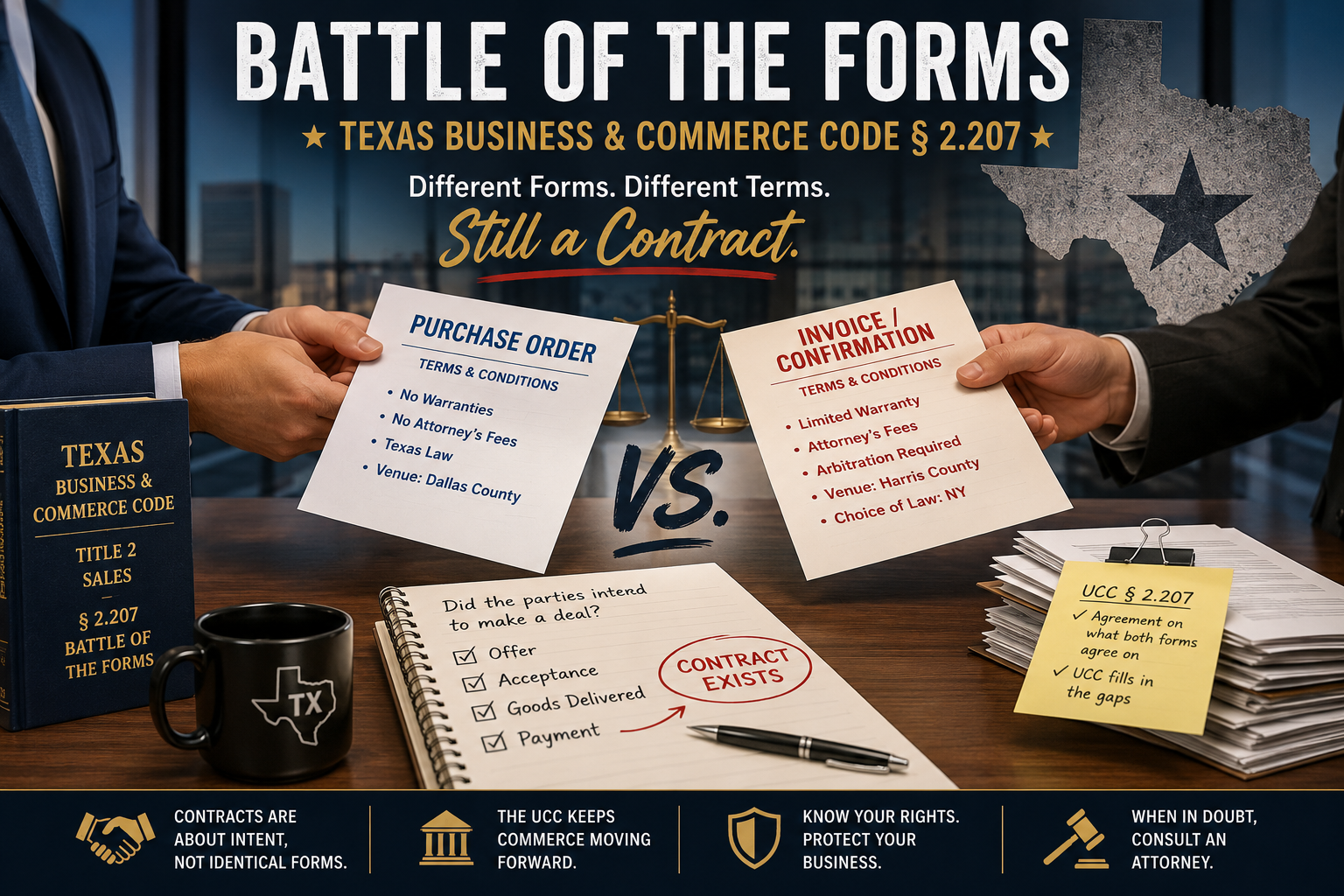
Business owners often assume that if two companies exchange contracts containing different terms, no contract exists until every disagreement is resolved.
Under Texas law, that assumption is often incorrect.
One of the most unusual—and frequently misunderstood—provisions of the Texas Business & Commerce Code is the so-called "Battle of the Forms." Instead of allowing minor contractual differences to prevent commercial transactions, Texas law often recognizes that a binding contract exists anyway.
Understanding this rule can help businesses avoid expensive contract disputes after goods have already been delivered.
What Is the Battle of the Forms?
Businesses frequently conduct transactions using their own standard paperwork.
For example:
- Seller sends a quotation.
- Buyer responds with a purchase order.
- Seller ships the goods with its own invoice.
- Each document contains different legal terms.
The documents may disagree about:
- Attorney's fees
- Warranties
- Arbitration
- Interest rates
- Choice of law
- Venue
- Limitation of damages
Rather than requiring every term to match perfectly, the Texas UCC provides rules for determining whether a contract was formed.
Texas Business & Commerce Code § 2.207
Texas Business & Commerce Code § 2.207(a) provides:
"A definite and seasonable expression of acceptance or a written confirmation which is sent within a reasonable time operates as an acceptance even though it states terms additional to or different from those offered or agreed upon, unless acceptance is expressly made conditional on assent to the additional or different terms."
This language significantly changed the common-law "mirror image rule."
Under traditional contract law, changing almost any term created a counteroffer rather than an acceptance.
The UCC recognizes that commercial businesses routinely exchange inconsistent forms while fully intending to complete the transaction.
Does a Contract Still Exist?
Often, yes.
If the parties clearly intended to buy and sell goods, the contract may still be enforceable even when their paperwork does not perfectly match.
The law focuses less on identical paperwork and more on whether the parties objectively intended to complete the transaction.
What Happens to the Conflicting Terms?
That depends.
When both parties are merchants, additional terms may automatically become part of the contract unless one of several statutory exceptions applies.
For example, an additional term generally will notbecome part of the agreement if:
- the original offer expressly limits acceptance to its own terms;
- the new term would materially alter the contract; or
- the receiving party objects within a reasonable time.
Whether a term "materially alters" the agreement is often the central issue in litigation.
What Is a Material Alteration?
Courts evaluate materiality on a case-by-case basis.
Examples that may materially alter an agreement include provisions involving:
- mandatory arbitration;
- significant warranty disclaimers;
- large limitations on liability;
- substantial attorney's fee provisions; or
- unexpected indemnity obligations.
Small administrative differences, however, may not materially change the parties' bargain.
What If the Parties Never Signed Anything?
Even then, a contract may still exist.
Texas Business & Commerce Code § 2.207(c) recognizes that the parties' conduct alone may establish a contract.
If both businesses proceed with performance—for example:
- goods are shipped,
- goods are accepted,
- payment is made,
the law may conclude that a contract exists despite inconsistencies in the written documents.
In those situations, the contract generally consists of:
- the terms on which both writings agree; and
- the applicable provisions supplied by the Uniform Commercial Code.
Why This Matters
Many businesses rely on preprinted purchase orders and invoices without ever reading the other party's documents.
Later, when a dispute arises, each side assumes its own boilerplate language controls.
The Battle of the Forms demonstrates that neither party automatically wins.
Instead, courts analyze:
- whether a contract was formed;
- whether both parties were merchants;
- whether the additional terms materially altered the agreement;
- whether timely objections were made; and
- whether the parties' conduct independently created a contract.
Practical Takeaway
The Battle of the Forms is one of the Texas UCC's most practical—and surprising—rules. Businesses often believe conflicting paperwork prevents a contract from existing. In reality, Texas law frequently reaches the opposite conclusion. When commercial parties act like they have a deal, the law often treats them as having one, even if their forms never completely matched.
If your business is involved in a dispute over purchase orders, invoices, or conflicting contract terms, understanding Texas Business & Commerce Code § 2.207 may significantly affect your rights and obligations.
Disclaimer: This article is for informational purposes only and does not constitute legal advice. Every commercial transaction is unique, and you should consult an attorney regarding your specific circumstances.
At David C. Barsalou, Attorney at Law, PLLC, we help clients navigate business, family, tax, estate planning, and real estate matters ranging from document drafting to litigation with clarity and confidence. If you’d like guidance on your situation, schedule a consultation today. Call us at (713) 397-4678, email barsalou.law@gmail.com, or reach us through our Contact Page. We’re here to help you take the next step.
