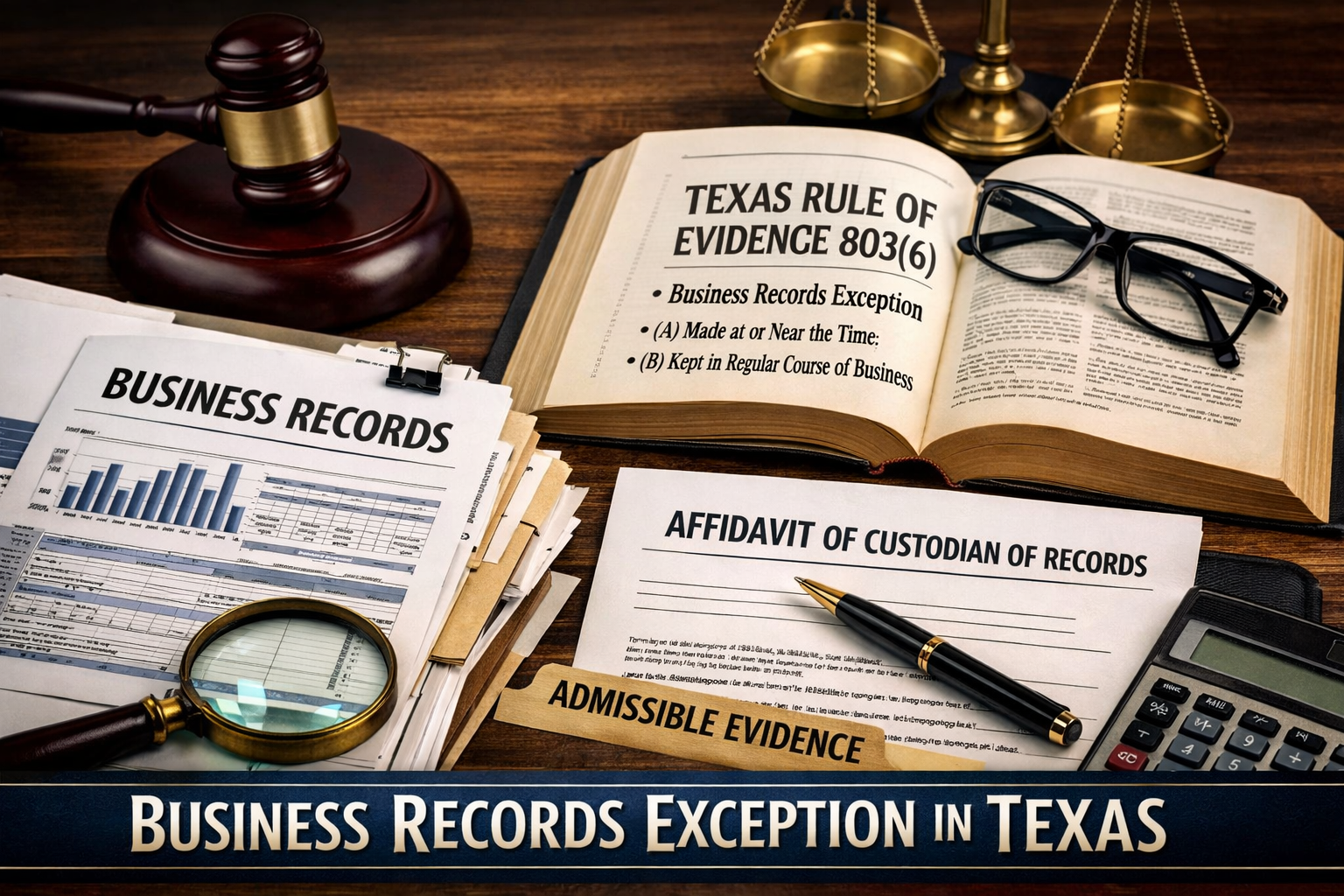
Introduction
In Texas litigation, one of the most powerful evidentiary tools is the business records exception to hearsay under Texas Rule of Evidence 803(6). While many practitioners rely on affidavits under Rule 902(10), fewer fully appreciate the underlying evidentiary mechanics—and the strategic leverage—of Rule 803(6) itself.
This article breaks down the statutory language, explores practical courtroom application, and highlights how lawyers can use (or attack) business records effectively.
The Statutory Framework: Texas Rule of Evidence 803(6)
Texas Rule of Evidence 803(6) provides:
“A record of an act, event, condition, opinion, or diagnosis if:
(A) the record was made at or near the time by—or from information transmitted by—someone with knowledge;
(B) the record was kept in the course of a regularly conducted business activity;
(C) making the record was a regular practice of that activity;
(D) all these conditions are shown by the testimony of the custodian or another qualified witness…; and
(E) the opponent does not show that the source of information or the method or circumstances of preparation indicate a lack of trustworthiness.”
This rule allows hearsay evidence—normally inadmissible—to come into evidence if reliability is sufficiently established.
Why TRE 803(6) Matters More Than You Think
At first glance, Rule 803(6) looks procedural. In reality, it often decides cases.
Business records are frequently the backbone of:
· Debt collection cases
· Contract disputes
· Construction payment claims
· Family law financial tracing
· Probate accountings
If admitted, they can establish liability, damages, and timelines—without live testimony from every participant.
The Four Core Requirements (and Where Cases Are Won or Lost)
1. “At or Near the Time”
The closer the record is created to the underlying event, the more reliable it is presumed to be.
Litigation insight:
Opposing counsel will often attack delayed entries, arguing they were reconstructed for litigation.
2. “By Someone with Knowledge”
The rule requires that the information originate from someone with firsthand knowledge.
Key nuance:
The person testifying does not need to be the original author.
Texas courts allow a “qualified witness” who understands the system—even if they did not create the record.
3. “Regular Course of Business”
The record must be part of a routine, systematic process.
Example:
· Regular invoices = admissible
· One-off litigation summaries = usually not
4. “Regular Practice to Make the Record”
This is where many cases fail.
It is not enough that the business kept the record—it must be standard practice to create it.
The “Trustworthiness” Escape Hatch
Even if all elements are met, Rule 803(6)(E) allows exclusion if:
“the method or circumstances of preparation indicate a lack of trustworthiness.”
This is the primary attack vector.
Common arguments:
· Records created in anticipation of litigation
· Altered or incomplete data sets
· Outsourced or third-party data with weak verification
· Internal inconsistencies
Strategic takeaway:
This provision turns admissibility into a credibility battle, not just a checklist.
Relationship to Rule 902(10): Self-Authentication
Texas Rule of Evidence 902(10) allows business records to be admitted via affidavit instead of live testimony.
But here’s the critical point:
👉 Rule 902(10) does NOT replace Rule 803(6)
👉It merely provides a procedural shortcut to satisfy it
If the underlying Rule 803(6) elements are weak, a 902(10) affidavit will not save the evidence.
Advanced Litigation Strategy
1. Use Business Records as Offensive Weapons
Instead of treating them as foundational evidence, use them to:
· Lock in timelines
· Establish admissions
· Anchor damages early
Well-prepared records can support early summary judgment.
2. Attack the System, Not the Document
Rather than arguing about a single record, challenge:
· The recordkeeping process
· Data integrity controls
· Training of personnel
· Gaps in procedures
This is far more effective than nitpicking entries.
3. Beware of “Integrated Business Records”
Texas courts often allow records from one business that incorporate another’s data.
But this is a danger zone.
To admit such records, you must show:
· The receiving business relied on the data
· The data was integrated into its own records
· There were safeguards ensuring accuracy
Failure here can collapse an entire evidentiary foundation.
Practical Example
A contractor sues for unpaid invoices and introduces:
· Internal invoices
· Payment ledger
· Email confirmations
If properly authenticated under 803(6):
· The invoices prove the charges
· The ledger proves nonpayment
· The emails corroborate agreement
That combination can win the case without live witnesses.
Common Pitfalls
· ❌ Using summaries instead of original records
· ❌ Failing to establish “regular practice”
· ❌ Over-relying on affidavits without evidentiary depth
· ❌ Ignoring trustworthiness challenges
Conclusion
Texas Rule of Evidence 803(6) is not just an evidentiary rule—it is a case-building tool.
Lawyers who understand how to properly establish (or dismantle) business records gain a major advantage in:
· Summary judgment
· Bench trials
· Jury persuasion
In many cases, the outcome turns not on witness testimony—but on whether the records come in.
At David C. Barsalou, Attorney at Law, PLLC, we help clients navigate business, family, tax, estate planning, and real estate matters ranging from document drafting to litigation with clarity and confidence. If you’d like guidance on your situation, schedule a consultation today. Call us at (713) 397-4678, email barsalou.law@gmail.com, or reach us through our Contact Page. We’re here to help you take the next step.
