Introduction
Most people assume that if their spouse incurs a debt—medical bills, rent, or even basic living expenses—they are automatically on the hook. In Texas, that’s not entirely true… but it’s not entirely false either.
Enter the Doctrine of Necessaries—a somewhat old-school legal concept that still has real bite in modern Texas law. It sits at the intersection of family law, creditor rights, and contract law, and it can surprise both spouses and creditors alike.
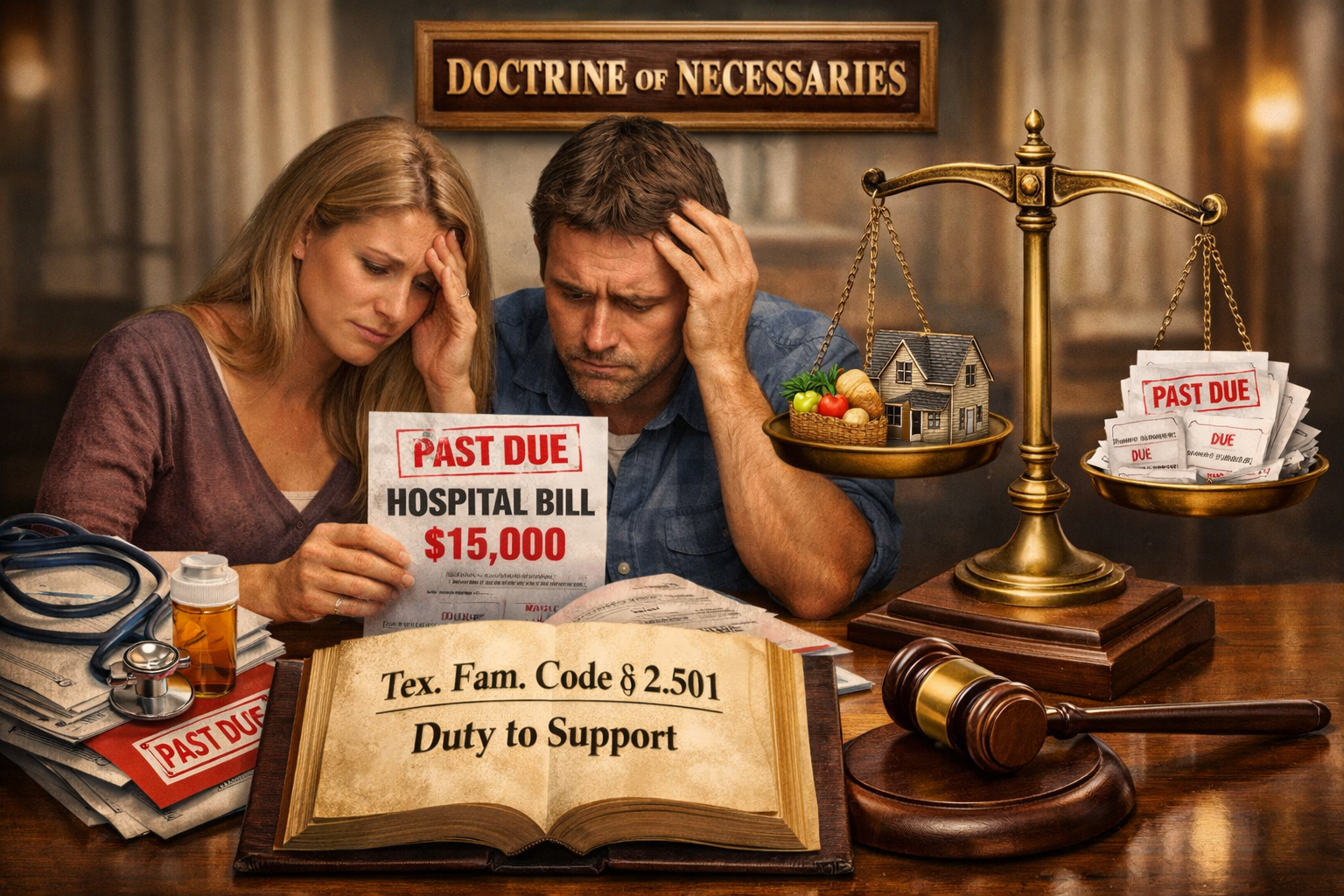
The Statutory Backbone: Texas Family Code § 2.501
Texas has partially codified the concept through its spousal support obligations:
“Each spouse has the duty to support the other spouse.”
— Tex. Fam. Code § 2.501(a)
This simple sentence carries more weight than it appears. It creates a legal duty of support, which courts and creditors may use to justify liability for certain debts incurred by a spouse.
What Are “Necessaries”?
“Necessaries” generally include:
- Medical care
- Food and groceries
- Shelter (rent or mortgage-related expenses)
- Basic clothing
- Essential utilities
These are not luxury expenses. The doctrine is limited to things reasonably necessary for a spouse’s health and welfare.
How the Doctrine Works in Practice
1. One Spouse Incurs a Necessary Expense
Example:
- Wife incurs $15,000 in emergency medical bills.
2. The Creditor Is Not Paid
- The hospital looks for recovery options.
3. The Creditor Pursues the Other Spouse
- Even if the husband never signed anything.
4. Legal Theory: Duty of Support
The creditor argues:
- Under Tex. Fam. Code § 2.501, the husband had a duty to support his spouse.
- Medical care qualifies as a “necessary.”
- Therefore, the husband may be liable.
Key Case Law Principle
Texas courts have historically recognized that:
- A spouse may be held liable for the reasonable value of necessaries furnished to the other spouse, even without a contract.
This is essentially a quasi-contract (equitable) theory, not a traditional contractual obligation.
Important Limitations (Where It Gets Interesting)
This doctrine is not unlimited, and this is where it becomes strategically useful for litigation.
1. Reasonableness Requirement
The expense must be:
- Necessary
- Reasonable in amount
A $2,000 ER visit? Likely covered.
A $40,000 elective cosmetic procedure? Probably not.
2. Community vs. Separate Property
Texas is a community property state, which complicates things:
- Community property is generally liable for debts incurred during marriage.
- But separate property may not be reachable unless liability is established.
This creates leverage in:
- Collections defense
- Divorce property division
- Post-judgment enforcement
3. Timing Matters (Marriage Status)
- The doctrine typically applies during marriage.
- After divorce, liability becomes far more limited and fact-specific.
4. Creditor Must Prove the Elements
The burden is on the creditor to show:
- The goods/services were “necessaries”
- The charges were reasonable
- The spouse had a duty to provide support
That’s not always easy—and it opens the door to defensive litigation strategies.
Why This Doctrine Still Matters Today
Even though it sounds archaic, it comes up in modern scenarios like:
- Medical debt collection
- Nursing home / elder care bills
- Emergency services
- Spouses with unequal income or financial control
It also appears indirectly in:
- Divorce disputes (who should bear the debt?)
- Probate issues (claims against estates)
- Creditor lawsuits against non-signing spouses
Strategic Takeaways (From a Practitioner’s Perspective)
For Creditors:
- Don’t assume both spouses are liable—but investigate.
- The doctrine can be a powerful fallback theory.
For Debtors:
- You are not automatically liable for everything your spouse does.
- But you may be exposed for core living expenses.
For Divorce Cases:
- This doctrine can influence:
- Characterization of debt
- Reimbursement claims
- Equitable division arguments
A Real-World Example
- Husband refuses to pay wife’s medical bills during marriage
- Hospital sues husband under doctrine of necessaries
- Court evaluates:
- Was the care necessary?
- Were the charges reasonable?
- Did the husband fail his support duty?
Result: Husband may be held liable—even without signing anything
Why This Topic Is So Overlooked
Most lawyers focus on:
- Community property rules
- Contract liability
But the Doctrine of Necessaries sits quietly in the background as a hybrid equitable doctrine—and it can change outcomes in close cases.
Conclusion
The Doctrine of Necessaries in Texas is a perfect example of how old legal principles still shape modern disputes. While you are not automatically responsible for your spouse’s debts, Texas law does impose a duty of support that can create liability in specific situations—especially for essential living expenses.
Understanding this doctrine can mean the difference between:
- Winning or losing a collection case
- Allocating debt properly in divorce
- Structuring defenses against unexpected liability
At David C. Barsalou, Attorney at Law, PLLC, we help clients navigate business, family, tax, estate planning, and real estate matters ranging from document drafting to litigation with clarity and confidence. If you’d like guidance on your situation, schedule a consultation today. Call us at (713) 397-4678, email barsalou.law@gmail.com, or reach us through our Contact Page. We’re here to help you take the next step.