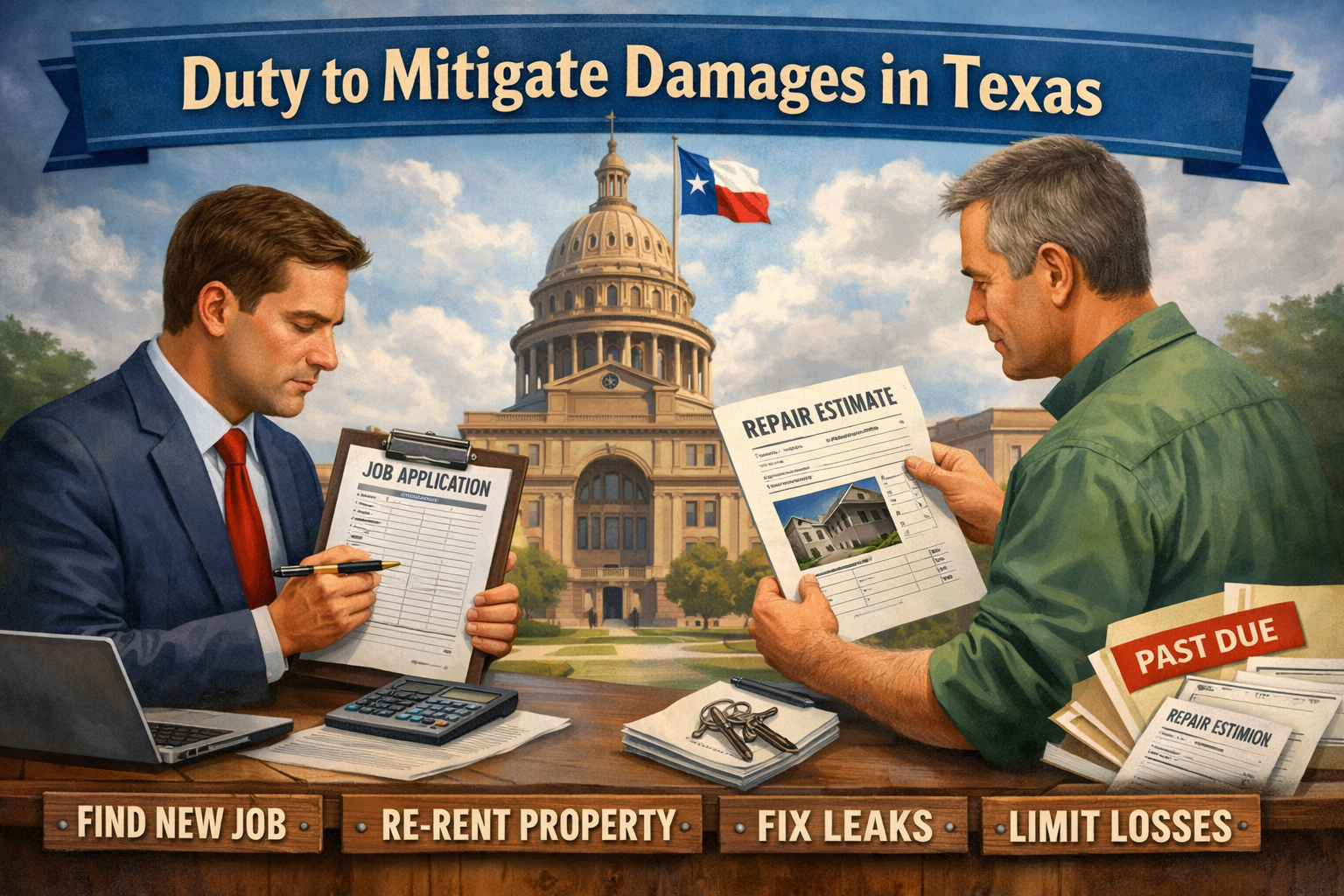
When people think about lawsuits, they often assume that if someone wrongs them, they can simply sit back, let the damage grow, and then demand full compensation in court.
Under Texas law, that assumption is wrong.
In most civil cases, injured parties have a legal obligation to mitigate their damages—meaning they must take reasonable steps to reduce their losses. Failing to do so can dramatically reduce, or even eliminate, the amount they recover.
This rule affects contract disputes, landlord-tenant cases, employment claims, business litigation, and family-law-related property disputes.
Understanding how mitigation works can make or break your case.
What Does “Mitigating Damages” Mean?
To “mitigate” damages means to make reasonable effortsto limit your financial harm after something goes wrong.
Texas courts do not reward people who allow avoidable losses to accumulate.
Instead, the law expects injured parties to act prudently and responsibly once a problem arises.
The Legal Basis: Texas Law on Mitigation
Texas courts have long recognized the duty to mitigate damages. The Texas Supreme Court has explained that:
A party injured by another’s breach must exercise reasonable care to minimize damages.
This principle is reflected in Texas Pattern Jury Charges and case law and is commonly applied in civil trials.
In contract cases, for example, Texas courts follow this rule:
“A party who seeks to recover damages must use reasonable efforts to avoid or lessen those damages.”
See generally Tex. Pattern Jury Charges—Business, Consumer, Insurance & Employment PJC 115.4 (Mitigation of Damages).
Where Mitigation Comes Up Most Often in Texas Cases
1. Breach of Contract Disputes
In contract cases, mitigation is especially important.
Example:
A business loses a major supplier who breaches a contract. Instead of finding a replacement, the business shuts down and sues for massive losses.
A court may reduce damages if a reasonable substitute was available.
Courts expect parties to:
- Look for alternative vendors
- Seek replacement services
- Continue operations when possible
- Avoid unnecessary shutdowns
2. Landlord–Tenant Cases
Mitigation is critical in Texas leasing disputes.
Under Texas Property Code § 91.006, landlords have a statutory duty to mitigate when a tenant abandons the property.
“A landlord has a duty to mitigate damages if a tenant abandons the leased premises.”
This means landlords must make reasonable efforts to re-rent the property instead of letting it sit vacant and charging the former tenant indefinitely.
Failing to attempt re-leasing can reduce or eliminate unpaid rent claims.
3. Employment Disputes
In wrongful termination and wage cases, former employees must usually seek new employment.
If someone is fired and refuses to look for work, courts may limit lost-wage damages.
Reasonable mitigation may include:
- Applying for similar jobs
- Accepting comparable positions
- Not rejecting suitable offers without good reason
4. Property Damage and Construction Claims
In construction and property disputes, owners cannot allow damage to worsen.
Example:
A roof leaks. The owner does nothing for months. Mold develops.
The contractor may not be responsible for all resulting damage if prompt repairs would have prevented it.
Owners are expected to:
- Make temporary repairs
- Prevent further deterioration
- Secure damaged property
5. Divorce and Family Property Disputes
Mitigation also appears in divorce-related financial disputes.
For example:
- Wasting marital assets after separation
- Failing to refinance when ordered
- Letting foreclosure occur unnecessarily
Courts may adjust property divisions when one spouse fails to act reasonably.
What Counts as “Reasonable” Mitigation?
Texas law does not require perfection. It requires reasonableness.
Courts consider:
- Cost of mitigation
- Likelihood of success
- Available alternatives
- Timing
- Information available at the time
You are not required to:
- Take extreme risks
- Spend unreasonable sums
- Accept inferior substitutes
- Act against your own interests
You are required to act like a reasonable person would under similar circumstances.
Who Has the Burden of Proof?
In Texas, failure to mitigate is an affirmative defense.
This means:
The defendant must prove:
- You failed to mitigate, and
- Your failure increased damages.
If the defendant cannot show this, your recovery is not reduced.
How Mitigation Affects Jury Verdicts
In jury trials, judges often submit mitigation questions.
A typical instruction asks whether the plaintiff failed to reduce damages and, if so, by how much.
If jurors find a failure to mitigate, they subtract that amount from the verdict.
Example:
- Claimed damages: $150,000
- Avoidable losses: $40,000
- Final award: $110,000
Mitigation directly impacts money.
Common Mistakes That Hurt Texas Plaintiffs
Many people damage their own cases without realizing it.
Common errors include:
- Refusing reasonable settlement offers
- Ignoring repair needs
- Letting property sit vacant
- Refusing alternative employment
- Failing to document efforts
- Acting out of anger instead of strategy
Judges and juries notice these behaviors.
How to Protect Yourself: Practical Tips
If you may end up in a dispute, take these steps early:
1. Document Everything
Keep records of:
- Job applications
- Repair estimates
- Advertising efforts
- Vendor searches
- Communications
2. Act Promptly
Delays often look unreasonable in hindsight.
3. Seek Professional Advice
Consulting a lawyer early can help you structure mitigation properly.
4. Avoid Emotional Decisions
Courts evaluate behavior objectively, not emotionally.
Can Mitigation Ever Be Excused?
Yes. Texas courts may excuse mitigation when:
- It is impossible
- It is excessively costly
- It involves unreasonable risk
- The defendant prevented mitigation
Each case is fact-specific.
Why This Rule Exists
The mitigation doctrine serves important purposes:
- Prevents economic waste
- Encourages responsible behavior
- Promotes fairness
- Discourages strategic damage inflation
The law compensates real losses—not avoidable ones.
When Should You Talk to a Texas Lawyer?
You should seek legal advice if:
- You are dealing with a breached contract
- A tenant or landlord dispute arises
- Your business suffers losses
- Property is damaged
- A divorce involves financial conflict
- You are considering litigation
Early guidance often preserves damages.
Final Thoughts
In Texas, winning a lawsuit is not just about proving someone else was wrong.
It is also about proving that you acted responsibly afterward.
If you fail to mitigate damages, you may win on liability but lose thousands—or more—on recovery.
Smart plaintiffs protect their cases from day one.
At David C. Barsalou, Attorney at Law, PLLC, we help clients navigate business, family, tax, estate planning, and real estate matters ranging from document drafting to litigation with clarity and confidence. If you’d like guidance on your situation, schedule a consultation today. Call us at (713) 397-4678, email barsalou.law@gmail.com, or reach us through our Contact Page. We’re here to help you take the next step.