Introduction
One of the most misunderstood doctrines in Texas civil litigation is the economic loss rule. Many people believe that if someone causes them financial harm, they can simply sue for negligence, fraud, or another tort claim. However, Texas courts often prevent tort claims when the dispute arises purely from a contract.
This principle is known as the economic loss rule, and it can determine whether a lawsuit proceeds as a contract case or gets dismissed entirely.
Understanding this doctrine is critical in construction disputes, business contracts, real estate transactions, and service agreements—areas where parties frequently attempt to convert contract disputes into tort claims.
What Is the Economic Loss Rule?
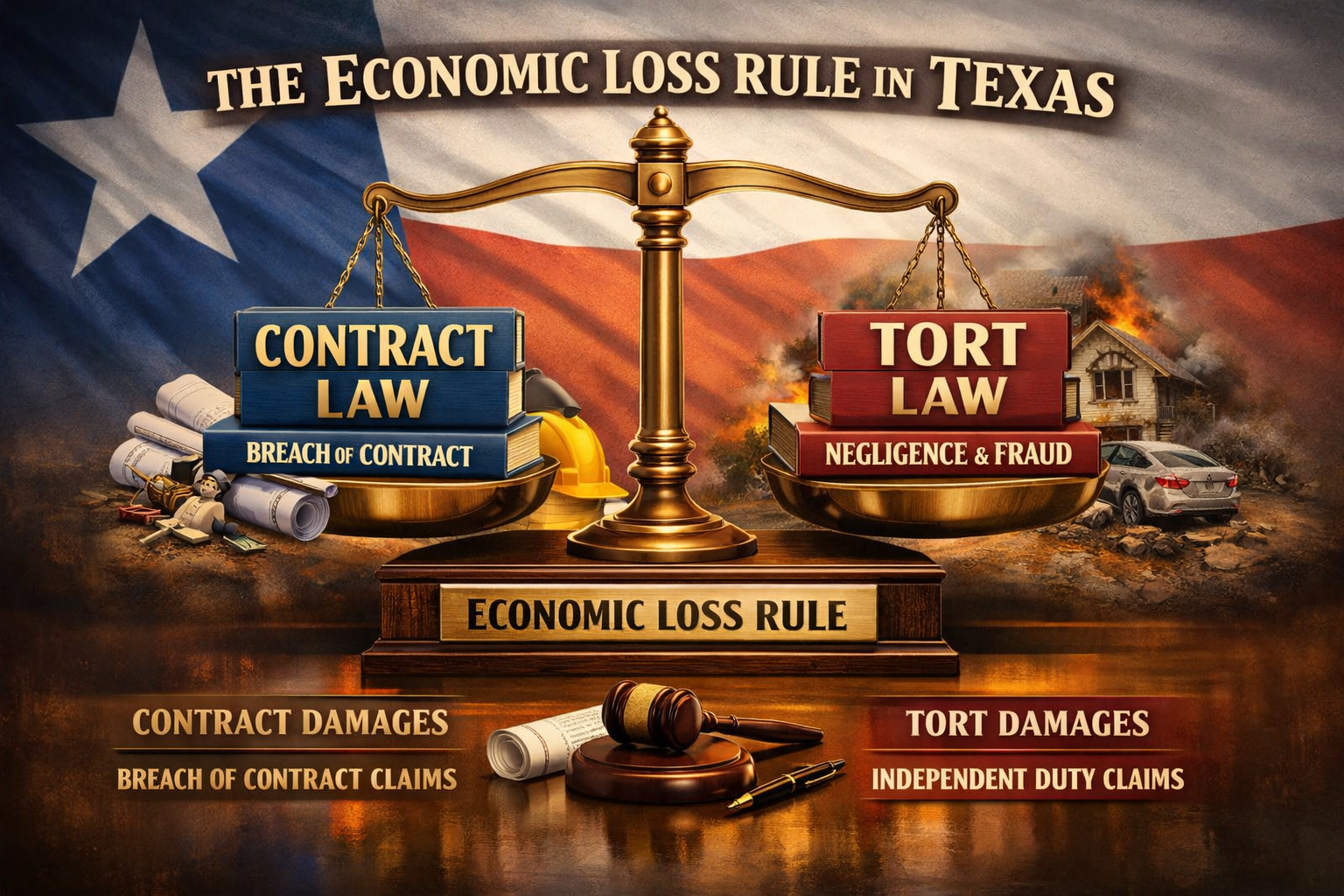
The economic loss rule generally prevents a plaintiff from recovering purely economic damages in tort when the loss arises from a contractual relationship.
In other words:
- If the harm results from failure to perform a contract, the remedy is usually breach of contract, not negligence.
- Tort claims are typically limited to independent duties imposed by law, not duties created solely by contract.
Texas courts repeatedly emphasize this distinction.
For example, the Texas Supreme Court explained:
“When the injury is only the economic loss to the subject of a contract itself, the action sounds in contract alone.”
This principle preserves the boundary between contract law and tort law.
Why the Rule Exists
The rule serves several purposes:
1. Protecting Contractual Expectations
Contract law allows parties to negotiate:
- pricing
- warranties
- risk allocation
- remedies
Allowing tort claims for every contract breach would undermine the bargain the parties negotiated.
2. Preventing Unlimited Liability
Tort law can involve broader damages such as:
- consequential damages
- emotional distress
- punitive damages
If every contract breach could become a tort claim, potential liability would become unpredictable.
3. Preserving Legal Structure
Texas law maintains a fundamental distinction:
- Contract law governs voluntarily assumed obligations.
- Tort law governs duties imposed by law.
When the Economic Loss Rule Applies
Texas courts frequently apply the doctrine in several contexts.
Construction Disputes
A contractor who performs defective work typically creates a contract claim, not negligence.
For example:
- homeowner hires contractor
- contractor performs poor work
- house suffers only the expected repair costs
In that situation, the claim is usually breach of contract, not negligence.
Product Defects
If a defective product damages only itself, courts often limit recovery to contract or warranty remedies.
The classic example:
- defective HVAC unit breaks
- damage limited to the HVAC system itself
This typically remains a contract/warranty dispute, not a tort claim.
Professional Services
Professional service disputes—such as those involving accountants, consultants, or contractors—may also trigger the rule when the alleged negligence merely duplicates contractual obligations.
When Tort Claims May Still Be Allowed
The economic loss rule does not eliminate all tort claims arising from contractual relationships.
Texas courts recognize several exceptions.
Independent Injury
If the defendant’s conduct causes damage beyond the contract itself, tort claims may proceed.
Example:
- defective construction causes structural collapse
- neighboring property is damaged
That additional harm may support negligence claims.
Independent Legal Duty
Tort claims may also survive if the defendant violated a duty imposed by law, not merely the contract.
Fraud is a common example.
Texas law recognizes fraud as an independent tort under Texas Civil Practice and Remedies Code § 41.003, which authorizes exemplary damages in cases involving fraud, malice, or gross negligence.
Professional Negligence
In certain circumstances, professionals may owe duties independent of contract.
For example:
- lawyers
- engineers
- architects
These professionals may be subject to professional malpractice claims.
The Economic Loss Rule and Texas Civil Litigation
The doctrine frequently arises in motions to dismiss and summary judgment.
Defendants often argue:
- the plaintiff’s claim sounds only in contract
- tort claims are barred by the economic loss rule
If the court agrees, tort causes of action may be dismissed early in the case.
This can dramatically affect:
- available damages
- litigation strategy
- settlement value
Why This Doctrine Matters in Texas Lawsuits
The economic loss rule can decide whether a case is worth pursuing.
A plaintiff who expects:
- punitive damages
- tort damages
- expanded liability
may find those remedies unavailable if the court determines the dispute is purely contractual.
On the other hand, defendants frequently rely on this doctrine to narrow lawsuits and eliminate tort claims early in litigation.
Practical Takeaways
If you are involved in a Texas contract dispute:
- Not every financial loss supports a tort claim.
- Courts often limit disputes to contract remedies only.
- The key question is whether the defendant violated an independent legal duty.
Because the distinction between contract and tort claims can be complex, legal analysis is often necessary before filing or defending a lawsuit.
Conclusion
The economic loss rule plays a critical role in Texas civil litigation by defining the boundary between contract law and tort law. When damages arise solely from the failure to perform a contract, Texas courts typically restrict recovery to contract remedies.
Understanding this doctrine can help parties evaluate their legal options and avoid pursuing claims that may ultimately be dismissed.
At David C. Barsalou, Attorney at Law, PLLC, we help clients navigate business, family, tax, estate planning, and real estate matters ranging from document drafting to litigation with clarity and confidence. If you’d like guidance on your situation, schedule a consultation today. Call us at (713) 397-4678, email barsalou.law@gmail.com, or reach us through our Contact Page. We’re here to help you take the next step.
