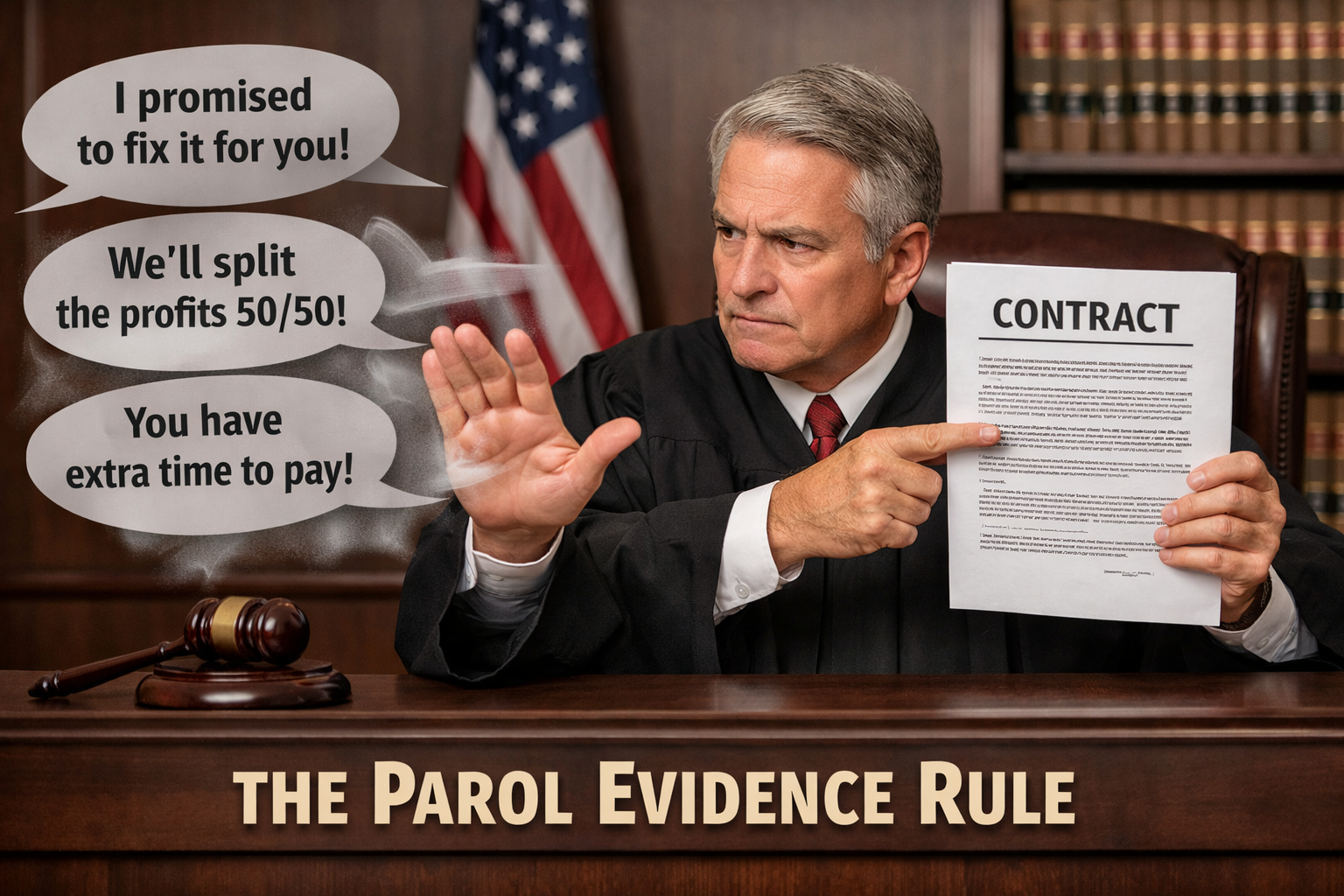
Contracts are supposed to provide certainty. When parties reduce an agreement to writing, courts generally presume that the written document reflects the final agreement between them.
The Parol Evidence Rule is the legal doctrine that enforces that idea. In Texas, it prevents parties from introducing outside statements or earlier agreements to contradict the terms of a final written contract.
Understanding this rule is critical for business owners, real estate investors, and anyone signing a written agreement in Texas.
What Is the Parol Evidence Rule?
The Parol Evidence Rule provides that when parties have entered into a final written agreement, prior or contemporaneous oral agreements cannot be used to contradict the written contract.
Texas courts consistently enforce this principle. The rule protects the integrity of written contracts by preventing one party from later claiming that “something else was promised.”
As the Texas Business and Commerce Code § 2.202provides:
“Terms with respect to which the confirmatory memoranda of the parties agree or which are otherwise set forth in a writing intended by the parties as a final expression of their agreement… may not be contradicted by evidence of any prior agreement or of a contemporaneous oral agreement.”
This statute appears in the Uniform Commercial Code portion of Texas law governing sales of goods, but Texas courts apply the same general principle broadly to contract disputes.
Why the Rule Exists
The Parol Evidence Rule serves several important purposes:
- Contract certainty – written contracts would be meaningless if they could easily be contradicted by alleged oral statements.
- Fraud prevention – parties could otherwise invent conversations after a dispute arises.
- Judicial efficiency – courts rely on written documents rather than conflicting testimony about what someone allegedly said.
Because of these concerns, courts generally treat the written contract as the best evidence of the parties’ agreement.
When the Parol Evidence Rule Applies in Texas
The rule typically applies when:
• There is a written contract
• The contract appears complete and final
• A party tries to introduce earlier or simultaneous oral agreements
If those conditions are met, courts usually refuse to consider outside statements that contradict the written terms.
Example:
A written contract says a property is sold “as is.”
One party later claims:
“But the seller told me verbally he would fix the foundation.”
Under the Parol Evidence Rule, that statement is usually inadmissiblebecause it contradicts the written agreement.
Important Exceptions to the Parol Evidence Rule
The Parol Evidence Rule is not absolute. Texas courts allow outside evidence in several important situations.
1. Fraud
Evidence may be admitted to show the contract was induced by fraud.
For example:
• A seller intentionally lies about property condition
• A party conceals material information
Texas courts allow outside evidence in these cases because fraud undermines the legitimacy of the contract itself.
2. Contract Ambiguity
If a contract is ambiguous, courts may consider outside evidence to interpret its meaning.
For example:
A contract says payment is due “after completion,” but the term completion is unclear.
Courts may then look at communications or conduct between the parties to determine what they intended.
3. Evidence of Later Agreements
The Parol Evidence Rule only applies to prior or contemporaneous statements.
It does not prevent evidence of:
• Later modifications
• Subsequent agreements
• Later waivers
This is why written contracts often include “no oral modification” clauses, although even those are not always iron-clad.
4. Showing the Contract Was Never Final
Sometimes outside evidence is allowed to prove the document was not intended to be the final agreement.
Examples include:
• Draft agreements
• Letters of intent
• Negotiation documents
In those cases, the writing may not qualify as the final integrated contract.
Integration Clauses Strengthen the Rule
Many contracts include what is called an integration clause or merger clause, such as:
“This agreement constitutes the entire agreement between the parties and supersedes all prior negotiations and understandings.”
These clauses make it much harder for a party to introduce outside evidence.
They signal to the court that the document was intended to be the complete and final expression of the agreement.
Why the Parol Evidence Rule Matters in Real Life
The Parol Evidence Rule affects many common legal situations, including:
• Real estate contracts
• Business purchase agreements
• Settlement agreements
• Loan agreements
• Contractor disputes
• Divorce property settlements
A common mistake people make is relying on handshake promises that never appear in the written contract.
When a dispute arises, the court typically looks at what the contract actually says — not what someone claims was discussed earlier.
Practical Advice Before Signing a Contract
Because of the Parol Evidence Rule, it is essential to:
• Put all important terms in writing
• Carefully review the contract before signing
• Avoid relying on verbal promises
• Ensure any changes are documented in writing
If a term matters to you, it should appear clearly in the contract itself.
Final Thoughts
The Parol Evidence Rule is one of the most important doctrines in contract law. It reinforces a simple but powerful principle:
Written agreements matter.
Once parties sign a final contract, courts generally refuse to consider earlier statements that contradict it.
For businesses, property owners, and individuals entering into agreements in Texas, understanding this rule can prevent costly disputes later.
At David C. Barsalou, Attorney at Law, PLLC, we help clients navigate business, family, tax, estate planning, and real estate matters ranging from document drafting to litigation with clarity and confidence. If you’d like guidance on your situation, schedule a consultation today. Call us at (713) 397-4678, email barsalou.law@gmail.com, or reach us through our Contact Page. We’re here to help you take the next step.