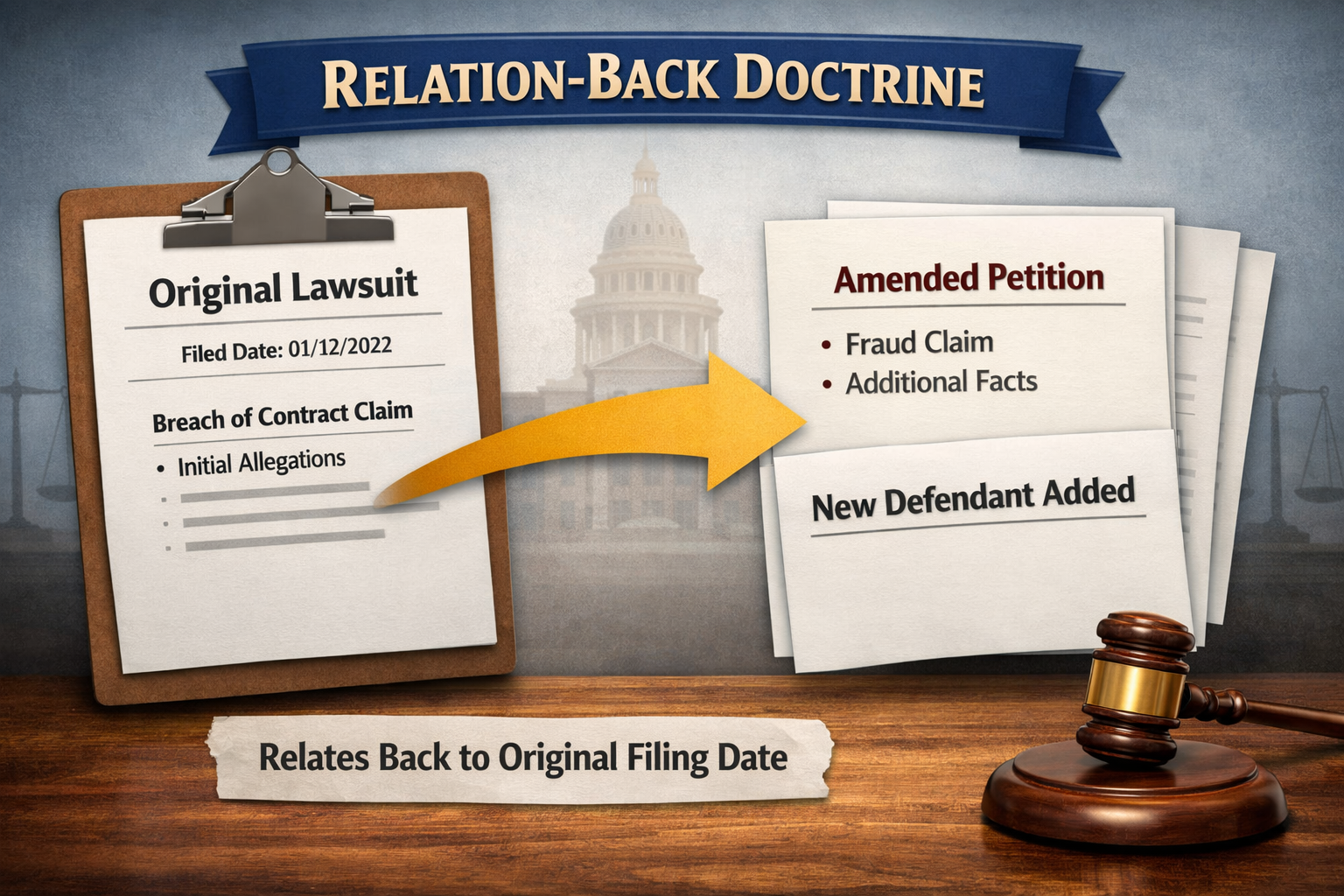
Texas civil litigation often turns on deadlines, particularly statutes of limitations. A claim filed after the applicable limitations period is usually barred. However, Texas law contains an important procedural safeguard known as the relation-back doctrine, which can allow an amended pleading filed after limitations expires to remain valid.
Understanding this doctrine can determine whether a claim survives or is dismissed.
The General Rule: Amendments Relate Back to the Original Filing
Texas law recognizes that lawsuits evolve. Parties frequently amend pleadings to clarify allegations, add facts, or refine legal theories. The Legislature addressed this reality in Texas Civil Practice and Remedies Code § 16.068, which provides:
“If a filed pleading relates to a cause of action, cross action, counterclaim, or defense that is not subject to a plea of limitation when the pleading is filed, a subsequent amendment or supplement to the pleading that changes the facts or grounds of liability or defense is not subject to a plea of limitation unless the amendment or supplement is wholly based on a new, distinct, or different transaction or occurrence.”
— Tex. Civ. Prac. & Rem. Code § 16.068
In simpler terms, an amended pleading usually “relates back” to the date the original petition was filed. If the original petition was timely, the amended one is typically treated as timely as well.
This prevents technical pleading defects from destroying otherwise valid claims.
The Texas Rules of Civil Procedure Also Allow Liberal Amendment
Texas courts generally favor allowing pleadings to be amended so cases can be decided on their merits rather than procedural technicalities.
For example, Texas Rule of Civil Procedure 63 states:
“Parties may amend their pleadings… provided that any pleadings… offered for filing within seven days of the date of trial… shall be filed only after leave of the judge is obtained.”
Similarly, Rule 65 provides:
“Unless the substituted instrument shall be set aside on exception, the instrument for which it is substituted shall no longer be regarded as a part of the pleading.”
Together, these rules allow parties to refine their pleadings throughout litigation while still preserving earlier filing dates in many circumstances.
When Relation-Back Applies
The doctrine typically applies when an amendment:
• Clarifies or expands factual allegations
• Refines legal theories based on the same conduct
• Corrects minor pleading defects
• Adds details about the same transaction or event
For example, a plaintiff might initially plead breach of contract, then later amend the petition to add fraud arising from the same transaction. If the underlying facts involve the same deal or conduct, courts often allow the amendment to relate back.
When the Doctrine Does NOT Apply
Relation-back is not unlimited. The statute specifically excludes amendments that introduce a “new, distinct, or different transaction or occurrence.”
In those situations, the amended claim may be barred if limitations has expired.
Examples include:
• Adding a completely unrelated contract dispute
• Introducing a different accident or event
• Suing over conduct unrelated to the original allegations
In short, the amendment must arise from the same core facts as the original pleading.
The Special Problem of Adding New Parties
The doctrine becomes more complicated when a plaintiff attempts to add new defendants after limitations expires.
Texas courts generally hold that relation-back does not automatically apply to new parties unless specific doctrines apply, such as:
• Misnomer – the correct party was sued but named incorrectly
• Misidentification – a closely related entity was mistakenly sued
Outside those narrow situations, adding a new defendant after limitations has expired can result in dismissal.
Why the Doctrine Matters in Real Litigation
The relation-back doctrine frequently arises in cases involving:
• Real estate disputes
• Business litigation
• Construction claims
• Debt and contract lawsuits
• Probate litigation involving amended claims
It is especially important when new evidence emerges during discovery that requires refining or expanding the original allegations.
Without relation-back, many legitimate claims would fail simply because a pleading needed to be amended.
Practical Takeaway
Texas courts prefer resolving disputes based on substance rather than technical pleading errors. The relation-back doctrine allows amended pleadings to preserve claims that arise from the same transaction originally alleged.
However, the protection disappears if the amendment introduces a new and unrelated claim or attempts to add new parties after limitations expires.
As a result, properly drafting and timing amended pleadings can make the difference between winning a case or losing it on a procedural technicality.
At David C. Barsalou, Attorney at Law, PLLC, we help clients navigate business, family, tax, estate planning, and real estate matters ranging from document drafting to litigation with clarity and confidence. If you’d like guidance on your situation, schedule a consultation today. Call us at (713) 397-4678, email barsalou.law@gmail.com, or reach us through our Contact Page. We’re here to help you take the next step.