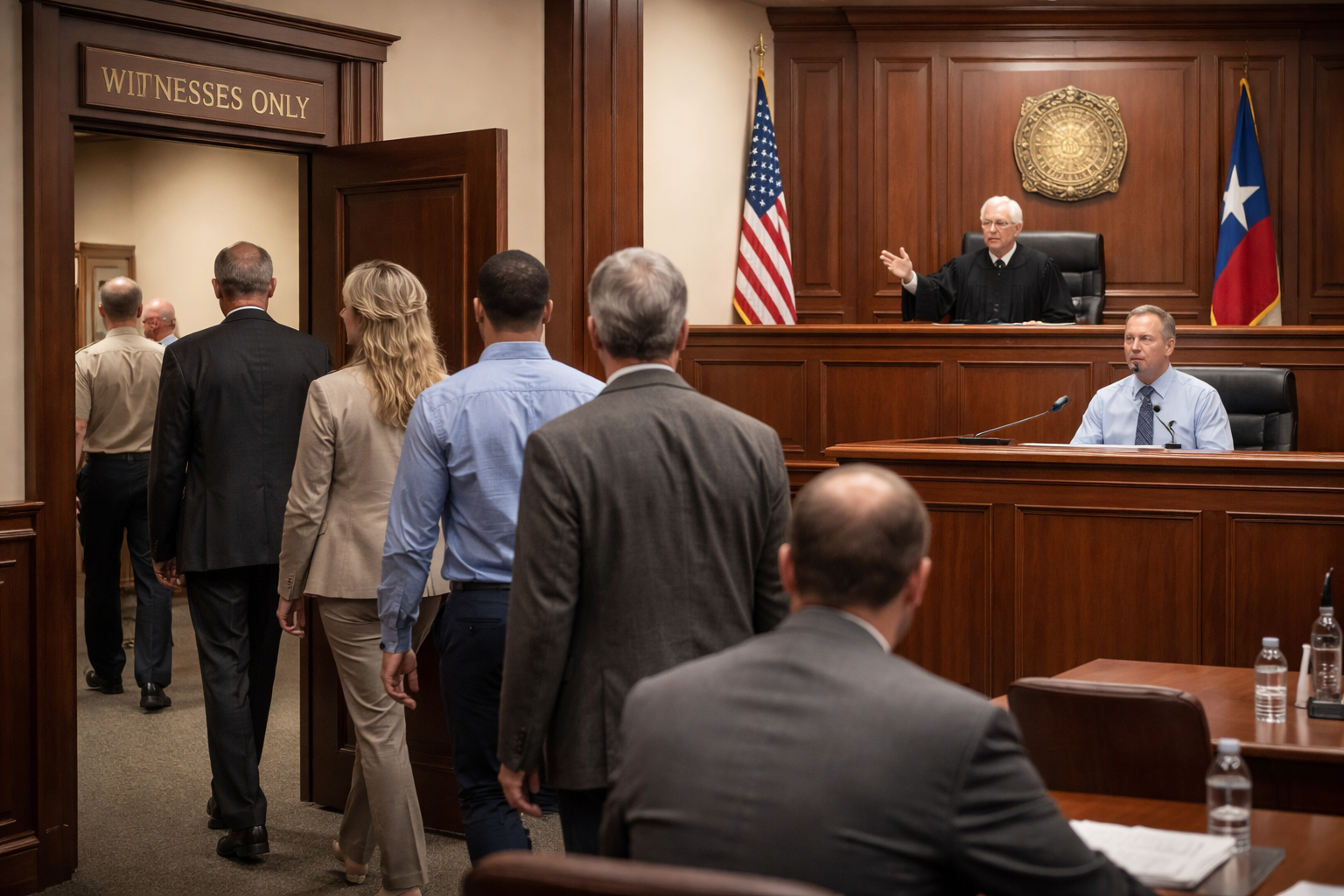
If you have ever attended a Texas trial or hearing, you may have heard a lawyer say:
“Your Honor, we invoke the Rule.”
Moments later, the judge orders witnesses to leave the courtroom. To non-lawyers, this can seem strange or even dramatic. But it is actually a long-standing evidentiary safeguard designed to prevent witnesses from tailoring their testimony.
In Texas, this practice is formally known as witness sequestration, and it is governed by the Texas Rules of Evidence.
What Is “The Rule”?
“The Rule” refers to Texas Rule of Evidence 614, which allows the court to exclude witnesses from the courtroom so they cannot hear other witnesses testify.
The rule states:
Texas Rule of Evidence 614(a):
“At a party’s request, the court must order witnesses excluded so that they cannot hear other witnesses’ testimony. Or the court may do so on its own.”
In practice, this means that once the Rule is invoked:
- Witnesses must leave the courtroom
- They cannot hear the testimony of other witnesses
- They may be instructed not to discuss testimony with others
The goal is simple: each witness must testify based on their own knowledge, not what they heard others say in court.
Why Courts Use Witness Sequestration
Witness sequestration exists to prevent several problems:
1. Tailored Testimony
If witnesses hear earlier testimony, they may consciously or subconsciously alter their own statements to match or contradict it.
2. Collusion
Multiple witnesses could coordinate their testimony to support a particular version of events.
3. Credibility Distortion
When testimony evolves during a trial, the court needs to know whether a witness actually remembers something or simply adapted to what others said.
By removing witnesses from the courtroom, courts preserve the independent value of each witness’s testimony.
When the Rule Applies
The Rule can be invoked in:
- Civil trials
- Criminal trials
- Evidentiary hearings
- Some bench hearings
Either party may request it, or the judge may order it independently.
Once invoked, the court typically gives instructions similar to:
- Do not discuss the case with other witnesses
- Do not listen to testimony outside the courtroom
- Do not read transcripts or reports of testimony
Violating these instructions can create serious problems.
Who Cannot Be Excluded?
Not everyone can be removed from the courtroom. Rule 614 provides several exceptions.
The rule states that it does not authorize excluding:
Texas Rule of Evidence 614(b):
- “a party who is a natural person;
- an officer or employee of a party that is not a natural person, after being designated as the party’s representative by its attorney;
- a person whose presence a party shows to be essential to presenting the party’s claim or defense; or
- a victim in a criminal case.”
In civil litigation, this often means:
- The plaintiff and defendant stay in the courtroom
- A corporate representative may remain
- Expert witnesses sometimes remain if necessary for case strategy
What Happens If a Witness Violates the Rule?
If a witness violates sequestration, the judge has discretion in how to respond.
Possible consequences include:
- Allowing cross-examination about the violation
- Limiting testimony
- Striking testimony
- Holding a party or witness in contempt in extreme cases
However, Texas courts generally prefer exposing the violation to the jury rather than automatically excluding testimony.
The reasoning is that credibility issues are usually better evaluated by the factfinder.
Why the Rule Matters in Real Cases
Witness sequestration may sound like a minor procedural issue, but it can significantly affect the outcome of a trial.
Consider a case involving:
- A car accident
- A business dispute
- A contested probate matter
If multiple witnesses testify about the same event, hearing earlier testimony could subtly influence later witnesses. The Rule protects against that.
For lawyers, invoking the Rule is often a routine but important strategic step at the beginning of a hearing.
A Small Rule With a Big Impact
The Rule is one of the simplest procedural tools in Texas courts, yet it plays a major role in protecting the integrity of testimony.
By ensuring witnesses testify independently, the rule helps judges and juries determine what actually happened—rather than what witnesses collectively decide to say after hearing each other.
In other words, sometimes the most important thing a witness can do in court is wait outside the courtroom until it is their turn to testify.
At David C. Barsalou, Attorney at Law, PLLC, we help clients navigate business, family, tax, estate planning, and real estate matters ranging from document drafting to litigation with clarity and confidence. If you’d like guidance on your situation, schedule a consultation today. Call us at (713) 397-4678, email barsalou.law@gmail.com, or reach us through our Contact Page. We’re here to help you take the next step.