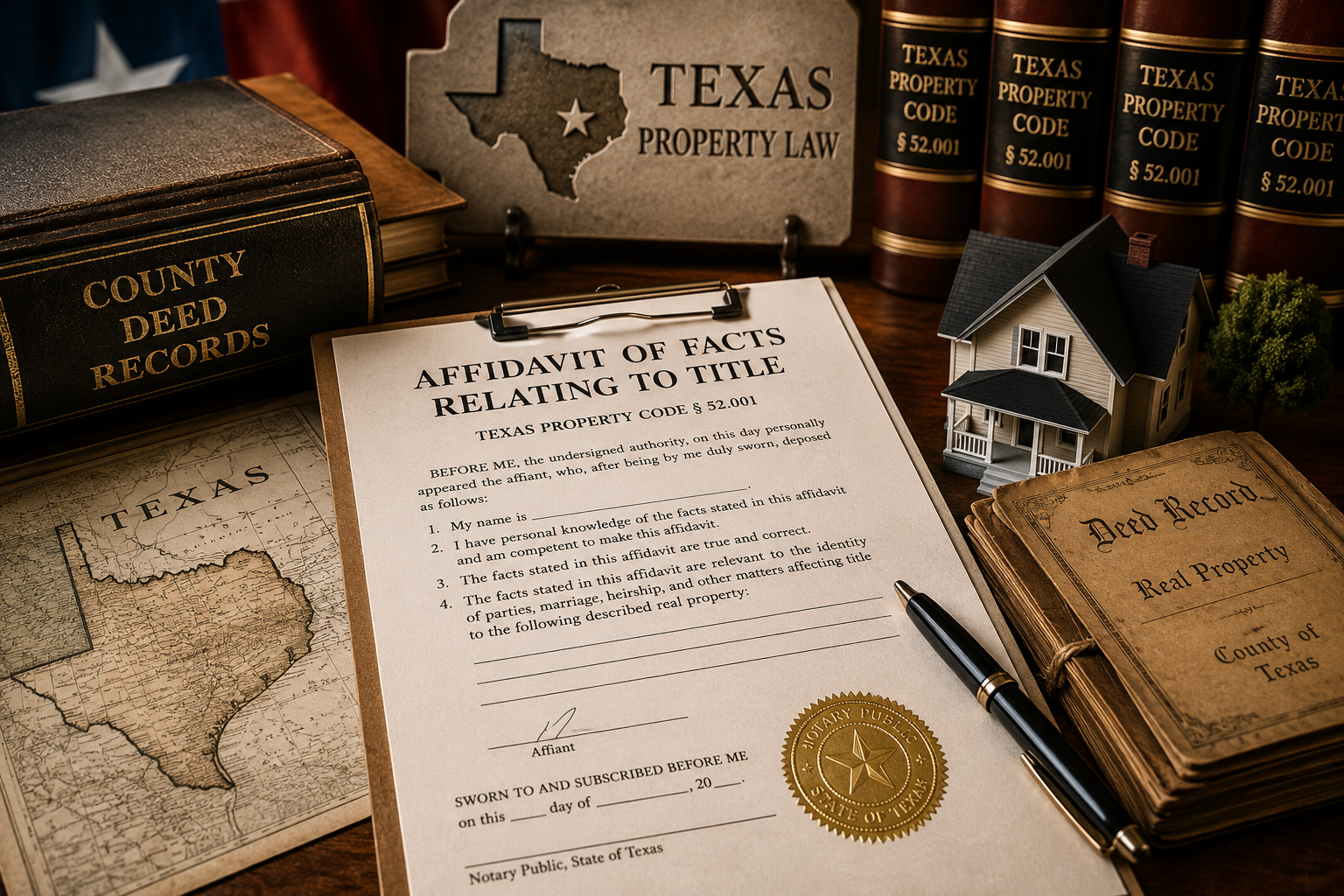
When a Texas property owner dies, many families assume that probate is always required before real estate can be sold, refinanced, or transferred. While probate is often the preferred solution, Texas law provides another tool that can sometimes help establish ownership of real property: the Affidavit of Facts Relating to Title.
Although it is not a substitute for probate in every situation, this little-known document can help preserve evidence of ownership and family history in county real property records. Understanding how it works can save heirs significant time, expense, and uncertainty.
What Is an Affidavit of Facts Relating to Title?
Texas Property Code § 52.001 authorizes the recording of affidavits containing facts relevant to land title.
The statute provides:
"An affidavit stating facts relevant to the identity of parties, marriage, heirship, or other matters affecting title to land may be recorded in the deed records of a county."
See Tex. Prop. Code § 52.001.
These affidavits are commonly used to place information into the public record concerning matters that affect ownership of real property.
Examples include:
- Family relationships;
- Marital status;
- Death of an owner;
- Identity of heirs;
- Clarification of names appearing in title records;
- Historical possession and ownership facts;
- Boundary and access facts.
Unlike a deed, the affidavit does not transfer ownership. Instead, it serves as evidence regarding facts that affect ownership.
Why Would Someone Use One?
Consider a common scenario.
A parent dies owning a small tract of land. No probate is opened because the property is modest and the family remains in agreement. Years later, a title company discovers that the deceased owner is still listed in the county records.
The heirs now need a way to explain the ownership history.
An Affidavit of Facts Relating to Title can create a recorded chain of evidence establishing:
- The owner's death;
- The identity of surviving heirs;
- The relationship of those heirs to the decedent;
- Facts showing who inherited the property.
The affidavit may help future purchasers, lenders, surveyors, and title companies understand the property's ownership history.
What Information Can Be Included?
Texas Property Code § 52.001 specifically identifies several categories of facts that may be recorded.
Common examples include:
Marriage Facts
The affidavit may establish:
- Whether an owner was married;
- Identity of a spouse;
- Dates of marriage;
- Community property facts.
Identity Issues
The affidavit may explain:
- Maiden names;
- Name changes;
- Nicknames;
- Misspellings appearing in older deeds.
For example, an affidavit may establish that "Robert J. Smith," "Bob Smith," and "R.J. Smith" are the same person.
Heirship Facts
The affidavit may identify:
- Children;
- Surviving spouse;
- Family lineage;
- Date of death;
- Other facts relevant to inheritance.
These provisions are particularly useful when property has remained in a family for many years without formal probate proceedings.
Does the Affidavit Automatically Transfer Ownership?
No.
This is one of the most common misunderstandings.
The affidavit is evidence of facts. It is not a conveyance instrument.
Recording an affidavit does not:
- Create ownership;
- Eliminate competing claims;
- Replace a deed;
- Replace a probate proceeding when probate is required.
Instead, the affidavit becomes part of the public record and may be considered by courts, title companies, and future purchasers when evaluating ownership questions.
Why Do Title Companies Care About These Affidavits?
Real estate transactions depend heavily on documentation.
When an owner dies, the title record often contains gaps that make future transactions difficult.
A properly prepared affidavit can help fill those gaps by documenting:
- Family history;
- Ownership history;
- Death information;
- Relationships among heirs.
The result is a more complete public record.
In some circumstances, title companies may accept such affidavits as part of the evidence needed to insure title, particularly when combined with other documentation.
When Is Probate Still Necessary?
Affidavits are not a magic solution.
Formal probate is frequently required when:
- There are disputes among heirs;
- A will exists that must be admitted to probate;
- Creditors must be addressed;
- Title companies require judicial proof of ownership;
- Significant assets remain in the estate.
Probate provides certainty that an affidavit alone cannot always provide.
For that reason, property owners and heirs should be cautious about assuming that recording an affidavit eliminates the need for legal proceedings.
Best Practices
If you are considering an Affidavit of Facts Relating to Title, consider the following:
- Verify all facts before signing.
- Use independent witnesses whenever possible.
- Attach supporting documents.
- Ensure the affidavit is properly acknowledged before a notary.
- Record the affidavit in the county where the property is located.
- Consult a Texas attorney before relying on the affidavit to establish ownership.
Small mistakes in title records can create expensive litigation years later.
Final Thoughts
The Texas Affidavit of Facts Relating to Title is one of the most overlooked tools in Texas real estate law. While it does not replace probate or transfer ownership by itself, it can preserve important facts concerning marriage, heirship, identity, and property history.
For families dealing with inherited property, especially land that has remained in a family for generations, a properly prepared affidavit may help establish a clearer chain of title and reduce future ownership disputes.
Because every property situation is unique, obtaining legal advice before relying on an affidavit can prevent significant problems later.
Disclaimer: This article is provided for informational purposes only and does not constitute legal advice. Reading this article does not create an attorney-client relationship.
At David C. Barsalou, Attorney at Law, PLLC, we help clients navigate business, family, tax, estate planning, and real estate matters ranging from document drafting to litigation with clarity and confidence. If you’d like guidance on your situation, schedule a consultation today. Call us at (713) 397-4678, email barsalou.law@gmail.com, or reach us through our Contact Page. We’re here to help you take the next step.