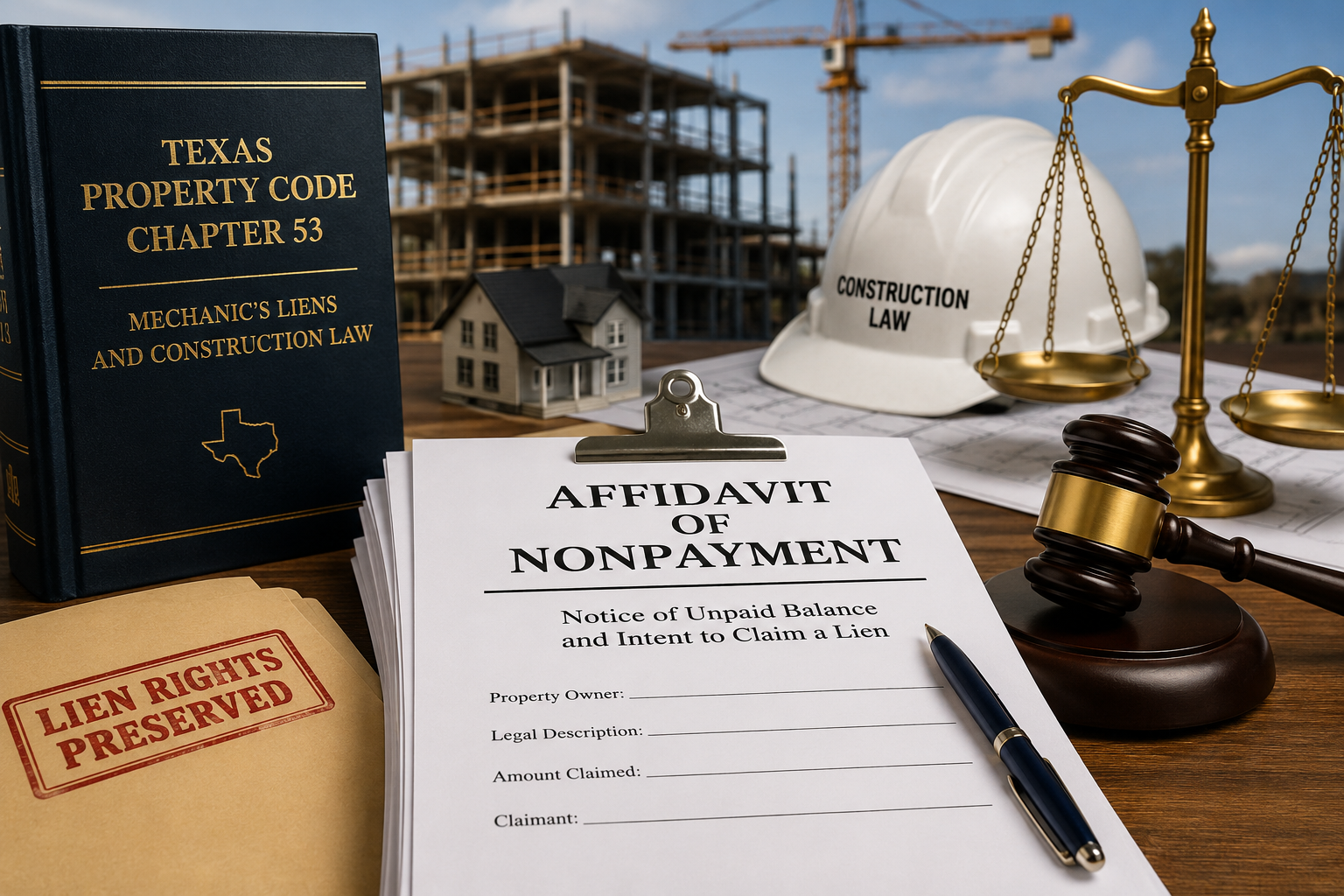
What Is an Affidavit of Nonpayment Under Texas Law?
Texas construction law contains a little-known procedure that can dramatically affect the rights of contractors, subcontractors, suppliers, lenders, and property owners. It is called an Affidavit of Nonpayment, and when properly filed, it can preserve lien rights that might otherwise be lost.
Many property owners are familiar with mechanic's liens. Far fewer understand that Texas law provides an additional mechanism allowing certain claimants to formally place the owner and others on notice that payment has not been received.
Because construction projects often involve multiple tiers of contractors and suppliers, payment disputes can arise even when an owner believes all invoices have been paid. The Affidavit of Nonpayment helps address that problem.
The Statutory Basis
The Texas Property Code expressly authorizes the filing of an Affidavit of Nonpayment.
Texas Property Code § 53.056 provides:
"A claimant other than an original contractor may give notice of an unpaid balance and file an affidavit claiming a lien."
The mechanic's lien statutes further establish detailed requirements regarding notice, timing, and the contents of lien affidavits.
Additionally, Texas Property Code § 53.054 states in relevant part:
"To claim a lien, a person must file an affidavit with the county clerk of the county in which the property is located."
These provisions work together to create a framework allowing unpaid participants in a construction project to protect their interests.
Why Is This Important?
Imagine the following situation:
A homeowner hires a general contractor to remodel a residence.
The homeowner pays the general contractor in full.
The general contractor then fails to pay a material supplier.
The supplier may still possess statutory rights against the property despite the owner's belief that the project has been fully paid.
An Affidavit of Nonpayment can become a critical component of preserving those rights.
As a result, owners, lenders, title companies, and contractors should all understand the significance of these filings.
What Information Must Be Included?
Texas mechanic's lien law is highly technical. A lien affidavit generally must contain information such as:
- The amount claimed;
- The identity of the claimant;
- A description of the work or materials furnished;
- The name of the property owner;
- A legally sufficient description of the property; and
- Other information required by Chapter 53 of the Texas Property Code.
Even minor defects can become the subject of litigation.
Texas courts have repeatedly emphasized the importance of complying with statutory requirements when asserting lien rights.
The Strategic Value of an Affidavit of Nonpayment
For contractors and suppliers, an Affidavit of Nonpayment serves several purposes:
1. Preserving Leverage
Construction disputes frequently settle because lien rights create pressure on parties to resolve payment disagreements.
2. Protecting Priority
Timely filings can help preserve rights that may otherwise be waived.
3. Creating a Public Record
Once recorded in county property records, the filing becomes discoverable by lenders, title companies, and prospective purchasers.
4. Supporting Future Litigation
The affidavit can become an important exhibit in later lien foreclosure or breach-of-contract litigation.
Common Mistakes
Waiting Too Long
Texas lien deadlines are unforgiving. Missing a statutory deadline can completely eliminate otherwise valid rights.
Incorrect Property Descriptions
A vague or inaccurate legal description can create substantial problems.
Improper Notice
The Texas Property Code contains detailed notice requirements. Filing an affidavit alone may not be sufficient.
Assuming Payment to the General Contractor Solves Everything
Owners often believe that paying the prime contractor automatically eliminates all risk. Construction law is frequently more complicated than that.
Can an Owner Challenge an Affidavit of Nonpayment?
Yes.
Property owners may challenge the validity of a claimed lien for numerous reasons, including:
- Failure to comply with statutory deadlines;
- Defective notice;
- Improper affidavit contents;
- Payment disputes;
- Contract defenses; or
- Failure to satisfy statutory prerequisites.
In some situations, owners may also remove the effect of a lien through bonding procedures under Chapter 53 of the Texas Property Code.
Practical Takeaway
The Affidavit of Nonpayment is one of the more obscure tools in Texas construction law, yet it can significantly impact a project's financial outcome.
Contractors and suppliers should understand when and how the procedure applies. Property owners should understand that paying a general contractor does not always guarantee that downstream parties have been paid.
Because Texas mechanic's lien law is highly technical and deadline-driven, both claimants and property owners should seek legal advice promptly when an Affidavit of Nonpayment appears in the county records.
Disclaimer
This article is provided for informational purposes only and does not constitute legal advice. Every construction dispute is unique, and readers should consult qualified counsel regarding their specific circumstances.
At David C. Barsalou, Attorney at Law, PLLC, we help clients navigate business, family, tax, estate planning, and real estate matters ranging from document drafting to litigation with clarity and confidence. If you’d like guidance on your situation, schedule a consultation today. Call us at (713) 397-4678, email barsalou.law@gmail.com, or reach us through our Contact Page. We’re here to help you take the next step.