Introduction
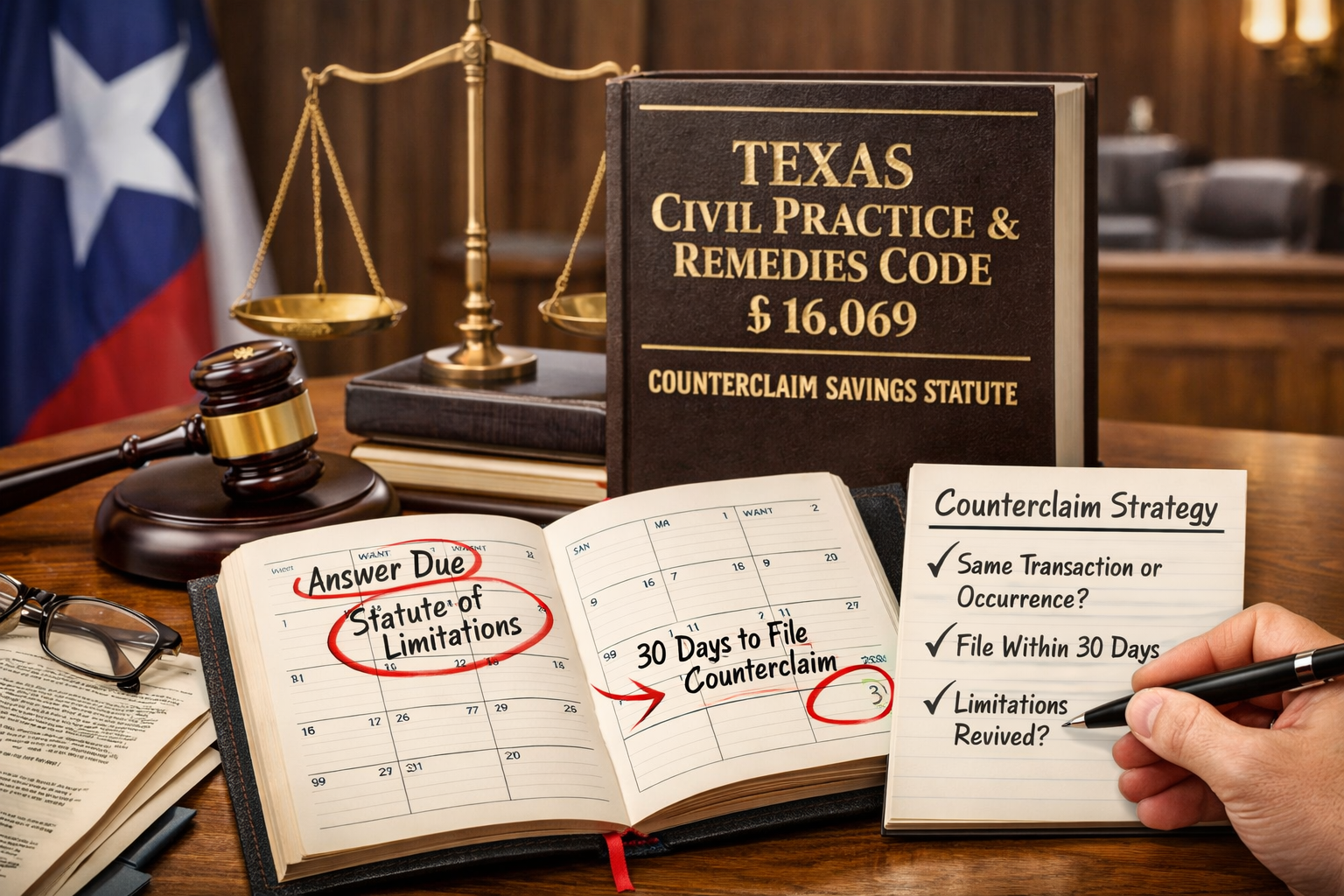
Most lawyers (and clients) understand statutes of limitations as hard deadlines. Miss it, and your claim is gone. But Texas has a lesser-known procedural escape hatch that can breathe life back into an otherwise time-barred claim—when it is asserted as a counterclaim.
This rule is codified in Texas Civil Practice and Remedies Code § 16.069, and it can dramatically shift litigation leverage, particularly in contract disputes, debt collection cases, and business litigation.
The Statute: What the Law Actually Says
Texas law provides:
“If a counterclaim or cross claim arises out of the same transaction or occurrence that is the basis of an action, a party to the action may file the counterclaim or cross claim even though as a separate action it would be barred by limitation on the date the party’s answer is required.”
— Tex. Civ. Prac. & Rem. Code § 16.069(a)
But there’s a catch:
“The counterclaim or cross claim must be filed not later than the 30th day after the date on which the party’s answer is required.”
— Tex. Civ. Prac. & Rem. Code § 16.069(b)
Plain English: What This Means
This statute allows a defendant to assert a claim that would otherwise be barred by limitations if:
- The claim arises out of the same transaction or occurrence as the plaintiff’s claim; and
- The counterclaim is filed within 30 days after the defendant’s answer is due.
In other words:
👉 A claim that is “dead” on its own can be revived if used defensively—and timely.
Why This Rule Exists
The policy is fairness.
If a plaintiff sues over a transaction, Texas law recognizes that:
- The defendant should be allowed to fully litigate that same transaction;
- Even if the defendant did not sue first;
- And even if limitations would otherwise bar the claim.
This prevents a plaintiff from:
- Waiting until the last minute to sue, and
- Using limitations as a strategic weapon to block related counterclaims.
Common Real-World Applications
1. Contract Disputes
A contractor sues for unpaid work.
The homeowner has a defective work claim—but limitations expired last month.
➡️ If the defect claim arises from the same project, it may still be asserted as a counterclaim under § 16.069.
2. Debt Collection Cases
A creditor sues on a note.
The borrower has a claim for fraud or misrepresentation tied to the loan.
➡️ Even if time-barred independently, the claim may survive as a counterclaim.
3. Business Litigation
One partner sues for breach.
The other partner has offsetting claims tied to the same dealings.
➡️ § 16.069 can revive those claims if properly asserted.
The 30-Day Trap (Where Lawyers Mess This Up)
The statute is generous—but unforgiving on timing.
The counterclaim must be filed:
⏱️ Within 30 days after the answer is due—not when it is actually filed.
That distinction matters.
If your answer is due Monday:
- The 30-day clock starts Monday, even if you file your answer early or late.
Miss that window?
❌ The savings statute does not apply.
❌The claim remains barred.
“Same Transaction or Occurrence” – The Key Limitation
Not every counterclaim qualifies.
Texas courts require a logical relationship between:
- The plaintiff’s claim; and
- The defendant’s counterclaim.
This is similar to the compulsory counterclaim analysis.
Examples that usually qualify:
- Same contract
- Same project
- Same loan
- Same business relationship
Examples that likely fail:
- Separate agreements
- Unrelated dealings
- Independent torts with no factual overlap
Strategic Implications for Litigation
For Plaintiffs
Be careful when filing suit near limitations deadlines.
You may unintentionally:
- Revive the defendant’s otherwise dead claims; and
- Expand the scope of the case dramatically.
For Defendants
Always evaluate:
👉 “Do I have a claim tied to this transaction—even if I thought it expired?”
If yes:
- You may still assert it;
- But you must act quickly.
For Attorneys
This statute is a classic procedural leverage tool:
- It can transform defense into offense;
- It can create settlement pressure;
- It can significantly increase case value.
But only if you spot it early.
Key Takeaways
- Texas allows certain time-barred claims to be revived as counterclaims.
- The rule applies only to claims arising from the same transaction or occurrence.
- The counterclaim must be filed within 30 days of the answer deadline.
- Missing the timing requirement kills the benefit.
- This statute can materially change litigation strategy and outcomes.
Final Thought
Most people think statutes of limitations are absolute. Texas law disagrees—at least in this narrow but powerful context.
If you’re in litigation, timing isn’t just about deadlines. Sometimes, it’s about knowing when a “dead” claim isn’t actually dead.
At David C. Barsalou, Attorney at Law, PLLC, we help clients navigate business, family, tax, estate planning, and real estate matters ranging from document drafting to litigation with clarity and confidence. If you’d like guidance on your situation, schedule a consultation today. Call us at (713) 397-4678, email barsalou.law@gmail.com, or reach us through our Contact Page. We’re here to help you take the next step.