Understanding a Powerful but Frequently Overlooked Texas Legal Doctrine
Most people assume that if they have several legal claims arising from the same dispute, they should simply assert all of them and let the court sort things out. While Texas law generally permits pleading alternative theories, there comes a point when pursuing one remedy can bar another.
This principle is known as the Doctrine of Election of Remedies, and although it sounds highly technical, it can dramatically affect lawsuits involving contracts, fraud, real estate disputes, probate matters, and business litigation.
For litigants and attorneys alike, understanding when a legal choice becomes binding can mean the difference between recovering damages and walking away empty-handed.
What Is the Election of Remedies Doctrine?
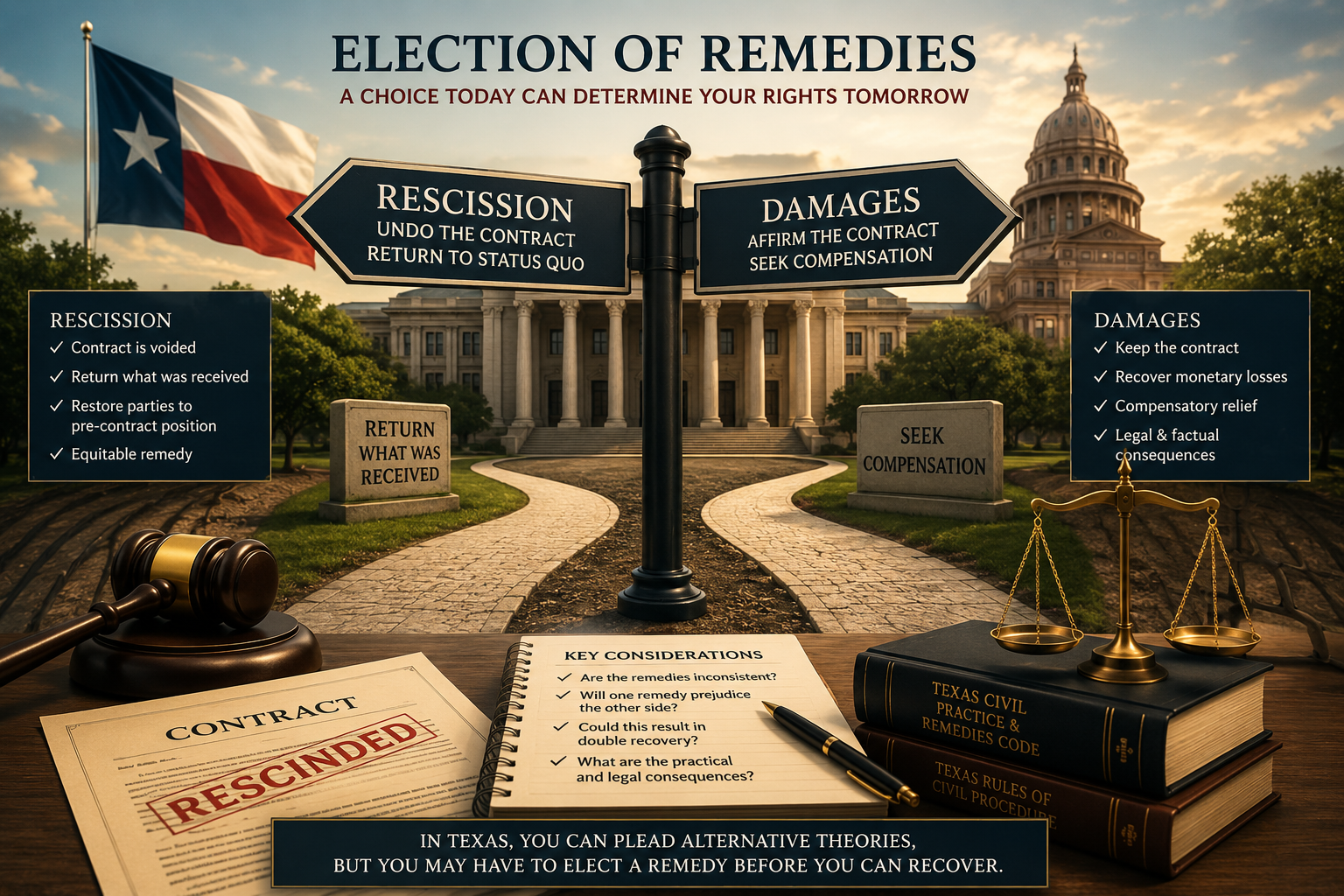
The election of remedies doctrine is an equitable principle designed to prevent a party from obtaining inconsistent forms of relief for the same wrong.
Texas courts have explained that the doctrine is intended to prevent double recovery and to prevent litigants from taking inconsistent positions that would unfairly prejudice the opposing party.
In many cases, a plaintiff may initially pursue multiple theories of recovery. The problem arises when the remedies sought are fundamentally inconsistent.
For example, a party generally cannot simultaneously:
- Affirm a contract and seek benefits under it; and
- Rescind the same contract and treat it as though it never existed.
Eventually, the plaintiff must choose.
A Common Example: Fraud in a Contract
Imagine that a seller fraudulently induces a buyer to purchase real property.
The buyer may have two very different remedies available:
Option One: Rescission
The buyer asks the court to unwind the transaction entirely.
The goal is to return both parties to their pre-contract positions.
The buyer returns the property.
The seller returns the purchase price.
Option Two: Affirm the Contract and Seek Damages
The buyer keeps the property but sues for the losses caused by the fraud.
Instead of undoing the deal, the buyer seeks compensation.
These remedies are often inconsistent because one treats the contract as voidable and the other treats the contract as valid.
Texas Pleading Rules Allow Alternatives
One reason this doctrine surprises people is that Texas procedure generally allows parties to plead inconsistent theories.
Texas Rule of Civil Procedure 48 provides:
"A party may set forth two or more statements of a claim or defense alternatively or hypothetically..."
This means that a plaintiff may initially allege:
- Breach of contract;
- Fraud;
- Rescission;
- Declaratory judgment; and
- Other alternative theories.
The election usually becomes important later in the litigation process when the plaintiff seeks a final recovery.
The Doctrine Is Closely Related to the One Satisfaction Rule
Texas law generally seeks to prevent double recoveries.
A plaintiff is entitled to be made whole.
A plaintiff is not entitled to recover the same damages twice merely because multiple legal theories apply.
As a result, even when a plaintiff prevails on several causes of action, the court may require an election between overlapping remedies.
This issue frequently arises in:
- Business disputes;
- Construction litigation;
- Real estate lawsuits;
- Probate litigation;
- Fiduciary-duty claims; and
- Fraud cases.
Election of Remedies in Probate Litigation
The doctrine can become particularly interesting in probate disputes.
Consider a beneficiary who believes property was wrongfully transferred before death.
The beneficiary may pursue remedies seeking:
- Recovery of the property itself;
- Imposition of a constructive trust;
- Money damages;
- Accounting relief; or
- Declaratory relief.
Depending upon the facts, some remedies may coexist while others may be inconsistent.
A party who obtains title to property through one remedy may be unable to simultaneously recover the full value of that same property as damages.
Election of Remedies in Real Estate Cases
Real estate disputes frequently present election issues.
Examples include:
- Fraudulent inducement claims;
- Defective construction claims;
- Deed disputes;
- Seller disclosure disputes; and
- Earnest money contract disputes.
A buyer who elects rescission generally seeks to undo the transaction.
A buyer who elects damages generally seeks to keep the property while receiving compensation.
The choice can have substantial financial consequences.
When Does an Election Become Binding?
Not every statement made during litigation creates a binding election.
Texas courts generally examine whether:
- The remedies are truly inconsistent;
- The party made an informed choice;
- The opposing party suffered prejudice; and
- Allowing both remedies would result in unfairness or double recovery.
Because these issues are highly fact-specific, the timing and manner of an election can become a significant strategic consideration.
Practical Considerations
Before choosing a remedy, litigants should carefully consider:
- Whether rescission is realistically available;
- The collectability of a damages judgment;
- Tax consequences of unwinding a transaction;
- Ownership issues involving third parties;
- Title implications; and
- The likelihood of recovering attorneys' fees.
Sometimes the theoretically strongest legal claim does not produce the most practical result.
Why the Doctrine Still Matters
The doctrine of election of remedies reflects a broader principle embedded throughout Texas law: courts seek fairness, consistency, and the avoidance of double recovery.
While modern pleading rules permit flexibility at the beginning of a lawsuit, parties eventually must choose a path when inconsistent remedies collide.
That decision can significantly affect the outcome of litigation involving contracts, business disputes, probate controversies, and real estate matters.
For that reason, understanding the election of remedies doctrine is not merely an academic exercise—it is often a critical component of successful litigation strategy.
Statutory and Rule References
Texas Rule of Civil Procedure 48
"A party may set forth two or more statements of a claim or defense alternatively or hypothetically..."
Texas Civil Practice and Remedies Code § 37.003
"A court of record within its jurisdiction has power to declare rights, status, and other legal relations whether or not further relief is or could be claimed."
Although declaratory relief may coexist with other claims, parties must remain mindful that Texas law generally prohibits obtaining duplicative recoveries for the same injury.
Conclusion
The Texas Doctrine of Election of Remedies is one of those legal concepts that sounds obscure but appears in surprisingly practical disputes. Whether a case involves fraud, contracts, probate litigation, or real estate transactions, the choice between competing remedies can shape the value and outcome of the entire lawsuit. Understanding when Texas law permits alternative theories—and when it requires a final election—can help litigants avoid costly strategic mistakes.
At David C. Barsalou, Attorney at Law, PLLC, we help clients navigate business, family, tax, estate planning, and real estate matters ranging from document drafting to litigation with clarity and confidence. If you’d like guidance on your situation, schedule a consultation today. Call us at (713) 397-4678, email barsalou.law@gmail.com, or reach us through our Contact Page. We’re here to help you take the next step.
