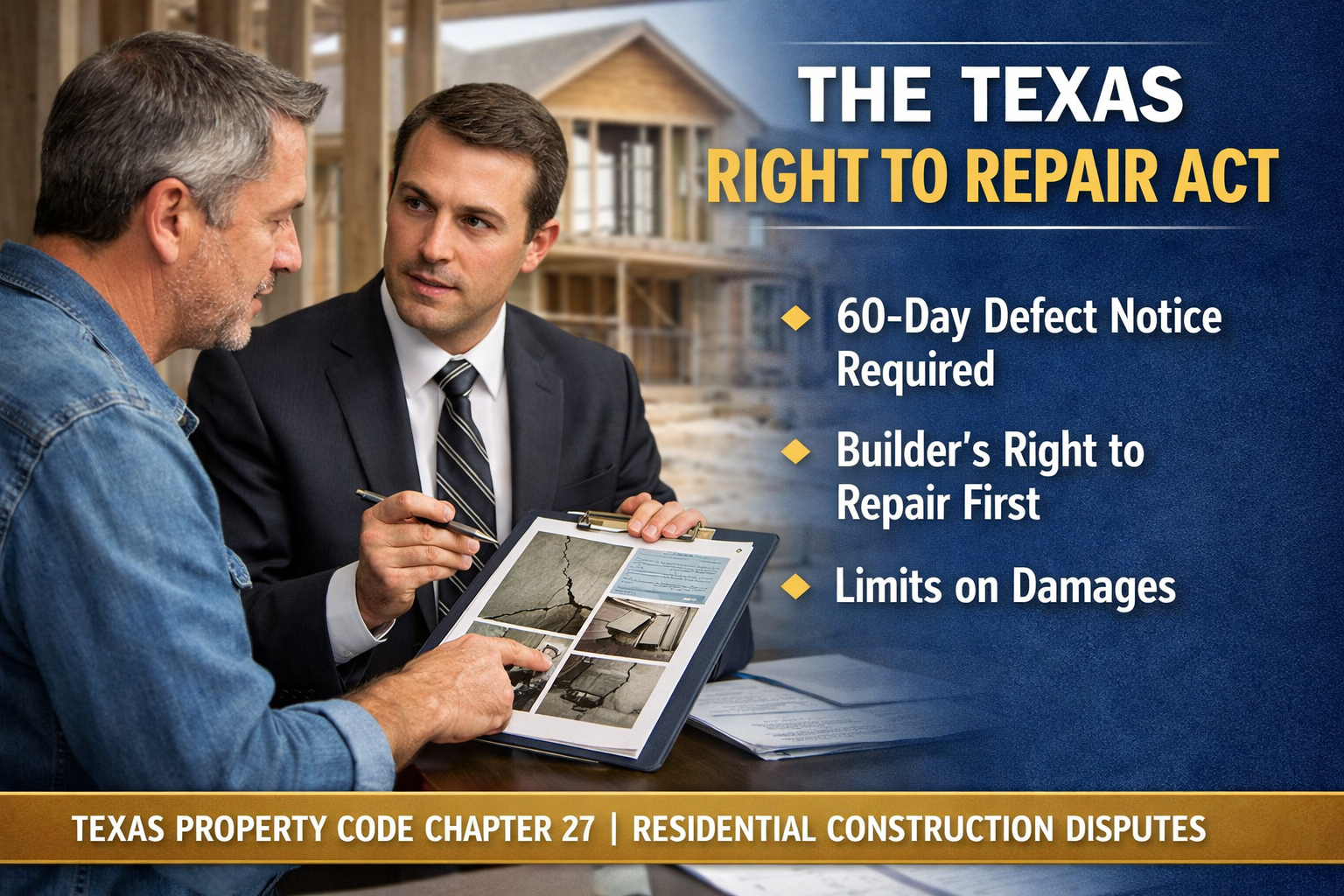
The Texas Right to Repair Act: What Homeowners and Contractors Need to Know Before Filing a Construction Lawsuit
Construction defects are one of the most common sources of disputes in Texas real estate and business litigation. Homeowners often discover foundation issues, roof leaks, mold, or structural defects and assume they can immediately file suit.
In reality, Texas law requires most property owners to follow a mandatory pre-suit process under the Texas Residential Construction Liability Act (RCLA) before going to court.
Failing to follow this process can delay your case, reduce your damages, or even result in dismissal.
This article explains how the Texas Right to Repair Act works, what the law requires, and how it affects both homeowners and contractors.
What Is the Texas Right to Repair Act?
The Texas Right to Repair Act is found in Chapter 27 of the Texas Property Code, commonly called the Residential Construction Liability Act (RCLA).
Its purpose is to:
- Encourage early resolution of construction disputes
- Give builders a chance to inspect and repair problems
- Reduce unnecessary lawsuits
- Control litigation costs
Instead of rushing into court, property owners must first give the contractor an opportunity to fix the alleged defects.
When Does the RCLA Apply?
The RCLA generally applies to claims involving:
- Single-family homes
- Duplexes, triplexes, and fourplexes
- Condominiums
- Townhomes
- Residential remodeling projects
It covers claims arising from:
- Defective construction
- Poor workmanship
- Violations of building standards
- Breach of warranty
- Improper materials
Texas Property Code § 27.002(a) provides:
“This chapter applies to any action to recover damages arising from a construction defect…”
If your claim involves residential construction, the RCLA almost always applies.
The Mandatory Pre-Suit Notice Requirement
Before filing a lawsuit, the homeowner must give written notice to the contractor.
Notice Deadline
Texas Property Code § 27.004(a) states:
“At least the 60th day before the date a claimant files an action, the claimant shall give written notice…”
This means:
- You must send notice at least 60 days before filing suit
- The notice must describe the alleged defects in reasonable detail
If you file first and give notice later, your case may be stayed or dismissed.
Contractor’s Right to Inspect and Offer Repairs
After receiving notice, the contractor has the right to:
- Inspect the property
- Request testing
- Make a settlement or repair offer
Under § 27.004(b), the contractor has 35 days to respond.
The contractor may offer:
- To repair the defects
- To pay for repairs
- To replace damaged items
- To compensate the homeowner financially
The homeowner is not required to accept the offer, but rejecting a reasonable offer can affect damages later.
How the RCLA Limits Damages
One of the most important features of the Act is that it limits recoverable damages.
Texas Property Code § 27.004(g) allows courts to reduce damages if the homeowner unreasonably rejects a valid repair offer.
Potential limitations include:
- Reduced repair costs
- Limited consequential damages
- Restrictions on mental anguish claims
- Limits on exemplary damages
In many cases, failing to comply with the statute costs homeowners thousands of dollars in recoverable damages.
What Damages Are Still Available?
When properly followed, the RCLA still allows recovery for:
- Reasonable cost of repairs
- Engineering inspections
- Temporary housing expenses
- Related property damage
- Certain attorney’s fees
Texas Property Code § 27.004(h) permits recovery of reasonable attorney’s fees in appropriate cases.
However, compliance with the statute is critical.
Common Mistakes Homeowners Make
1. Filing Too Early
Many homeowners file suit immediately after discovering defects. This often triggers a motion to abate and delays the case.
2. Sending Inadequate Notice
Vague letters like “my house is defective” are not enough. The notice must identify specific problems.
3. Rejecting Reasonable Offers
Unreasonably refusing repairs can severely limit damages later.
4. Using Informal Communication
Text messages and casual emails rarely satisfy statutory notice requirements.
Formal written notice is best.
How the RCLA Protects Contractors and Builders
For contractors, the RCLA provides important protections:
- Opportunity to fix mistakes
- Reduced litigation risk
- Predictable damage exposure
- Early dispute resolution
Properly responding to notices can often prevent lawsuits altogether.
Ignoring them is a costly mistake.
How the RCLA Affects Lawsuits in Practice
In real litigation, RCLA compliance becomes a central issue.
Defense attorneys often file motions based on:
- Lack of notice
- Insufficient detail
- Premature filing
- Unreasonable rejection of offers
Courts routinely enforce these provisions.
A technically strong construction defect case can be weakened by procedural errors.
When Should You Speak to a Lawyer?
You should consider legal counsel if:
- You are planning to send a pre-suit notice
- A contractor has sent you a repair offer
- A lawsuit is being threatened
- Defects involve major structural issues
- Large financial losses are involved
Early legal guidance often saves money by preventing compliance mistakes.
Final Thoughts: Follow the Process Before You File
Texas does not allow most residential construction disputes to jump straight into court.
The Right to Repair Act requires:
- Written notice
- Inspection
- Opportunity to repair
- Good-faith negotiation
Skipping these steps can seriously harm your case.
Whether you are a homeowner or contractor, understanding Chapter 27 of the Texas Property Code is essential before pursuing litigation.
If you are facing a construction defect dispute, consulting with an experienced Texas attorney early can protect your rights and improve your outcome.
At David C. Barsalou, Attorney at Law, PLLC, we help clients navigate business, family, tax, estate planning, and real estate matters ranging from document drafting to litigation with clarity and confidence. If you’d like guidance on your situation, schedule a consultation today. Call us at (713) 397-4678, email barsalou.law@gmail.com, or reach us through our Contact Page. We’re here to help you take the next step.
