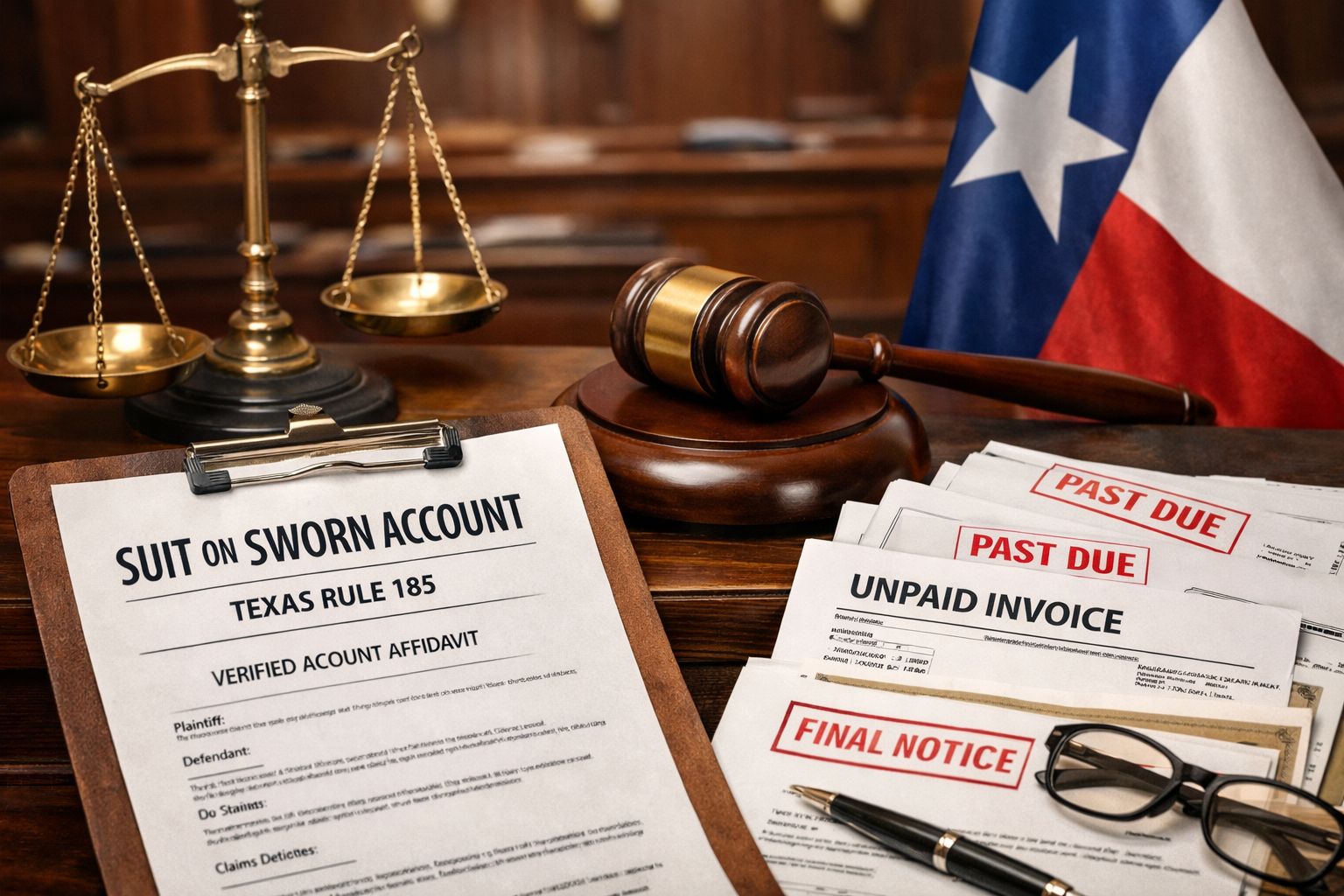
In Texas civil litigation, some legal claims come with procedural advantages that can dramatically shift the balance of a lawsuit. One of the most unusual—and powerful—is the “Suit on a Sworn Account.”
This cause of action is commonly used by businesses that sell goods or services on credit. When properly pleaded, it can force the defendant to file a verified denial, or the claim may be taken as admitted.
For creditors, contractors, and service providers, this rule can make collecting unpaid invoices significantly easier.
What Is a Suit on a Sworn Account?
A sworn account claim is essentially a lawsuit seeking payment for goods or services that were provided and accepted but not paid for.
Texas law recognizes this procedural device in Texas Rule of Civil Procedure 185, which provides:
“When any action or defense is founded upon an open account or other claim for goods, wares and merchandise… or for personal service rendered, or labor done or labor or materials furnished… the same shall be taken as prima facie evidence thereof, unless the party resisting such claim shall file a written denial, under oath.”
— Tex. R. Civ. P. 185
In plain English, the rule means:
If the plaintiff properly verifies the account, the claim becomes automatic prima facie evidence of the debt unless the defendant files a sworn denial.
That procedural feature makes sworn accounts particularly effective for straightforward commercial disputes.
When Can You Use This Type of Claim?
A sworn account generally applies to transactions involving:
• sale of goods
• professional services
• labor or materials
• business accounts between companies
Texas courts frequently allow sworn account claims in cases involving:
- contractors and subcontractors
- professional service providers
- wholesalers or suppliers
- mechanics and repair businesses
- certain credit accounts between businesses
However, the claim typically does not apply to every type of contract dispute. For example, complex contracts involving disputed terms often require traditional breach-of-contract claims instead.
What the Plaintiff Must Prove
To properly plead a sworn account in Texas, the plaintiff must show:
- A sale of goods or provision of services occurred
- The charges were reasonable
- The charges are unpaid
- The account is just and true
The petition must also include a sworn verificationstating that the account is accurate.
This sworn statement is what triggers the burden-shifting effect of Rule 185.
The Defendant’s Trap: Failure to File a Verified Denial
One of the most unusual aspects of a sworn account lawsuit is how the defendant must respond.
If the defendant wants to dispute the claim, Texas law requires a sworn denial.
Texas Rule of Civil Procedure 185 states:
“The account shall be taken as prima facie evidence thereof, unless the party resisting such claim shall file a written denial, under oath.”
If the defendant fails to verify the denial:
• The account may be taken as admitted
• The plaintiff’s evidence may be presumed valid
• The case becomes far easier for the creditor to prove
Many defendants—and even some inexperienced lawyers—miss this requirement.
Why Lawyers Often Plead Both Claims
In practice, attorneys usually plead two causes of action together:
- Suit on a sworn account
- Breach of contract
Why?
Because the sworn account claim provides procedural leverage, while the contract claim provides a broader legal foundation if disputes arise.
This dual pleading strategy protects the case from technical challenges.
Why This Rule Still Matters
Despite being an older procedural rule, sworn accounts remain extremely relevant today—especially in:
- construction disputes
- contractor payment claims
- business-to-business collections
- professional services billing disputes
For businesses dealing with unpaid invoices, this rule can be one of the most efficient litigation tools available.
Final Thoughts
Texas litigation contains many procedural rules that can dramatically affect the outcome of a case. The Suit on a Sworn Accountis one of the most powerful examples.
When used correctly, it shifts the burden onto the defendant and simplifies proof of the debt.
For creditors and businesses dealing with unpaid accounts, understanding this rule can make the difference between an easy judgment and a prolonged lawsuit.
If you are dealing with an unpaid business debt or contract dispute in Texas, consulting an attorney can help determine whether a sworn account claim may apply to your situation.
At David C. Barsalou, Attorney at Law, PLLC, we help clients navigate business, family, tax, estate planning, and real estate matters ranging from document drafting to litigation with clarity and confidence. If you’d like guidance on your situation, schedule a consultation today. Call us at (713) 397-4678, email barsalou.law@gmail.com, or reach us through our Contact Page. We’re here to help you take the next step.