When someone dies, the first question in probate is often deceptively simple: Did the person leave a will?
Sometimes the family knows exactly where the will is located. Sometimes an attorney has the original. Sometimes it is sitting in a filing cabinet at home.
And sometimes everyone believes the original will is inside the deceased person's safe-deposit box.
That creates an odd legal problem. The very document that may identify the executor and establish who should administer the estate can be sitting inside a box that no one has ordinary authority to open.
Fortunately, Texas law specifically addresses this situation.
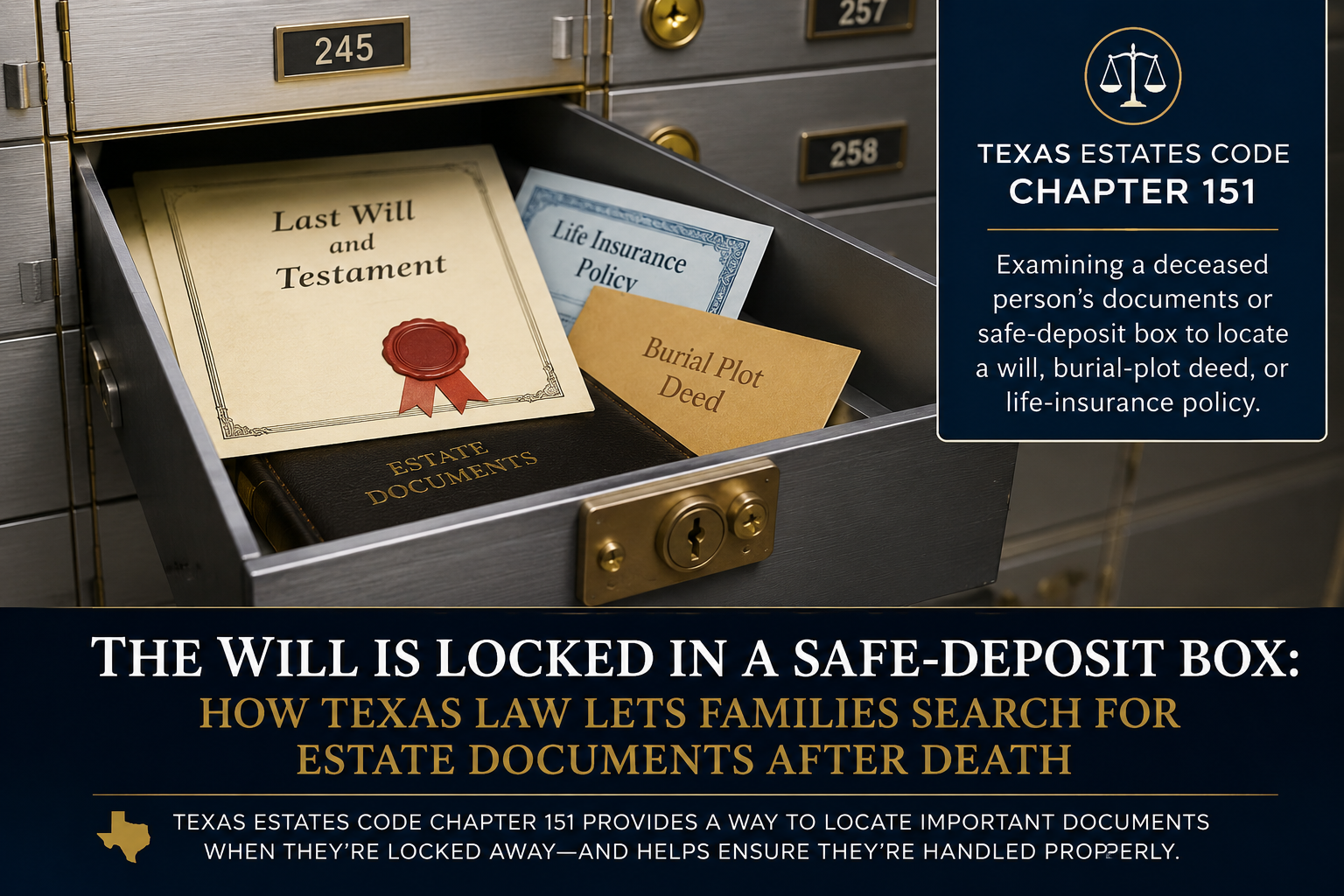
Chapter 151 of the Texas Estates Code establishes procedures for examining a deceased person's documents or safe-deposit box for certain important estate documents—even before a traditional estate administration is underway. ()
Texas Has a Specific Law for Searching a Deceased Person's Safe-Deposit Box
Texas Estates Code Chapter 151 is titled "Examination of Documents and Safe Deposit Boxes."
The statute is unusually specific about what someone may be looking for.
Texas Estates Code § 151.001 allows a probate judge, under appropriate circumstances, to order an examination if the decedent's documents or safe-deposit box may contain:
"a will of the decedent"
as well as a deed to a burial plot or a life-insurance policy payable to a named beneficiary. Tex. Est. Code § 151.001(a)(2). ()
This is one of those obscure probate statutes that solves a very practical problem: how do you obtain the document giving someone authority over the estate when obtaining the document may itself require legal authority?
Chapter 151 provides a way through that circular problem.
A Probate Court Can Order the Box Examined
Texas Estates Code § 151.001 permits a judge of a court having probate jurisdiction over the decedent's estate to order a person to allow a designated court representative to examine the decedent's documents or safe-deposit box.
The applicant must show that the person may possess or control the documents—or leased the safe-deposit box to the decedent—and that the documents or box may contain one of the specified documents. ()
The examination is also controlled. Section 151.001(b) requires it to occur in the presence of the judge or the judge's agent and the person controlling the documents or box (or an appropriate corporate representative). ()
In other words, the statute does not simply authorize someone to obtain an order, walk into a bank, empty the box into a briefcase, and leave.
The purpose is much narrower: locating specified estate-related documents.
What Happens If They Find the Will?
Finding the will does not mean the person searching the box simply gets to take it home.
Texas Estates Code § 151.002 provides a specific procedure for documents discovered during a court-ordered examination.
A judge may order that possession be taken of one of the documents described in § 151.001. The statute then directs where the document goes.
A will is delivered to the clerk of a court with probate jurisdiction in the appropriate county. A burial-plot deed is delivered to the person designated by the judge. A life-insurance policy goes to a beneficiary named in the policy. (Texas Legislative Service)
That distinction is important.
Chapter 151 is primarily a document-recovery procedure, not a shortcut around estate administration.
Surprisingly, a Court Order Is Not Always Necessary
This may be the most interesting part of the statute.
Texas Estates Code § 151.003 creates a procedure for examination without a court order.
The statute provides that the person controlling the documents or leasing the safe-deposit box to the decedent may permit an examination by certain people, including:
"the decedent's spouse"
a parent, an adult descendant, or a person named as executor in a copy of a document appearing to be the decedent's will. Tex. Est. Code § 151.003(a). (Texas Legislative Service)
The examination must occur in the presence of the person controlling the document or leasing the box—or, where that person is a corporation, an appropriate corporate representative. Tex. Est. Code § 151.003(b). (Texas Legislative Service)
This provision can be extremely useful because probate sometimes begins during a period when the family knows important documents exist but does not yet have them.
The Statute Does Not Let the Family Clean Out the Box
This is the trap.
Permission to examine a safe-deposit box is not necessarily permission to remove its contents.
Texas Estates Code § 151.005 is remarkably direct:
"A person may not remove the contents of a decedent's safe deposit box"
except as authorized by §§ 151.002, 151.004, or another law. ()
Suppose the box contains:
- an original will;
- a burial-plot deed;
- a life-insurance policy;
- a diamond ring;
- $5,000 in cash;
- stock certificates; and
- an old Rolex.
Chapter 151 may provide a mechanism for locating and delivering the specified documents. It does not, merely because an examination is permitted, give a relative a general right to walk away with the cash, jewelry, securities, or other estate property.
That distinction can matter considerably in a contested estate.
What Documents Can Be Delivered Without a Court Order?
Section 151.004 also specifies what may happen when an examination occurs under the no-court-order procedure.
A document appearing to be the decedent's will may be delivered to the appropriate probate clerk or to a person named as executor in the document. A burial-plot deed or burial instructions may be delivered to the person conducting the examination, and a life-insurance policy may be delivered to a beneficiary named in the policy. ()
There is even a recordkeeping requirement.
If the person leasing the safe-deposit box to the decedent delivers a document appearing to be a will under this provision, that person must retain a copy until the fourth anniversary of the date of delivery. Tex. Est. Code § 151.004(b). ()
Texas probate law can become surprisingly detailed about what happens to a single piece of paper.
Why Burial Documents Are Included
One of the quirkiest aspects of Chapter 151 is that it is not exclusively concerned with property distribution.
The statute expressly contemplates looking for a deed to a burial plot. Section 151.004 goes even further by referring to a document appearing to give burial instructions. ()
There is a practical reason for this.
Probate proceedings can take time. Burial decisions usually cannot.
The Legislature therefore created a mechanism capable of locating documents that may be needed immediately after death rather than waiting for the ordinary administration of the estate to unfold.
Why Safe-Deposit Boxes Can Create Probate Problems
A safe-deposit box feels like an obvious place to keep important documents.
Legally, however, it can create an awkward situation.
If the original will is inside the box, the document naming the executor may be inaccessible at precisely the moment when the executor needs to establish authority.
Chapter 151 helps separate two different questions:
Who may look for important documents?
and
Who ultimately has authority over the decedent's property?
Those are not necessarily the same person.
A surviving spouse or adult child may be permitted to participate in an examination under § 151.003 without thereby becoming executor, administrator, owner, or beneficiary of everything found inside the box.
What If the Family Does Not Know Whether a Will Is in the Box?
Section 151.001 does not require certainty that the box contains a will.
Rather, the statute applies when it is shown that the documents or safe-deposit box "may contain" one of the specified documents. ()
That makes sense.
If a family already possessed the will, there ordinarily would be little reason to search the safe-deposit box for it.
The procedure exists precisely because the document's location may not be certain.
Evidence that the decedent routinely kept important legal papers in the box, told family members the will was there, or otherwise used the box for estate documents could therefore become practically significant when seeking relief from the probate court.
A Safe-Deposit Box Is Not a Substitute for an Estate Plan
Chapter 151 also illustrates a broader estate-planning lesson.
Having a properly executed will is important. Making sure someone can find it after death is important too.
A beautifully drafted will that no one can locate may produce litigation, delay, additional expense, or even a dispute over whether the decedent died intestate.
Texas law provides procedures for dealing with a will locked away in a safe-deposit box, but avoiding the problem in the first place is generally easier.
An estate plan should therefore address not merely what the documents say, but where the originals will be kept and how the appropriate people will locate them when they are needed.
The Bottom Line
If a loved one dies and the family believes the original will is locked inside a safe-deposit box, the answer is not necessarily to wait until someone has already been formally appointed to administer the estate.
Texas Estates Code Chapter 151 provides specific procedures for examining a decedent's documents and safe-deposit box. In some circumstances, a probate court can order the examination. In others, a spouse, parent, adult descendant, or person apparently named as executor may be permitted to examine the box without first obtaining a court order. ()
But the authority is limited.
The right to search for the will is not the right to empty the safe-deposit box.
That small distinction is a good example of how Texas probate law handles a surprisingly ordinary problem with a remarkably specific statutory solution.
This article is for general informational purposes only and does not constitute legal advice. Probate rights and procedures depend on the particular facts of each estate.
At David C. Barsalou, Attorney at Law, PLLC, we help clients navigate business, family, tax, estate planning, and real estate matters ranging from document drafting to litigation with clarity and confidence. If you’d like guidance on your situation, schedule a consultation today. Call us at (713) 397-4678, email barsalou.law@gmail.com, or reach us through our Contact Page. We’re here to help you take the next step.