Introduction
Most Texas litigants obsess over pleadings, motions, and trial strategy—but quietly sitting in the background is one of the most important procedural frameworks in the entire case: the discovery control plan.
Under , you’ve covered discovery generally, but not the structure that governs all discovery activity. That structure is found in Texas Rule of Civil Procedure 190, which determines how much discovery you get, how long you have, and how aggressive your strategy can be.
If you misunderstand Rule 190, you can lose your case before it ever gets to summary judgment or trial.
What Is a Discovery Control Plan?
A discovery control plan is the court-approved framework that governs the scope, timing, and limits of discovery in a Texas lawsuit.
The rule itself states:
“Every case must be governed by a discovery control plan as provided in this rule.”
— Tex. R. Civ. P. 190.1
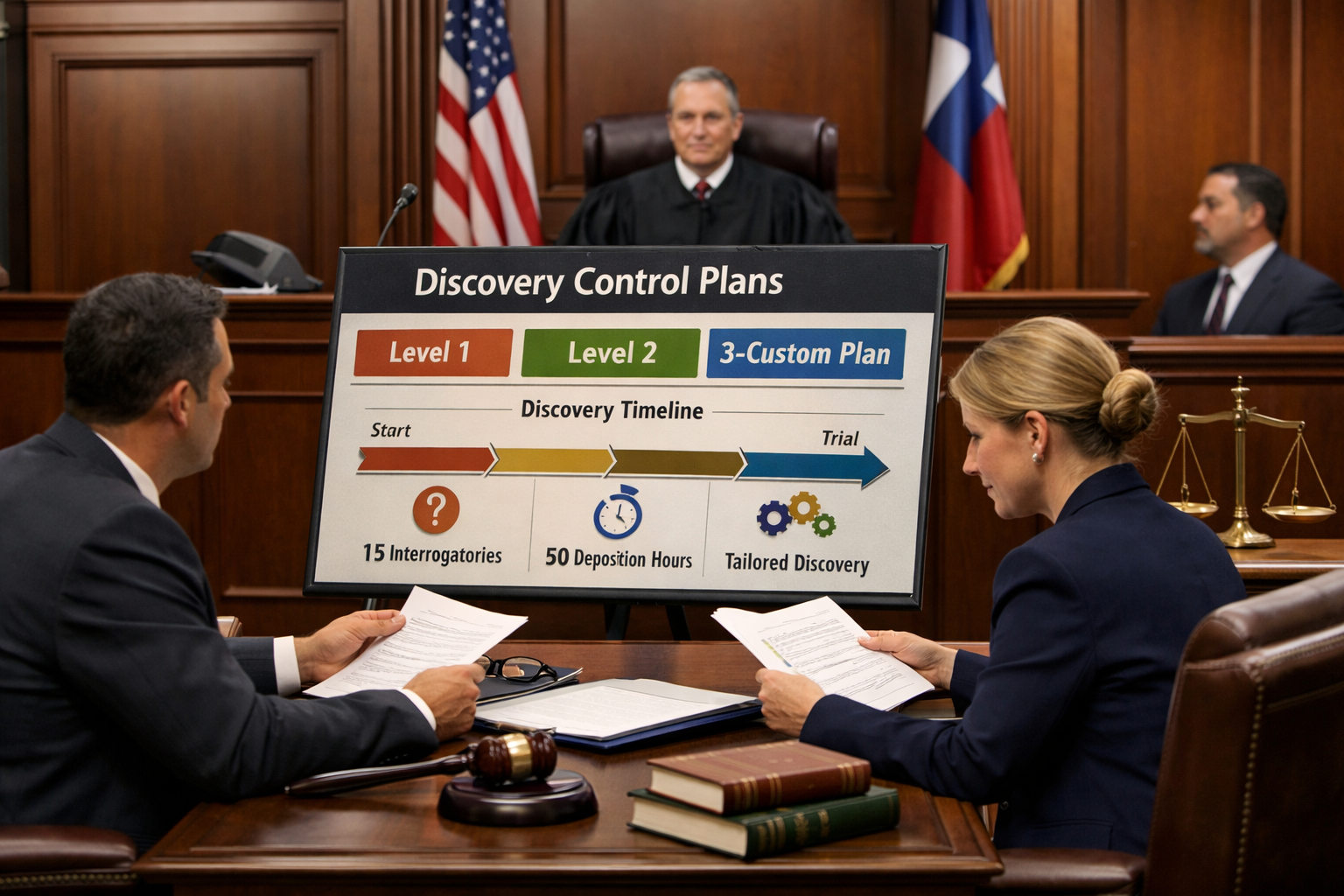
This means there is no such thing as “free-form discovery” in Texas. Every case falls into one of three structured levels.
The Three Levels of Discovery Under TRCP 190
Level 1 – Expedited Actions (Low Stakes, Tight Limits)
Level 1 applies to smaller cases, including those under Rule 169 expedited actions.
The rule provides:
“Discovery is limited to 180 days after the date the first discovery request is served.”
— Tex. R. Civ. P. 190.2(b)(1)
And importantly:
“Each party may have no more than 15 interrogatories…”
— Tex. R. Civ. P. 190.2(b)(3)
👉 Strategic takeaway:
This is a compressed battlefield. If you miss early discovery opportunities, you don’t get them back.
Level 2 – The Default (Most Cases)
If no plan is specified, your case falls into Level 2 automatically.
“Discovery must be conducted during the discovery period, which begins when the suit is filed and continues until… 30 days before trial.”
— Tex. R. Civ. P. 190.3(b)(1)
Depositions are also capped:
“Each side may have no more than 50 hours of oral depositions…”
— Tex. R. Civ. P. 190.3(b)(2)
👉 Strategic takeaway:
Level 2 is where most lawyers operate—but many fail to track deposition hour limits, which can quietly cripple late-stage case prep.
Level 3 – Customized Discovery Plans
Level 3 allows the court to tailor discovery to the case.
“The court must, on a party’s motion… order that discovery be conducted in accordance with a discovery control plan tailored to the circumstances of the specific suit.”
— Tex. R. Civ. P. 190.4(a)
👉 Strategic takeaway:
Level 3 is where sophisticated litigation happens. You can:
- Expand deposition limits
- Sequence discovery
- Target specific issues early
- Control costs (or weaponize them)
Why Discovery Control Plans Matter More Than You Think
1. They Define the Timeline of the Case
Deadlines for:
- Written discovery
- Depositions
- Expert designations
…are all tied to the discovery period.
Miss the window, and your evidence may be excluded.
2. They Limit Your Ability to Prove Your Case
If you run out of:
- Interrogatories
- Requests for production
- Deposition time
…you may be stuck with an incomplete record.
This becomes critical at summary judgment.
3. They Influence Settlement Leverage
A party with:
- More discovery time
- More deposition hours
- Better sequencing
…has more pressure leverage.
Discovery isn’t just fact-finding—it’s negotiation positioning.
Common Mistakes Lawyers and Litigants Make
❌ Assuming Level 2 Is Always “Good Enough”
Complex cases often require a Level 3 plan.
❌ Ignoring Deposition Hour Limits
Running out of hours mid-case is a self-inflicted wound.
❌ Failing to Move for a Custom Plan
If your case involves:
- Multiple parties
- Technical issues
- Hidden assets
…you should seriously consider Level 3.
❌ Waiting Too Long to Act
By the time discovery problems surface, it’s often too late to fix them.
Strategic Use of Rule 190 in Real Cases
In practice, Rule 190 becomes a quiet weapon:
- In family law, it can control financial discovery timing
- In creditor cases, it can accelerate asset identification
- In construction disputes, it can prioritize expert sequencing
- In probate, it can limit fishing expeditions
The lawyers who use Rule 190 proactively tend to control the case narrative early.
When Should You Seek a Level 3 Plan?
Consider it when:
- The case involves significant money or assets
- There are multiple parties or entities
- You need early depositions or phased discovery
- The opposing side is likely to overwhelm with discovery
A well-drafted motion can reshape the entire case.
Final Thoughts
Texas litigation is not just about who has the better facts—it’s about who operates within the procedural structure more effectively.
Rule 190 is one of the most overlooked tools in that structure.
If used correctly, it can:
- Control costs
- Limit your opponent
- Expand your leverage
- Set the tone for the entire lawsuit
If ignored, it can quietly strangle your case before it ever reaches trial.
At David C. Barsalou, Attorney at Law, PLLC, we help clients navigate business, family, tax, estate planning, and real estate matters ranging from document drafting to litigation with clarity and confidence. If you’d like guidance on your situation, schedule a consultation today. Call us at (713) 397-4678, email barsalou.law@gmail.com, or reach us through our Contact Page. We’re here to help you take the next step.