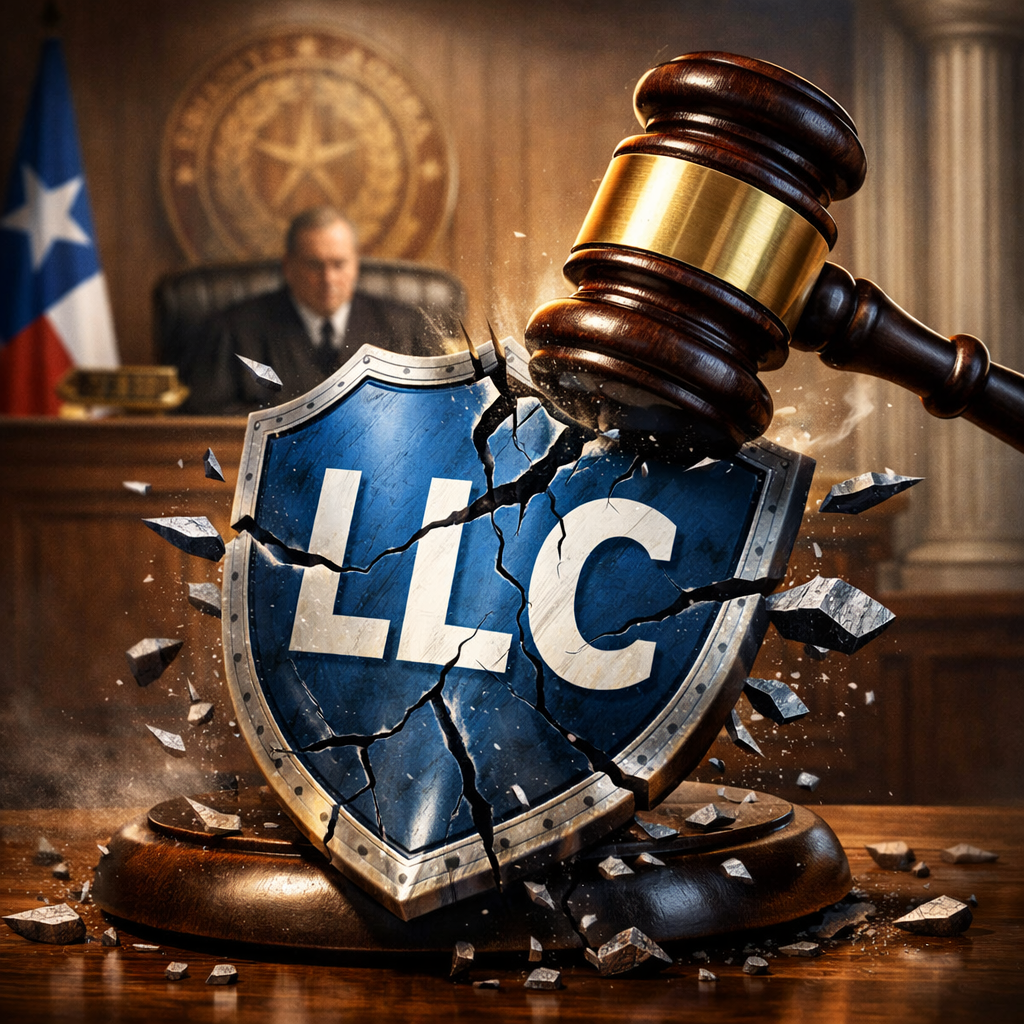
One of the most common misconceptions in Texas business law is that forming an LLC automatically shields the owner from all personal liability.
It does not.
Under limited circumstances, Texas courts will disregard the corporate form and hold owners personally liable. This is commonly known as “piercing the corporate veil.”
If you are suing a business that appears to be a shell, undercapitalized, or used to commit fraud, Texas law provides a pathway — but it is narrow and statute-controlled.
Let’s break down how it actually works.
1. The General Rule: Limited Liability Exists
Texas law strongly favors respecting the corporate form.
Under Texas Business Organizations Code § 21.223(a):
“A holder of shares, an owner of any beneficial interest in shares, or a subscriber for shares whose subscription has been accepted… is not liable to the corporation or its obligees with respect to… any contractual obligation of the corporation.”
For LLCs, similar protection is provided under:
Texas Business Organizations Code § 101.114
“Except as otherwise provided by this code, a member or manager is not liable for a debt, obligation, or liability of a limited liability company.”
In short: owners are not liable for company debts merely because they own the company.
But there is an exception.
2. The Statutory Exception: Actual Fraud for Personal Benefit
Texas significantly narrowed veil piercing for contractual claims in 1989 and reinforced that limitation in the Business Organizations Code.
Under Tex. Bus. Orgs. Code § 21.223(b):
“A holder of shares… may not be held liable to the corporation or its obligees with respect to any contractual obligation… unless the obligee demonstrates that the holder caused the corporation to be used for the purpose of perpetrating and did perpetrate an actual fraud on the obligee primarily for the direct personal benefit of the holder.”
That is a very high bar.
To pierce the veil in a contract case, you must prove:
- Actual fraud
- The fraud was committed through use of the entity
- It was done primarily for the owner’s direct personal benefit
Constructive fraud is not enough.
Bad management is not enough.
Failure to pay debts is not enough.
You must show intentional deception.
3. What Counts as “Actual Fraud”?
Texas courts interpret “actual fraud” as:
- A material misrepresentation
- Made knowingly or recklessly
- Intended to induce reliance
- Actually relied upon
- Causing injury
Merely moving money around poorly is insufficient.
But evidence like:
- Using the LLC to sign contracts with no intent to perform
- Draining company funds to avoid paying a creditor
- Using the entity to shield personal transactions
can potentially qualify — if tied to personal benefit.
4. Contract Claims vs. Tort Claims
Here’s where it gets technical.
The statutory limitation in § 21.223 applies primarily to contractual obligations.
For tort claims (fraud, DTPA, negligence, etc.), courts may apply broader common-law veil piercing theories, including:
- Alter ego
- Sham to perpetrate a fraud
- Use of entity to avoid existing obligations
However, even in tort cases, Texas courts remain reluctant to disregard the corporate structure absent serious abuse.
5. Undercapitalization Alone Is Not Enough
Historically, undercapitalization was a factor in veil piercing.
Today, under Texas law, undercapitalization by itself does not establish liability for contract claims without proof of actual fraud for personal benefit.
The Legislature made that clear.
This means creditors must build a fraud-based evidentiary case — not just argue that the company was thinly funded.
6. The “Alter Ego” Theory
Texas courts may disregard the entity when:
- There is such unity between the individual and the entity
- That the separateness has ceased
- And holding only the entity liable would result in injustice
Common alter-ego factors include:
- Commingling funds
- Failure to observe formalities
- Using company accounts as personal accounts
- Treating corporate assets as personal property
But again — in contract cases — actual fraud remains required.
7. Practical Litigation Strategy in Texas
If you are trying to pierce the veil in Texas, you typically must:
- Plead alter ego and actual fraud with specificity
- Conduct financial discovery
- Obtain bank records
- Trace transfers to personal accounts
- Prove personal benefit
This is not a shortcut claim.
It is fact-intensive and expensive.
But in the right case — especially where an owner siphons money while stiffing creditors — it can turn a worthless judgment into a collectible one.
8. Why This Matters in Real Estate, Construction, and Small Business Litigation
In your practice areas — real estate disputes, construction claims, promissory note litigation, breach of contract cases — defendants often operate through LLCs.
If the LLC has no assets, your only path to recovery may be:
- Fraudulent transfer claims
- Turnover orders
- Or veil piercing
Understanding the statutory limits under Texas Business Organizations Code is critical before filing suit.
Conclusion
Texas strongly protects LLC and corporate owners.
But protection is not absolute.
If an owner uses an entity to commit actual fraud for personal benefit, Texas courts can and will pierce the corporate veil.
The key is proof.
Not suspicion.
Not frustration.
Proof.
At David C. Barsalou, Attorney at Law, PLLC, we help clients navigate business, family, tax, estate planning, and real estate matters ranging from document drafting to litigation with clarity and confidence. If you’d like guidance on your situation, schedule a consultation today. Call us at (713) 397-4678, email barsalou.law@gmail.com, or reach us through our Contact Page. We’re here to help you take the next step.