Understanding Texas Rule of Civil Procedure 97(a)
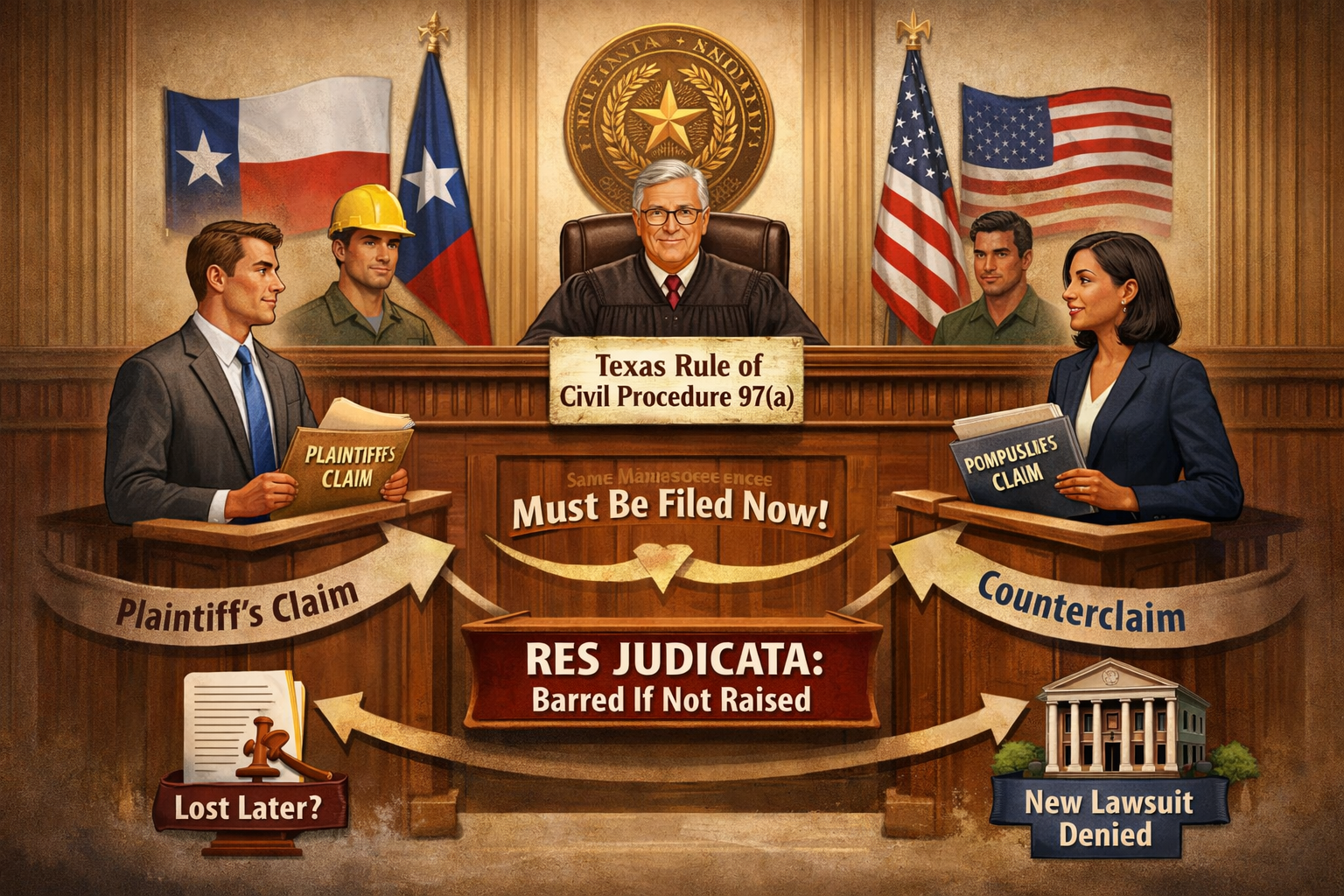
Litigation in Texas is designed to resolve disputes efficiently and in a single lawsuit whenever possible. One of the key procedural rules that enforces this policy is Texas Rule of Civil Procedure 97(a), which governs compulsory counterclaims.
Many litigants assume they can bring a claim later if they lose a lawsuit. In many situations, that assumption is wrong. Texas law may require that certain claims be brought in the same lawsuit, or they may be lost forever.
Understanding how compulsory counterclaims work can make the difference between preserving your legal rights and inadvertently waiving them.
The Rule: Texas Rule of Civil Procedure 97(a)
The governing law appears in Texas Rule of Civil Procedure 97(a), which provides:
“A pleading shall state as a counterclaim any claim within the jurisdiction of the court, not the subject of a pending action, which at the time of filing the pleading the pleader has against any opposing party, if it arises out of the transaction or occurrence that is the subject matter of the opposing party's claim.”
— Tex. R. Civ. P. 97(a)
In simple terms, this means that if a defendant has a claim against the plaintiff that arises out of the same event or transaction, that claim must usually be asserted in the same lawsuit.
Failing to do so can result in the claim being barred later by res judicata.
Why Texas Requires Compulsory Counterclaims
The rule exists to prevent:
- Multiple lawsuits about the same dispute
- Waste of court resources
- Inconsistent verdicts
- Strategic delay by litigants
Texas courts prefer to resolve all disputes arising from the same set of facts in a single case.
The Four-Part Test for Compulsory Counterclaims
Texas courts generally analyze four factors to determine whether a claim is compulsory:
- The claim arises from the same transaction or occurrence as the plaintiff’s claim.
- The claim exists at the time the defendant files their answer.
- The claim is within the jurisdiction of the court.
- The claim is not already pending in another lawsuit.
If these elements are satisfied, the counterclaim is compulsory.
Example: A Construction Dispute
Consider a common scenario in business litigation.
A contractor sues a property owner for unpaid invoices.
The owner believes the contractor’s work was defective and caused damages.
If the alleged defective work arises from the same construction project, the owner likely must bring that claim as a counterclaim in the same lawsuit.
If the owner waits and later tries to file a new lawsuit for defective work, the claim may be barred.
Compulsory vs. Permissive Counterclaims
Texas Rule of Civil Procedure 97 distinguishes between two types of counterclaims.
Compulsory Counterclaims
Must be filed in the same lawsuit or may be permanently lost.
Permissive Counterclaims
Rule 97(b) provides:
“A pleading may state as a counterclaim any claim against an opposing party not arising out of the transaction or occurrence that is the subject matter of the opposing party's claim.”
— Tex. R. Civ. P. 97(b)
These claims do not have to be filed in the same case.
For example:
- A debt collection lawsuit
- An unrelated breach of contract claim
Those may be brought separately.
What Counts as the Same “Transaction or Occurrence”?
This phrase is interpreted broadly by Texas courts.
Courts often look for:
- The same facts
- The same contract
- The same events
- Overlapping evidence
If the claims would rely on substantially the same evidence, courts often treat them as compulsory.
When a Counterclaim Is Not Required
There are important exceptions.
A counterclaim may not be compulsory if:
- The court lacks jurisdiction over the claim
- The claim had not yet accrued
- The claim was already pending in another lawsuit
- The necessary parties are not before the court
These situations can preserve the right to bring the claim later.
The Real Risk: Losing Your Claim Forever
The biggest danger is procedural.
If a claim qualifies as a compulsory counterclaim and is not raised, Texas courts may later apply claim preclusion (res judicata)to block it.
In practice, that means:
- The claim is permanently barred
- Even if it otherwise had merit
This rule is why defendants should consult an attorney immediately after being served with a lawsuit.
Why This Rule Matters in Business and Contract Disputes
Compulsory counterclaims frequently arise in cases involving:
- Breach of contract disputes
- Construction litigation
- Real estate disputes
- Business partnership conflicts
- Debt collection lawsuits
In these situations, parties often have claims against each other, and Rule 97(a) requires them to bring those claims at the same time.
Practical Takeaway
Texas civil procedure strongly favors resolving entire disputes in one lawsuit.
If you are sued in Texas and believe the plaintiff also wronged you, it is critical to determine whether your claim is a compulsory counterclaim under Texas Rule of Civil Procedure 97(a).
Failing to assert such a claim in the current lawsuit may mean losing the right to ever bring it at all.
At David C. Barsalou, Attorney at Law, PLLC, we help clients navigate business, family, tax, estate planning, and real estate matters ranging from document drafting to litigation with clarity and confidence. If you’d like guidance on your situation, schedule a consultation today. Call us at (713) 397-4678, email barsalou.law@gmail.com, or reach us through our Contact Page. We’re here to help you take the next step.