Introduction
In Texas litigation, affidavits are everywhere—summary judgment responses, business records, probate disputes, and more. But not all affidavits are created equal. In fact, some are so suspect that courts will completely disregard them.
Welcome to one of the more under-the-radar but powerful doctrines in Texas civil procedure: the “sham affidavit” rule.
If you’ve ever had a witness suddenly “remember” something different after deposition—or watched the other side try it—you’ve seen this doctrine in action.
What Is the Sham Affidavit Rule?
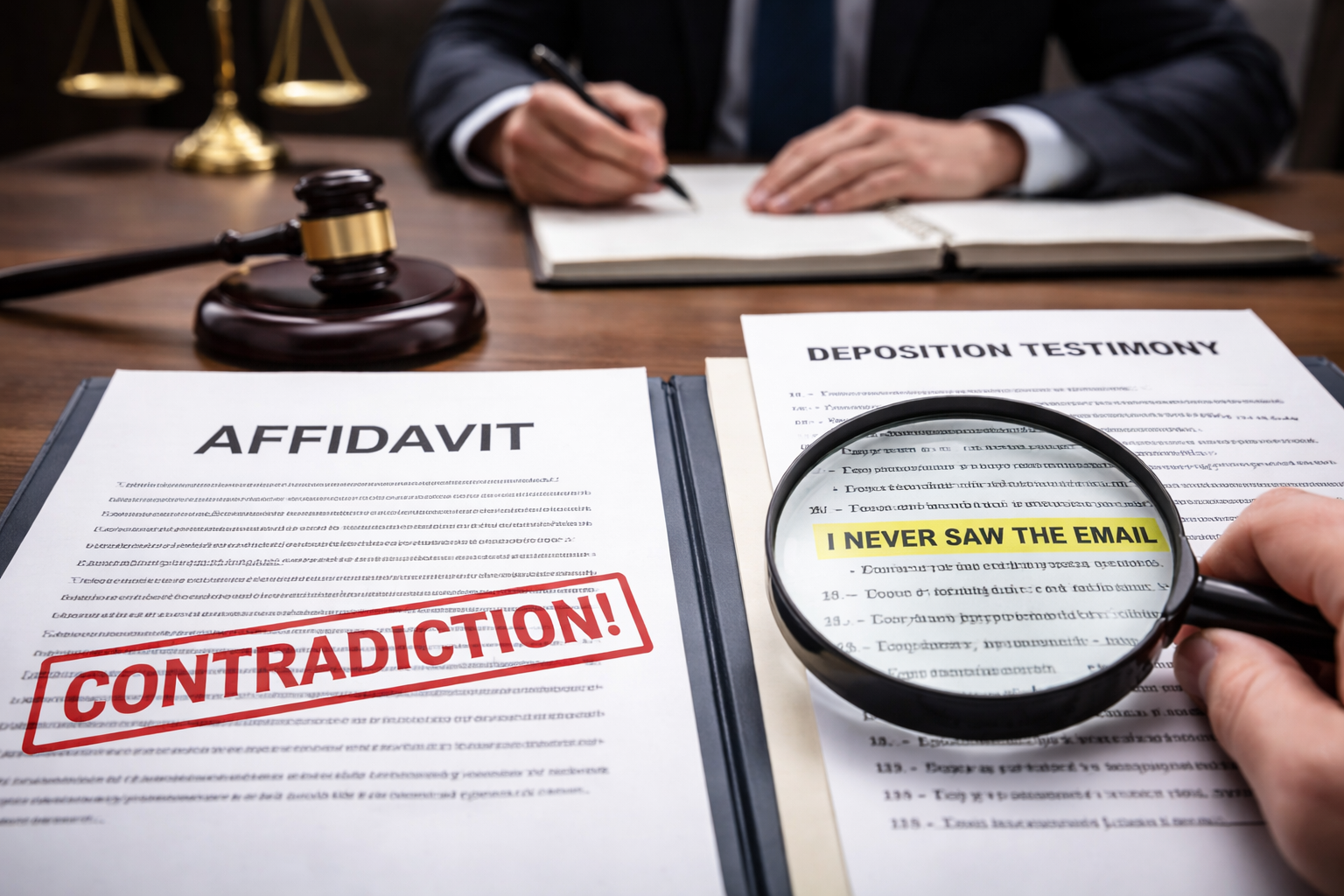
The sham affidavit rule prevents a party from creating a fact issue by submitting an affidavit that contradicts prior sworn testimony without explanation.
This most often arises in the context of summary judgment practice under:
Texas Rule of Civil Procedure 166a(c) – governing traditional summary judgment
Texas Rule of Civil Procedure 166a(i) – governing no-evidence summary judgment
These rules require that evidence used to defeat summary judgment be competent and credible. Courts have interpreted that to exclude affidavits that are merely attempts to manufacture a dispute.
The Core Principle
Texas courts have consistently held:
A party cannot defeat summary judgment by filing an affidavit that contradicts earlier sworn testimony without a reasonable explanation.
This doctrine comes from Texas case law, including:
- Farroux v. Denny’s Restaurants, Inc., 962 S.W.2d 108 (Tex. App.—Houston [1st Dist.] 1997, no pet.)
- Randall v. Dallas Power & Light Co., 752 S.W.2d 4 (Tex. App.—Dallas 1988, no writ)
In Farroux, the court explained that allowing contradictory affidavits would undermine the purpose of summary judgment by allowing parties to manufacture fact issues out of thin air.
How It Actually Plays Out (Real-World Scenario)
Let’s say in a deposition, a tenant testifies:
“I never attempted to pay rent before the deadline.”
Then, in response to your motion for summary judgment, they file an affidavit stating:
“I tried multiple times to pay rent before the deadline but was blocked.”
If there’s no explanation for the contradiction, you can move to strike the affidavit as a sham.
What Courts Look For
Texas courts don’t automatically strike contradictory affidavits. They analyze:
1. Direct Contradiction
Is the affidavit clearly inconsistent with prior sworn testimony?
2. Material Issue
Does the contradiction relate to a key fact?
3. Explanation Provided
Has the affiant explained the discrepancy?
If there’s a plausible explanation (e.g., confusion, newly discovered evidence), courts may allow it.
If not—it’s out.
Why This Matters in Practice
This doctrine is huge in your world:
🔹 Evictions
Tenants frequently change their story after the hearing starts going south.
🔹 Debt Collection / Contract Cases
Defendants suddenly “recall” payments or agreements that never existed.
🔹 Family Law
Affidavits contradicting prior financial disclosures or testimony.
🔹 Probate
Heirship claims that evolve mid-litigation.
If you know this rule cold, you can neutralize weak affidavits quickly.
How to Attack a Sham Affidavit
When you spot one, here’s the play:
Step 1: Cite the Prior Testimony
Quote deposition excerpts directly.
Step 2: Highlight the Contradiction
Make it obvious and undeniable.
Step 3: Move to Strike
File objections or a motion to strike the affidavit.
Step 4: Argue No Fact Issue Exists
Without the affidavit, the case collapses.
Practice Tip: Don’t Accidentally Create One
This cuts both ways.
When preparing affidavits:
- Review prior deposition testimony carefully
- Avoid “cleaning up” testimony too aggressively
- If something changed, explain why in the affidavit
A simple explanation can save the affidavit:
“Upon reviewing documents after my deposition, I realized…”
That alone can keep it admissible.
Why Courts Care So Much
The sham affidavit rule protects the integrity of:
- Summary judgment procedure
- Sworn testimony
- Judicial efficiency
Without it, every losing party could just submit a last-minute affidavit and force a trial.
Conclusion
The sham affidavit rule is one of those quiet doctrines that wins cases without fanfare.
If you know how to use it:
- You can knock out weak defenses
- Strengthen your summary judgment posture
- And keep the case focused on real evidence—not manufactured disputes
At David C. Barsalou, Attorney at Law, PLLC, we help clients navigate business, family, tax, estate planning, and real estate matters ranging from document drafting to litigation with clarity and confidence. If you’d like guidance on your situation, schedule a consultation today. Call us at (713) 397-4678, email barsalou.law@gmail.com, or reach us through our Contact Page. We’re here to help you take the next step.
