Introduction
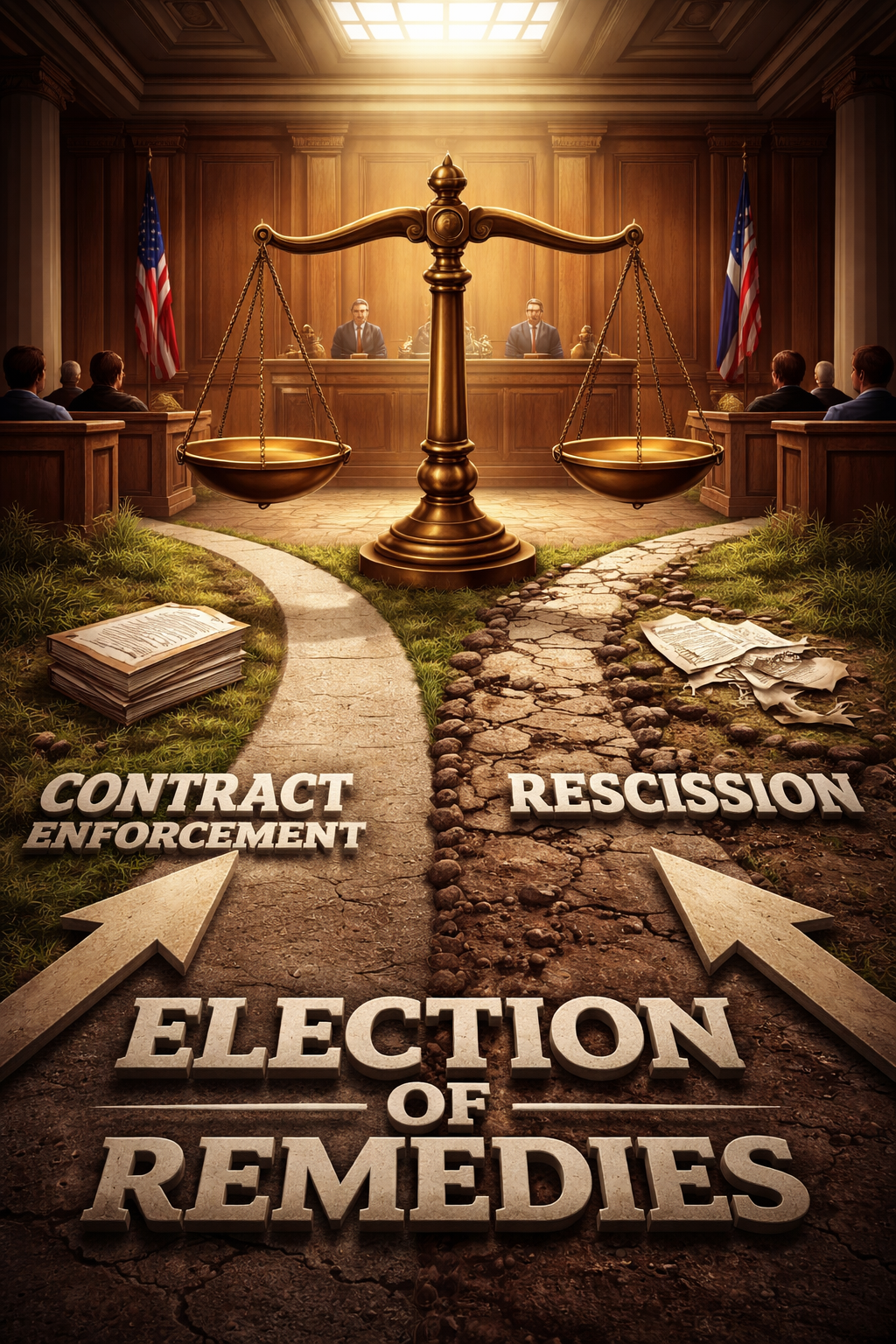
In Texas litigation, strategy is everything. But what many clients—and even some attorneys—fail to appreciate is that choosing one legal remedy can sometimes bar you from pursuing another. This concept is known as the election of remedies doctrine, and while it sounds academic, it can absolutely decide real cases.
Unlike more commonly discussed doctrines like res judicata or estoppel, election of remedies operates in a subtle but dangerous way: it penalizes inconsistent recovery paths, not merely inconsistent pleadings.
What Is the Election of Remedies Doctrine?
The election of remedies doctrine is a common law principle recognized by Texas courts that prevents a party from:
- Obtaining multiple recoveries for the same injury, or
- Pursuing inconsistent remedies that would result in unfair prejudice
The Texas Supreme Court has explained that the doctrine applies when:
- One remedy affirms a transaction, and
- Another remedy repudiates that same transaction
Once a party makes a binding election, they may be barred from switching theories later.
Codified Law and Procedural Overlay
While the doctrine itself is largely common law, it intersects with codified procedural rules:
Texas Rules of Civil Procedure 48
“A party may set forth two or more statements of a claim or defense alternatively or hypothetically…”
This rule allows pleading in the alternative, which is critical.
👉 Key Insight:
You can plead inconsistent remedies—but you cannot recover on inconsistent remedies.
Texas Civil Practice & Remedies Code § 41.004
“In an action in which a claimant seeks recovery of damages… the claimant may not recover exemplary damages unless compensatory damages are awarded.”
This reflects a broader policy:
➡️Texas law disfavors duplicative or inconsistent recoveries.
Classic Example: Fraud vs. Contract
This is where the doctrine gets real.
Scenario:
A plaintiff alleges:
- Breach of contract (affirming the agreement), and
- Fraudulent inducement (arguing the agreement should not exist)
The Problem:
- If you affirm the contract, you’re saying it is valid
- If you rescind based on fraud, you’re saying it is void
👉 You can plead both—but at some point, you must choose.
When Does Election Actually Occur?
This is the tricky part—and where lawyers get burned.
Election typically becomes binding when:
- A party obtains a judgment, or
- A party accepts benefits under one theory
Texas courts often look for:
- Clear inconsistency
- Detrimental reliance or prejudice
- Intent to elect
Why This Doctrine Still Matters Today
In modern practice, many attorneys assume:
“We can just plead everything and figure it out later.”
That’s mostly true—but not entirely.
Election of remedies still matters in:
1. Real Estate Disputes
- Rescission vs. enforcement of a contract
- Specific performance vs. damages
2. Business Litigation
- Shareholder disputes
- Partnership/accounting claims
- Fiduciary duty vs. contract enforcement
3. Debt and Collection Cases
- Suit on contract vs. unjust enrichment
- Acceleration vs. continued performance
Strategic Takeaways for Texas Lawyers
1. Plead Broadly, But Think Narrowly
Use TRCP 48 to plead in the alternative—but always have a theory of recovery strategy early.
2. Watch Client Conduct
Clients can accidentally elect remedies by:
- Accepting payments
- Enforcing part of an agreement
- Taking inconsistent positions outside court
3. Jury Charge Matters
Election often becomes an issue at:
- Jury submission, or
- Judgment stage
Failing to structure the charge properly can:
➡️Waive claims
➡️Force unintended elections
Common Misconception
❌ “Election of remedies means you can’t plead inconsistent claims.”
✔️Wrong.
✅ You can plead inconsistent claims
❌You cannot obtain inconsistent recoveries
That distinction is everything.
Why This Topic Matters (Even If It Sounds Academic)
This doctrine shows up in real cases where:
- A party overreaches
- A lawyer fails to pick a lane
- A client acts inconsistently
And when it hits, it can:
- Kill claims
- Limit recovery
- Create appellate issues
Final Thoughts
The election of remedies doctrine is one of those quiet, strategic doctrines that doesn’t get much attention—but absolutely should.
It rewards:
- Clear thinking
- Consistency
- Disciplined litigation strategy
And it punishes:
- Scattershot pleading
- Emotional decision-making
- Post hoc theory changes
At David C. Barsalou, Attorney at Law, PLLC, we help clients navigate business, family, tax, estate planning, and real estate matters ranging from document drafting to litigation with clarity and confidence. If you’d like guidance on your situation, schedule a consultation today. Call us at (713) 397-4678, email barsalou.law@gmail.com, or reach us through our Contact Page. We’re here to help you take the next step.