Introduction
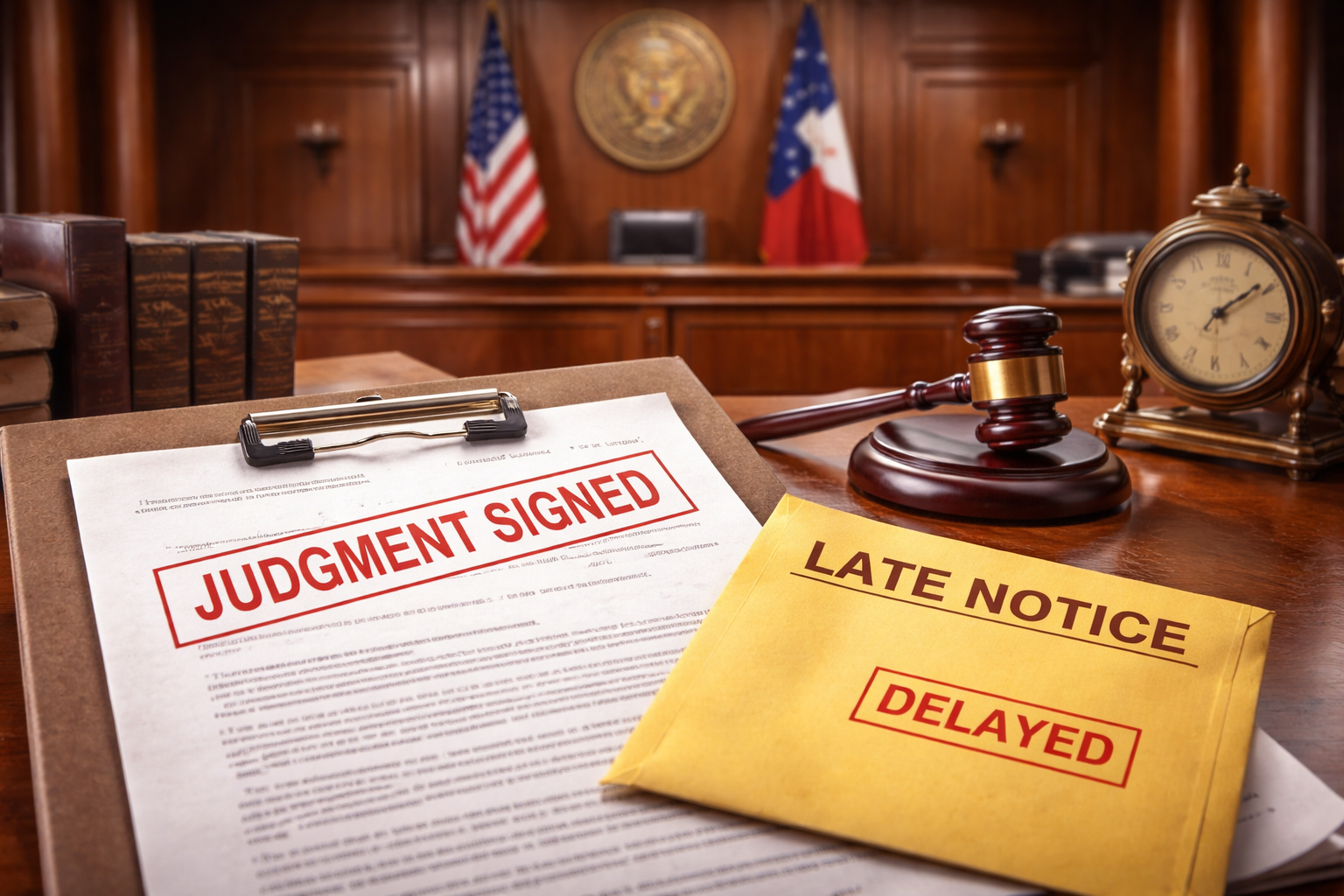
Most people assume that once a judgment is signed in a Texas case, the clock immediately starts ticking for post-judgment motions and appeals. That’s generally true—but there’s a critical exception that can completely reset those deadlines: lack of notice of the judgment.
Under Texas Rule of Civil Procedure 306a, a party who did not receive timely notice of a judgment may be able to restart post-judgment deadlines, sometimes saving an otherwise lost case. This is a powerful but often misunderstood procedural tool with serious real-world consequences.
The Problem: Deadlines You Never Knew Started
In Texas civil litigation, deadlines are strict:
- Motion for new trial → typically 30 days from judgment
- Notice of appeal → typically 30 days (or 90 with motion for new trial)
But what happens if a party never receives noticethat judgment was signed?
Without relief, the result would be harsh:
👉Your deadlines expire before you even know the case is over.
The Rule: Texas Rule of Civil Procedure 306a
Texas addresses this exact issue through TRCP 306a(4):
“If within 20 days after the judgment or other appealable order is signed, a party… has neither received the notice required by Rule 306a(3) nor acquired actual knowledge of the order, then… the periods… shall begin on the date that such party… received such notice or acquired actual knowledge…”
In plain English:
👉 If you didn’t know about the judgment, your deadlines may start later.
But There’s a Hard Stop: The 90-Day Limit
Rule 306a relief is not unlimited.
Under TRCP 306a(4) and (5):
The deadlines can only be extended up to 90 days after the judgment is signed.
This creates a strict outer boundary:
- Day 0 → Judgment signed
- Day 90 → Absolute cutoff (no matter what)
If you discover the judgment after 90 days, Rule 306a cannot help you.
The Procedure: You Must Prove It
You don’t get Rule 306a relief automatically. You must affirmatively establish it.
Under TRCP 306a(5):
“In order to establish the application of paragraph (4)… the party adversely affected is required to prove… the date on which the party… first either received notice or acquired actual knowledge…”
Practically, this means:
You must file:
- A sworn motion
- Evidence (affidavit/testimony)
- Request a hearing
And obtain a signed order from the court establishing:
- The date you first received notice or actual knowledge
Why This Matters Strategically
This rule comes up more often than people think, especially in:
1. Default Judgments
A defendant may not learn about the case until:
- Bank account is frozen
- Wage garnishment begins
- Collection efforts start
Rule 306a may allow:
👉A motion for new trial
👉Or even a direct appeal (if within 90 days)
2. Attorney Withdrawal or Miscommunication
If counsel withdraws or fails to notify the client:
- The client may not receive notice of judgment
- Rule 306a can become a lifeline
3. Clerical Notice Failures
Under TRCP 306a(3):
The clerk is required to give notice of judgment to the parties.
But when that fails:
👉The burden shifts to the affected party to invoke Rule 306a.
Key Distinction: “Notice” vs. “Actual Knowledge”
Courts draw a critical distinction:
- Formal notice → Clerk’s notice under Rule 306a(3)
- Actual knowledge → When you learn of the judgment by any means
Whichever happens first starts the clock.
👉 You cannot ignore informal knowledge to extend deadlines.
Common Pitfalls (Where Cases Get Lost)
❌ Waiting too long to act
Even with Rule 306a, delay can kill the claim.
❌ Failing to obtain a signed order
Without a court order establishing the notice date:
👉Appellate courts will dismiss for lack of jurisdiction.
❌ Confusing Rule 306a with a bill of review
Rule 306a applies within 90 days.
After that, you’re likely stuck with:
- Equitable bill of review (much harder)
Practical Example
- Judgment signed: January 1
- Party learns of judgment: February 15 (Day 45)
Result:
- Deadlines restart on February 15
- Motion for new trial due ~March 17
- Appeal deadlines adjusted accordingly
But if discovery occurs:
- April 5 (Day 94) → ❌ Too late (Rule 306a unavailable)
Why This Rule Matters to the Public
This is not just a technical rule—it protects basic fairness.
Without Rule 306a:
- People could lose rights without notice
- Judgments could become unchallengeable overnight
With it:
👉Texas balances finality with due process
Final Thoughts
Rule 306a is one of those deceptively simple rules that can completely change the trajectory of a case. It sits at the intersection of:
- Civil procedure
- Due process
- Appellate jurisdiction
And when used correctly, it can resurrect a case that appears dead.
But it is unforgiving:
👉Miss the 90-day window, and your options narrow dramatically.
At David C. Barsalou, Attorney at Law, PLLC, we help clients navigate business, family, tax, estate planning, and real estate matters ranging from document drafting to litigation with clarity and confidence. If you’d like guidance on your situation, schedule a consultation today. Call us at (713) 397-4678, email barsalou.law@gmail.com, or reach us through our Contact Page. We’re here to help you take the next step.