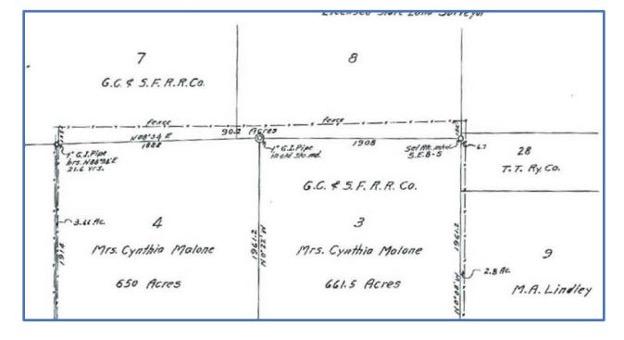
Boundary disputes are not new in Texas — we’ve had them since the days of the Republic. But buried deep in the Texas Property Code and Texas case law is a rarely-discussed doctrine that continues to quietly settle disputes all over the state:
The Doctrine of Agreed Boundaries
(An obscure but powerful rule affecting Texas landowners)
Most Texans assume their fence line marks their property line. But that’s often not true. And in some cases, a fence becomes the legal boundary even if it isn’t in the right spot — thanks to the obscure doctrine of “agreed boundaries.”
This is not explicitly laid out in one neat section of the Texas Property Code, but it arises from a mix of statutory principles and very old Texas common law that still applies. It is seldom taught and even more rarely raised in everyday real estate disputes.
What Is an Agreed Boundary?
An agreed boundary occurs when:
- Neighboring landowners are uncertain about the true property line,
- They mutually agree (explicitly or implicitly) on a line, often marked by a fence, tree line, or old road, and
- They both treat it as the boundary for a long period of time.
If those criteria are met, Texas courts may enforce this “agreed line” even if later surveys prove it wrong.
This principle is reinforced by Property Code concepts such as:
- § 22.001 – Trespass to Try Title, which recognizes possession claims,
- § 16.024 – Three-year statute of limitations on title disputes, and
- Adverse possession statutes (§ 16.025, § 16.026),
- Plus long-standing Texas common-law boundary doctrines.
In short: Texas courts hate boundary chaos. If neighbors settled their own disagreement decades ago, the law will usually respect it.
Why This Doctrine Exists
Texas is huge. Surveys were historically imprecise. Old Republic-era deeds can be vague (“to the big oak tree then down to the creek”). Over time, those natural markers disappear.
Courts created the doctrine so that:
- Neighbors don’t constantly resurvey land,
- Ranchers don’t have to fix fences after every survey change, and
- Land titles remain stable.
It’s a quiet doctrine… but massively important.
How It Works in Practice
1. Old fences may become the legal boundary.
If two ranch families accepted a fence line as the boundary for 30 years, the court can uphold that fence line even if it’s 15 feet off.
2. You cannot later “undo” an agreed line.
Once established by mutual agreement and long-term acceptance, you can’t just order a new survey and claim more land.
3. It can override a technically accurate survey.
This is the part most people find surprising. The survey shows one thing — but decades of neighborly conduct show another.
Texas courts have repeatedly held that conduct between landowners can define the boundary as reliably as a deed.
Why Many Lawyers Miss This Issue
Because it's not gathered neatly into a single statute, many attorneys overlook it and focus solely on:
- the deed descriptions,
- the survey, and
- the Texas Property Code’s adverse possession statutes.
But in quiet rural disputes — and even suburban fence fights — the “agreed boundary” doctrine can be the decisive issue.
Practical Advice for Texas Landowners
✔ If you’re buying rural property:
Ask how the current fence line was established. The “wrong” fence could be the real line.
✔ If you’re in a boundary dispute:
Investigate old maps, aerial photos, prior owners, and historical use. Evidence of long-term mutual acceptance is gold.
✔ If you’re a landlord or HOA:
Boundary issues can affect easements, setback enforcement, and common-area claims.
✔ If you're litigating:
Always check for historical acceptance before relying solely on a survey.
Conclusion
The Texas doctrine of agreed boundaries is one of the most obscure — but also one of the most practical — land-law doctrines still in force today. It reflects Texas’s frontier roots: neighbors settled boundaries through conduct, not paperwork.
And more often than people realize, Texas courts still honor those handshake boundaries today.
At David C. Barsalou, Attorney at Law, PLLC, we help clients navigate business, family, tax, estate planning, and real estate matters ranging from document drafting to litigation with clarity and confidence. If you’d like guidance on your situation, schedule a consultation today. Call us at (713) 397-4678, email barsalou.law@gmail.com, or reach us through our Contact Page. We’re here to help you take the next step.