Introduction
In modern litigation, especially in business disputes, construction cases, and financial matters, evidence is often overwhelming in volume. Thousands of pages of invoices, bank records, emails, or ledgers can make it impractical—if not impossible—for a judge or jury to meaningfully review the underlying documents.
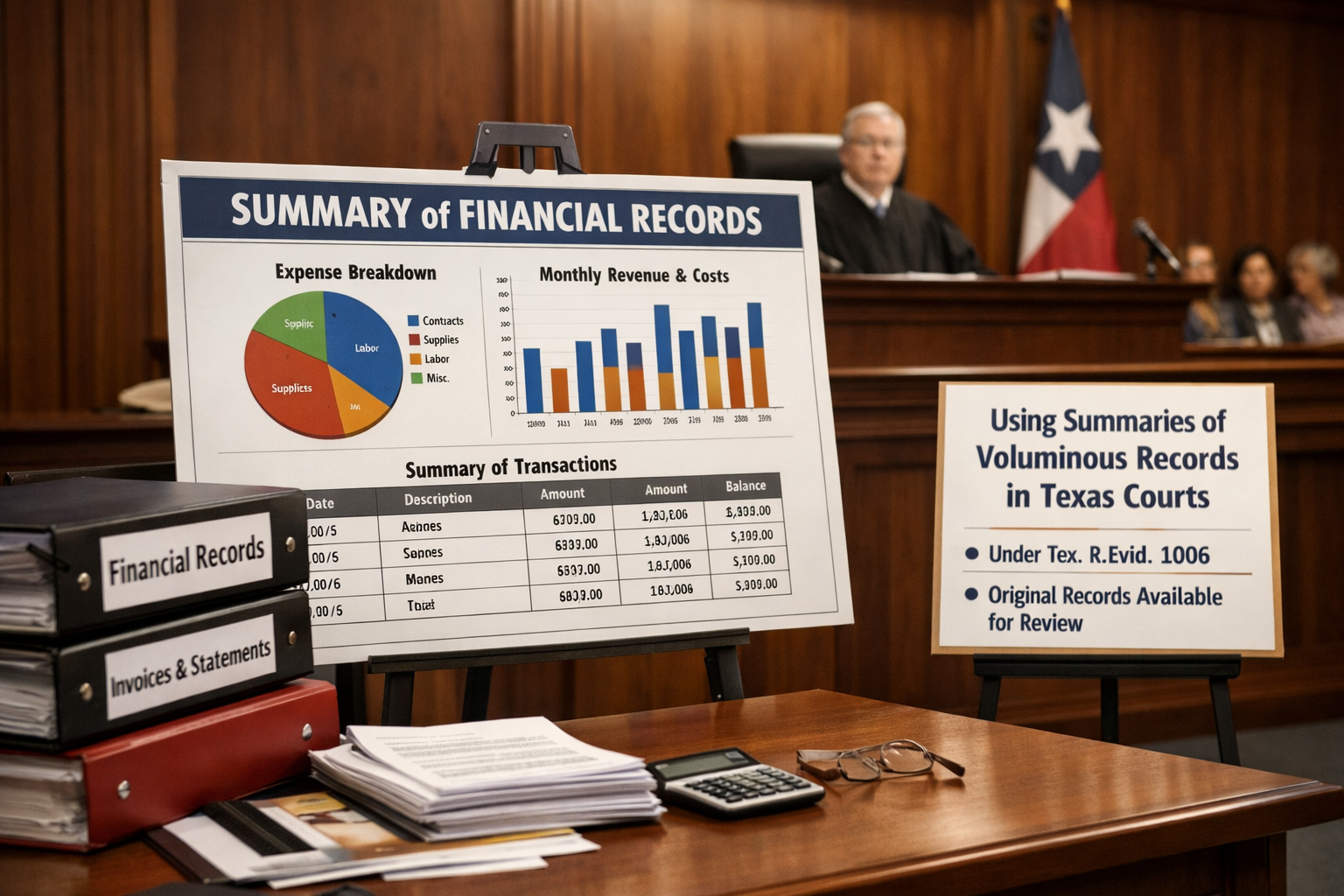
Texas law provides a powerful but underutilized solution: summaries of voluminous records under Texas Rule of Evidence 1006. When used correctly, this rule allows a party to present complex data in a simplified format while still complying with evidentiary requirements.
This article breaks down how TRE 1006 works, when it applies, and how to use it strategically in Texas litigation.
The Rule: Texas Rule of Evidence 1006
Texas Rule of Evidence 1006 provides:
“The proponent may use a summary, chart, or calculation to prove the content of voluminous writings, recordings, or photographs that cannot be conveniently examined in court.”
— Tex. R. Evid. 1006
The rule further requires:
“The proponent must make the originals or duplicates available for examination or copying… at a reasonable time and place.”
— Tex. R. Evid. 1006
When TRE 1006 Applies
To properly invoke Rule 1006, you must satisfy several key elements:
1. The Underlying Materials Must Be Voluminous
The rule is not for convenience—it is for necessity.
- Hundreds or thousands of pages
- Extensive financial records
- Large datasets (e.g., construction draws, HOA records, billing histories)
If the documents can reasonably be reviewed in court, the rule likely does not apply.
2. The Underlying Evidence Must Be Admissible
This is where many practitioners slip.
A summary does not cure inadmissibility. The underlying records must independently satisfy evidentiary rules, such as:
- Business records exception (TRE 803(6))
- Proper authentication (TRE 901 or 902)
If the underlying documents are inadmissible, the summary is inadmissible.
3. The Opposing Party Must Have Access
You must provide access to the underlying documents:
- Before trial
- At a reasonable time and place
- In a usable format
Failure to do so can result in exclusion of the summary.
Strategic Advantages of Rule 1006
1. Simplifying Complex Financial Evidence
In cases involving:
- Breach of contract damages
- Construction disputes
- HOA accounting issues
- Fraud tracing
A well-prepared summary can frame the narrative for the court.
2. Jury Persuasion
Jurors do not want to sift through thousands of pages. A clear chart or summary:
- Increases comprehension
- Enhances credibility
- Anchors damages calculations
3. Trial Efficiency
Judges appreciate efficiency. A Rule 1006 summary:
- Reduces trial time
- Minimizes confusion
- Avoids unnecessary evidentiary disputes mid-trial
Common Pitfalls
❌ Attempting to Sneak in Argument
A summary must be neutral and accurate, not argumentative.
Bad:
- “Defendant’s fraudulent overcharges totaling $250,000”
Better:
- “Summary of invoices and payments from Jan 2022–Dec 2023”
❌ Failing to Lay Proper Predicate
You still need a foundation witness who can testify:
- How the summary was prepared
- That it accurately reflects the underlying records
- That the records were made available
❌ Not Producing the Underlying Documents
If opposing counsel cannot verify your summary, expect exclusion.
Practical Litigation Strategy
Step 1: Build Your Summary Early
Don’t wait until trial. Use summaries:
- During discovery
- In mediation
- In summary judgment briefing
Step 2: Tie to Business Records Affidavits
Pair your summary with:
- TRE 803(6) affidavits
- Rule 902(10) self-authentication
This eliminates the need for live custodians.
Step 3: Use in Summary Judgment
Rule 1006 summaries can support dispositive motions when:
- The underlying records are properly authenticated
- The summary is accurate and supported
Step 4: Preempt Objections
Anticipate:
- “Incomplete summary” objections
- “Misleading presentation” arguments
Neutral formatting and full disclosure of records go a long way.
Case Law Insight (General Principle)
Texas courts consistently hold that:
- Rule 1006 summaries are admissible only if the underlying data is admissible and available
- Summaries cannot be used to circumvent hearsay rules
This reinforces that Rule 1006 is a procedural tool—not a substantive shortcut.
When Not to Use Rule 1006
Avoid relying on summaries when:
- The dataset is small
- The documents themselves are persuasive (e.g., key emails)
- You risk appearing to obscure unfavorable details
Sometimes the raw evidence tells a better story.
Conclusion
Texas Rule of Evidence 1006 is one of the most powerful tools available for handling complex evidence—but it requires precision.
When used correctly, it allows you to:
- Distill overwhelming data into a compelling narrative
- Improve judicial efficiency
- Strengthen your case at both summary judgment and trial
When used incorrectly, it can result in exclusion of critical evidence.
As with many procedural tools in Texas litigation, the advantage goes to the lawyer who prepares early and executes cleanly.
At David C. Barsalou, Attorney at Law, PLLC, we help clients navigate business, family, tax, estate planning, and real estate matters ranging from document drafting to litigation with clarity and confidence. If you’d like guidance on your situation, schedule a consultation today. Call us at (713) 397-4678, email barsalou.law@gmail.com, or reach us through our Contact Page. We’re here to help you take the next step.