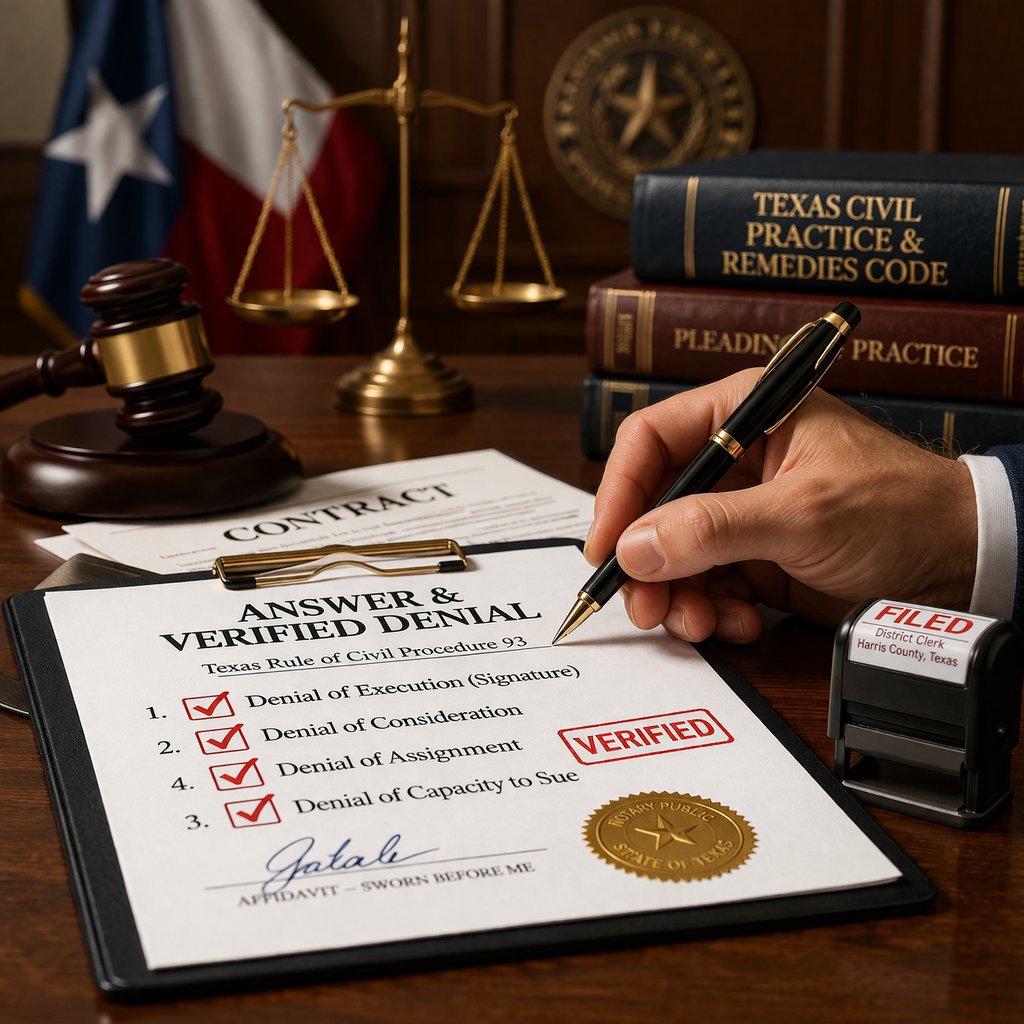
In Texas civil litigation, some defenses are so technical—and so easy to overlook—that they can decide a case before it truly begins. One of the most underappreciated procedural traps is the verified denial requirement under Texas Rule of Civil Procedure 93 (“TRCP 93”).
If you miss it, you may admit critical facts without realizing it. If you use it correctly, you can force the opposing party to actually prove their case.
This article explains what verified denials are, when they are required, and how they can make or break litigation in Texas courts.
What Is a Verified Denial?
A verified denial is a specific type of pleading that must be sworn to under oath. Unlike general denials, these target particular allegations that Texas law treats as admitted unless properly denied.
The rule is codified in TRCP 93, which provides:
“A pleading setting up any of the following matters, unless the truth of such matters appear of record, shall be verified by affidavit…”
— Tex. R. Civ. P. 93
In other words, if a defendant fails to verify certain denials, the court treats those facts as admitted—even if they are false.
When Is a Verified Denial Required?
TRCP 93 lists specific situations where a verified denial is mandatory. Some of the most important (and commonly litigated) include:
1. Denial of Capacity or Legal Existence
If you want to challenge whether a party has the legal capacity to sue or be sued (e.g., improper corporate status), you must verify it.
“That the plaintiff has not legal capacity to sue or that the defendant has not legal capacity to be sued…”
— Tex. R. Civ. P. 93(1)
2. Denial of Partnership or Corporate Status
If the plaintiff claims a partnership or corporate relationship, and you dispute it, you must file a verified denial.
“That any party alleged in any pleading to be a corporation is not incorporated as alleged…”
— Tex. R. Civ. P. 93(2)
3. Denial of Execution of a Written Instrument
This is one of the biggest landmines in Texas litigation.
If a plaintiff sues on a contract and you claim you didn’t sign it, you must file a verified denial.
“That the defendant did not execute the instrument sued upon…”
— Tex. R. Civ. P. 93(7)
If you fail to do so, the court will treat the signature as admitted—no proof required.
4. Denial of Consideration or Failure of Consideration
If you argue that a contract lacks consideration, that also requires verification.
“That there was no consideration for the contract…”
— Tex. R. Civ. P. 93(9)
5. Denial of Assignment
If a plaintiff claims they were assigned a contract or debt, and you dispute that, you must verify your denial.
“That a written instrument upon which a pleading is founded is without consideration, or that the consideration of the same has failed…”
— Tex. R. Civ. P. 93(9)
Why Verified Denials Matter So Much
1. Failure = Admission
Texas courts strictly enforce TRCP 93. If a verified denial is required and not filed:
- The issue is waived
- The fact is treated as admitted
- The opposing party does not need to prove it
This can be devastating in contract and debt cases.
2. Common in Debt Collection and Business Litigation
Verified denials frequently arise in:
- Suits on sworn account
- Promissory note enforcement
- Contract disputes
- Business entity disputes
In these cases, failing to verify can effectively hand the plaintiff a win.
3. Interacts with Other Procedural Rules
Verified denials often work alongside:
- TRCP 185 (Suit on Sworn Account)
- TRCP 166a (Summary Judgment)
If you fail to verify a denial, the plaintiff may use that omission to support a summary judgment, arguing there is no genuine issue of material fact.
Practical Litigation Strategy
For Plaintiffs
- Look for missing verified denials early
- Use them to:
- Narrow issues
- Support summary judgment
- Avoid unnecessary proof
For Defendants
- Treat TRCP 93 like a checklist
- If you’re disputing:
- Signature
- Capacity
- Assignment
- Consideration
👉 Verify it. Always.
What Does “Verified” Actually Mean?
A verified pleading must include an affidavit stating that the facts are true, typically:
- Signed by the party (or authorized representative)
- Sworn before a notary
- Based on personal knowledge
A defective or missing verification can be just as harmful as not filing one at all.
Real-World Example
Imagine a plaintiff sues on a promissory note. The defendant files a general denial but does not verify that they didn’t sign the note.
At trial—or even at summary judgment—the court may treat the signature as conclusively established. The defendant has effectively lost that issue without ever presenting evidence.
Why This Topic Matters
Verified denials are a perfect example of how Texas civil procedure rewards precision.
They are not flashy. They are not intuitive. But they are incredibly powerful.
For lawyers, they represent:
- A way to win cases early
- A trap that can destroy otherwise valid defenses
- A reminder that procedure is substance in Texas law
Final Thoughts
If you practice in Texas courts, TRCP 93 is not optional knowledge—it is essential.
The difference between a verified and unverified denial can determine whether your client gets their day in court—or loses before the case really begins.
At David C. Barsalou, Attorney at Law, PLLC, we help clients navigate business, family, tax, estate planning, and real estate matters ranging from document drafting to litigation with clarity and confidence. If you’d like guidance on your situation, schedule a consultation today. Call us at (713) 397-4678, email barsalou.law@gmail.com, or reach us through our Contact Page. We’re here to help you take the next step.