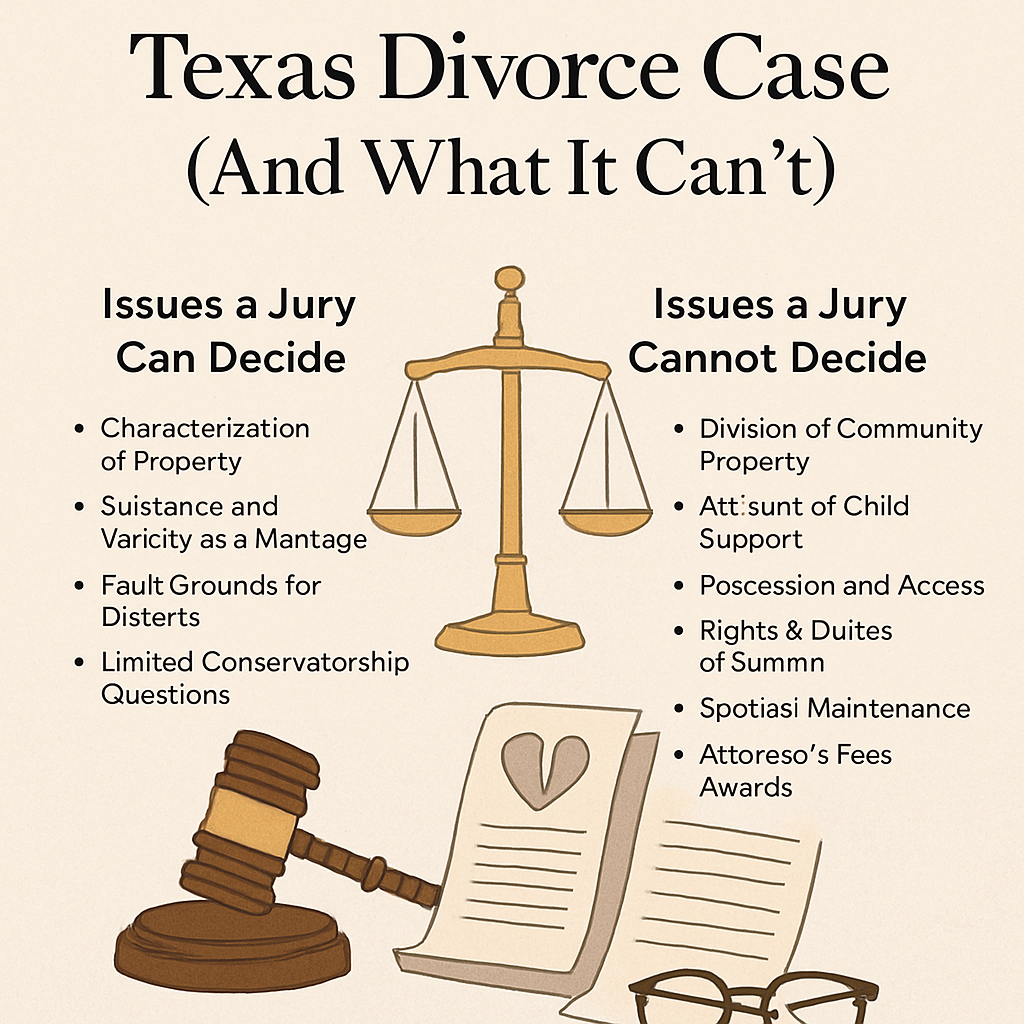
Understanding the surprising limits of jury trials in family law
Most Texans are surprised to learn that you canrequest a jury trial in a divorce, but that does not mean a jury will decide everything. In fact, under the Texas Family Code, a jury’s authority is very limited. While juries play a meaningful role on certain fact-intensive or rights-defining questions, the judge retains control over virtually all issues involving children and property division.
If you are considering a jury trial—or facing a spouse who has demanded one—here is a clear breakdown of what a jury can and cannot determine in a Texas divorce.
Why Request a Jury Trial at All?
A jury can be strategically powerful. Certain issues may benefit a spouse who wants community sentiment or outside perspective—especially in cases involving:
- Family violence
- Fault-based divorce grounds
- Characterization of property (separate vs. community)
- Who should have the right to decide where the child lives
But the jury’s authority stops at fact-finding. The judge still applies the law, enters the divorce decree, and manages all discretionary decisions.
Issues a Jury Can Decide in a Texas Divorce
Texas Family Code §§ 6.703, 105.002 set out a detailed list of the permissible jury questions in divorce and custody actions. They fall into two broad categories: property/grounds issues and limited conservatorship determinations.
1. Characterization of Property
A jury may decide whether an asset is:
- Separate property, or
- Community property
This is often crucial because separate property cannot be awarded to the other spouse.
Examples where jury findings matter:
- Whether a premarital home appreciated due to community or separate efforts
- Whether an inheritance was commingled
- Whether a spouse’s bank account is truly separate property
However, even after the jury decides characterization, the judge—not the jury—divides the community estate.
2. The Existence and Validity of a Marriage
A jury may resolve:
- Whether a common-law marriage existed
- Whether a marriage is void due to bigamy, incapacity, fraud, or other statutory grounds
- Whether a marriage was informal or ceremonial
Again, the judge handles the legal effect; the jury only addresses factual determinations.
3. Fault Grounds for Divorce
If alleged, the jury may decide whether one spouse committed:
- Adultery
- Cruelty
- Abandonment
- Confinement in a mental hospital
- Felony conviction
These findings can heavily influence the judge’s property division under “just and right” principles.
4. Limited Questions Regarding Conservatorship (Child-Related Issues)
This is the area most people misunderstand. A jury cannotdecide most child-related matters—but it can decide two very specific issues:
A. Who has the exclusive right to designate the primary residence of the child
This includes the option to say:
- Parent A chooses residence, or
- Parent B chooses residence, or
- Neither parent may designate a residence (i.e., geographic restriction)
B. Whether a geographic restriction applies
Example: Should the child’s residence be restricted to Harris County or can the custodial parent move?
Important: Even if the jury decides who gets the right, the judge will still decide:
- The possession schedule
- Rights and duties other than primary residence
- Child support
- All enforcement and modification issues
Issues a Jury Cannot Decide in a Texas Divorce
This list is even more important for clients to understand. Regardless of a jury request, the following remain exclusively with the judge:
❌ Division of community property
The judge makes the “just and right” division—even if the jury decides what property is community.
❌ Amount of child support
❌ Possession and access (visitation schedule)
❌ Most rights & duties of parents
Decision-making authority, medical decisions, education, etc.
❌ Spousal maintenance
The judge determines whether maintenance is available and how much.
❌ Attorney’s fees awards
❌ Protective orders
The rationale: The Texas Legislature strictly limits jury involvement because the judge is viewed as the party best situated to craft a stable long-term plan for children and property division.
Strategic Considerations: When Is a Jury Trial Worth It?
A jury trial may be advantageous when:
- You have strong fault evidence (adultery, family violence, cruelty)
- The other spouse has credibility issues better highlighted before laypeople
- Asset characterization is hotly contested
- You want a jury’s perspective on who should designate the child’s residence
A jury trial may not be ideal when:
- You want to minimize litigation costs
- The contested issues fall entirely within matters a judge must decide
- The facts are highly technical (valuation, tracing) and better suited to a bench trial
Conclusion
A Texas divorce jury has real but limited power. It can answer important factual questions—such as property characterization, fault grounds, and which parent determines the child’s residence—but the judge controls all discretionary decisions, including property division, possession schedules, and financial orders.
Understanding what a jury can (and cannot) decide is essential when evaluating whether requesting a jury trial is a smart strategic move in your divorce case.
If you have questions about jury strategy or are considering demanding a jury in your Texas divorce, Barsalou-Law can help you evaluate the benefits, risks, and costs with precision.
At David C. Barsalou, Attorney at Law, PLLC, we help clients navigate business, family, tax, estate planning, and real estate matters ranging from document drafting to litigation with clarity and confidence. If you’d like guidance on your situation, schedule a consultation today. Call us at (713) 397-4678, email barsalou.law@gmail.com, or reach us through our Contact Page. We’re here to help you take the next step.