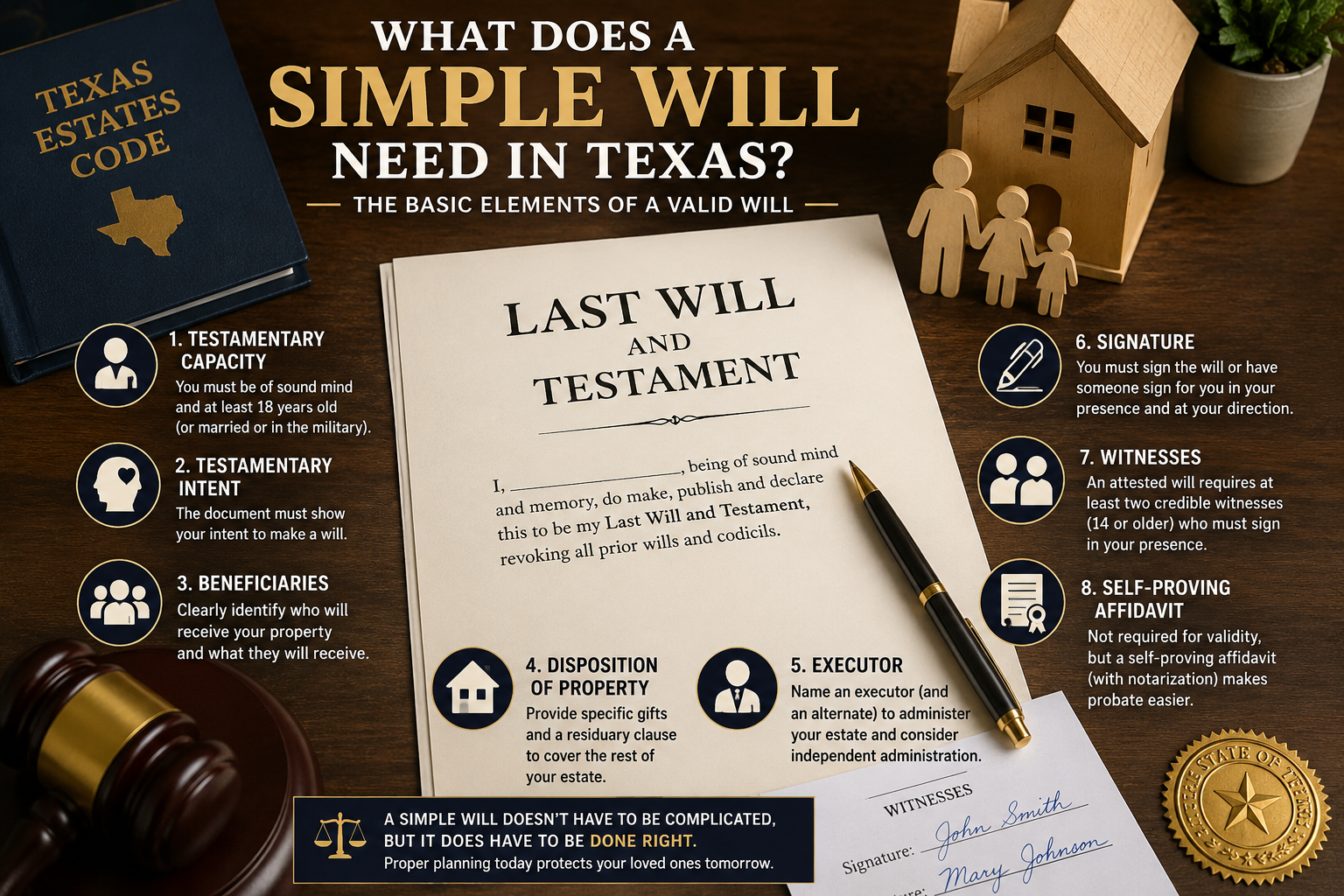
Estate planning can become complicated.
Some estates involve trusts, business interests, blended families, substantial tax issues, property in several states, complicated beneficiary arrangements, or other circumstances requiring careful planning.
But many people have much simpler objectives.
A person may simply want to leave property to a spouse or children, designate someone to administer the estate, and provide clear instructions about what should happen after death.
In those situations, a relatively simple will may be entirely appropriate.
But simplicity does not mean that anything written on a piece of paper will necessarily accomplish what the person intended.
Texas law imposes certain requirements for creating a valid will. A well-drafted will also usually contains provisions that are not strictly necessary to create a will but can make administering the estate substantially easier.
Understanding the difference can help explain what a simple Texas will actually needs to accomplish.
Who Can Make a Will in Texas?
Texas Estates Code § 251.001 provides that a person of sound mind may make a will if, when the will is made, the person:
- is at least 18 years old;
- is or has been married; or
- is a member of the United States armed forces, an auxiliary of the armed forces, or the United States Maritime Service.
Accordingly, adulthood is not the only possible basis for testamentary capacity under Texas law. (Texas Constitution and Statutes)
The requirement that the testator—the person making the will—be of sound mind is particularly important.
A will can later become the subject of litigation if someone alleges that the testator lacked testamentary capacity when the will was executed.
The relevant question is not simply whether the person was elderly, ill, forgetful, or had received a particular medical diagnosis. The issue is whether the person possessed the legally required capacity when the will was made.
A Will Must Actually Be Intended as a Will
A valid will is a testamentary instrument.
In other words, the document must reflect an intention to dispose of property or otherwise direct what will happen upon the person's death.
This distinction can become important when families discover informal notes, letters, lists, or other writings after someone dies.
Merely writing something about property does not necessarily make the document a will.
A properly drafted simple will therefore ordinarily makes its purpose unmistakable. It identifies the person making the document and states that the instrument constitutes that person's last will and testament.
What Property Should the Will Dispose Of?
One of the central functions of a will is to determine who receives the testator's property.
A simple will might contain specific gifts, such as leaving a particular item or piece of property to a particular beneficiary.
But one of its most important provisions is usually the residuary clause.
The residuary estate generally consists of property remaining after payment of enforceable obligations and expenses and after any specific gifts have been addressed.
For example, a simple will might provide that the remainder of the testator's estate passes to the testator's spouse and, if the spouse does not survive, to the testator's descendants.
A residuary clause helps prevent property from being unintentionally omitted from the testamentary plan.
Without an effective disposition of particular property, that property may instead pass under Texas intestacy law.
A Will Should Clearly Identify the Beneficiaries
A simple will should make clear who receives the property.
That sounds obvious, but ambiguity can create substantial problems.
A beneficiary can generally be identified by name and relationship to the testator. The will can also address what happens if the beneficiary dies before the testator.
Texas has statutory rules that can sometimes save gifts when beneficiaries predecease a testator, but careful drafting can reduce the need to determine whether those default rules apply.
A simple will therefore often answers two questions:
Who receives the property first?
And:
Who receives it if that person is no longer alive?
Those two questions can prevent a surprisingly large number of future problems.
A Simple Will Should Name an Executor
The executor is the person responsible for administering the estate after the testator dies and the will is admitted to probate.
Depending upon the estate, the executor's responsibilities may include identifying property, dealing with creditors, handling estate funds, selling property when appropriate, addressing taxes, and ultimately distributing the estate to the beneficiaries.
A well-drafted will usually names both a primary executor and at least one alternate in case the first choice cannot or will not serve.
Texas also permits independent administration, which can substantially reduce the degree of continuing court supervision involved in administering an estate.
For that reason, a conventional Texas will commonly provides for an independent executor and requests that the executor serve without bond to the extent permitted by law.
These provisions are not merely decorative boilerplate. They can materially affect the cost and inconvenience of probate.
Does a Texas Will Have to Be in Writing?
Generally, yes.
Texas Estates Code § 251.051 provides that, except as otherwise provided by law, a will must be:
- in writing;
- signed by the testator, or by another person acting for the testator in the testator's presence and under the testator's direction; and
- attested by at least two credible witnesses who are at least 14 years old and who sign the will in their own handwriting in the testator's presence. (Texas Constitution and Statutes)
These execution requirements are enormously important.
A beautifully drafted document that accurately expresses someone's wishes can create serious probate problems if it was not properly executed.
Does a Texas Will Need Two Witnesses?
An ordinary attested Texas will generally does.
Under § 251.051, there must be at least two credible witnesses who are at least 14 years old, and the witnesses must subscribe their names to the will in their own handwriting in the testator's presence. (Texas Constitution and Statutes)
This is one reason casually signing a downloaded will without understanding the execution requirements can be dangerous.
The words in the document matter.
But so does the manner in which the document is executed.
What About a Handwritten Will?
Texas recognizes an important exception for holographic wills.
Under Texas Estates Code § 251.052, a will written wholly in the testator's handwriting does not have to be attested by subscribing witnesses. (Texas Constitution and Statutes)
That can make holographic wills surprisingly powerful.
A person does not necessarily need a computer, elaborate form, witnesses, or pages of legal terminology to create a testamentary instrument capable of being admitted to probate.
But the apparent simplicity of holographic wills can create other problems.
The meaning of the handwriting may be ambiguous. Property may be omitted. Beneficiaries may not be adequately identified. There may be uncertainty about whether the writing was actually intended to operate as a will. And the document may lack administrative provisions that would have made probate easier.
So the fact that Texas recognizes handwritten wills does not mean that writing one's wishes on a piece of paper is always good estate planning.
Does a Texas Will Have to Be Notarized?
This is one of the most common sources of confusion.
Notarization and validity are not the same thing.
The basic execution requirements for an ordinary attested will under § 251.051 concern writing, signature, and witnesses. The statute does not make notarization one of those basic requirements. (Texas Constitution and Statutes)
However, notarization becomes highly relevant to a self-proved will.
Texas law allows wills to be made self-proved through procedures established by the Estates Code. A self-proved will can simplify the eventual probate process because additional proof concerning proper execution ordinarily is not required in the same manner. (Texas Constitution and Statutes)
Thus, saying that a Texas will "must be notarized" is generally inaccurate.
A better distinction is:
Witnessing can be necessary to validity for an ordinary attested will. Self-proving procedures make proving the will after death easier.
Those are different concepts.
What Is a Self-Proving Affidavit?
A self-proving affidavit is an estate-planning tool designed to make the will easier to probate later.
Rather than requiring the estate to locate witnesses years or decades after execution and establish the necessary facts concerning execution, a properly self-proved will provides evidence satisfying those requirements in advance.
That can be particularly valuable because witnesses move, die, forget circumstances, or simply become difficult to locate.
A simple will intended to remain effective for decades should therefore ordinarily address not merely whether the will is technically valid today, but whether the executor will be able to prove it efficiently years from now.
Should a Will Name a Guardian for Minor Children?
For parents of minor children, a will may also contain provisions concerning guardianship.
Property and guardianship are separate issues, but the will provides an important opportunity for a parent to state whom the parent wants to serve if a guardian becomes necessary.
Parents may also need to consider whether leaving substantial property outright to minor children is appropriate.
A supposedly "simple" estate can become less simple when young children are beneficiaries because minors cannot necessarily receive and manage property in the same manner as competent adults.
In those circumstances, testamentary trusts or other planning devices may become appropriate.
Does a Simple Will Need a Long List of Legal Powers?
Not necessarily.
Modern wills sometimes contain pages of provisions giving executors authority to sell property, settle claims, operate businesses, manage investments, distribute property, employ professionals, and perform other administrative acts.
Some of these provisions may be useful.
But the length of a will is not a measure of its quality.
A person with a modest and uncomplicated estate does not necessarily need an enormous document filled with provisions addressing situations that are extraordinarily unlikely ever to occur.
The objective should be to create a document sufficiently complete to accomplish the testator's objectives while avoiding unnecessary complexity.
A Will Does Not Control Everything You Own
Another important limitation is that a will does not necessarily control every asset associated with a deceased person.
Some property may pass outside probate.
Examples can include property governed by:
- valid beneficiary designations;
- payable-on-death arrangements;
- certain survivorship agreements;
- transfer-on-death deeds; or
- other nonprobate transfer mechanisms.
Consequently, drafting a will without considering how major assets are titled can produce unexpected results.
A will may say one thing while a valid beneficiary designation causes a particular asset to pass somewhere else.
Good estate planning therefore requires looking beyond the four corners of the will.
What Does a Very Simple Texas Will Usually Accomplish?
For someone with an uncomplicated estate, the conceptual structure can actually be remarkably straightforward.
The will identifies the testator, revokes prior wills, identifies the intended beneficiaries, disposes of the estate, addresses what happens if a beneficiary dies first, appoints an executor and alternate executor, provides appropriate administrative authority, and is properly executed.
Additional provisions can be added when the person's circumstances require them.
The legal sophistication lies less in making the document long than in recognizing which complications actually matter for that particular person.
Simple Does Not Mean Careless
There is nothing inherently superior about complicated estate planning.
For many Texans, the appropriate estate plan may genuinely be quite simple.
But simplicity works only when the document clearly expresses the testator's wishes and satisfies Texas law.
A defective 40-page will is not better than a properly prepared five-page will merely because it contains more words.
Likewise, an informal document that appears obvious to the person writing it may become considerably less obvious when that person is no longer available to explain what was intended.
That is the peculiar difficulty of wills.
By the time a will matters, its author cannot clarify it.
The document therefore needs to speak clearly for itself.
Conclusion
A simple Texas will does not necessarily require complicated tax planning, elaborate trusts, or dozens of pages of legal language.
At its core, a will should clearly establish that the testator intends the document to operate as a will, identify who should receive the estate, provide workable instructions for administration, and comply with Texas execution requirements.
For an ordinary attested will, Texas law generally requires a writing signed by the testator—or properly signed for the testator—and attested by at least two qualifying witnesses. Texas also recognizes holographic wills written wholly in the testator's handwriting, which do not require subscribing witnesses. (Texas Constitution and Statutes)
Beyond those basic validity requirements, careful drafting can make an enormous practical difference. Naming alternate beneficiaries and executors, addressing independent administration, properly disposing of the residuary estate, and making the will self-proved can help transform a technically valid document into an estate plan that actually works.
For many people, that is exactly what a simple will should do.
At David C. Barsalou, Attorney at Law, PLLC, we help clients navigate business, family, tax, estate planning, and real estate matters ranging from document drafting to litigation with clarity and confidence. If you’d like guidance on your situation, schedule a consultation today. Call us at (713) 397-4678, email barsalou.law@gmail.com, or reach us through our Contact Page. We’re here to help you take the next step.
