Most consumers have agreed to arbitration at some point in their lives, whether they realized it or not.
Arbitration clauses appear in credit card agreements, cellular telephone contracts, automobile financing documents, employment agreements, subscription services, and countless online transactions. They are frequently buried among pages of contractual language that consumers are unlikely to read carefully.
Yet these provisions can fundamentally change what happens when a consumer believes a business has acted unlawfully.
An arbitration clause may prevent a consumer from bringing an otherwise valid lawsuit before a judge or jury, requiring the dispute to be resolved through a private proceeding instead.
That does not necessarily mean the consumer loses the right to recover damages. It means the consumer may have agreed to pursue those damages through an entirely different legal process.
Understanding that distinction is important because arbitration can offer genuine advantages while also imposing substantial limitations.
1. What Is an Arbitration Clause?
An arbitration clause is a contractual provision requiring specified disputes between the parties to be resolved through arbitration rather than ordinary litigation.
In a traditional lawsuit, a party files a petition or complaint in court. The parties conduct discovery, present evidence, and ultimately receive a decision from a judge or jury.
Arbitration operates differently.
Rather than having a judge or jury decide the dispute, the parties present their claims to a private decision-maker known as an arbitrator.
Depending on the agreement, the arbitration may be administered by an organization such as the American Arbitration Association (AAA) or JAMS, or conducted through another agreed procedure.
The arbitrator considers the evidence, applies the governing law, and ordinarily issues a binding decision called an arbitration award.
That award can generally be enforced through the courts.
Consequently, arbitration is not simply an informal negotiation or mediation session. It can produce a legally enforceable result.
2. Can a Consumer Be Forced Into Arbitration?
Generally, yes, if the consumer entered into a valid, enforceable arbitration agreement covering the dispute.
The Federal Arbitration Act (FAA), codified at 9 U.S.C. §§ 1–16, establishes a strong federal framework for enforcing arbitration agreements involving interstate commerce.
Under 9 U.S.C. § 2, qualifying written arbitration agreements are generally enforceable, subject to ordinary contract defenses and applicable statutory exceptions.
Texas also has its own arbitration statute, the Texas General Arbitration Act, found in Chapter 171 of the Texas Civil Practice and Remedies Code.
However, the relationship between federal and state arbitration law is important.
For example, Texas Civil Practice and Remedies Code § 171.002 contains special limitations concerning certain consumer transactions involving consideration of $50,000 or less and certain personal injury claims.
Those limitations do not necessarily defeat an arbitration agreement governed by the FAA. Federal law may independently require enforcement even when the Texas statute does not apply.
Therefore, a consumer cannot assume that a relatively small transaction is exempt from arbitration.
3. What Rights Does a Consumer Actually Give Up?
An arbitration agreement ordinarily changes the forum and procedures used to resolve a dispute rather than automatically eliminating the underlying legal claim.
Nevertheless, several important litigation rights may be affected.
The Right to a Jury Trial
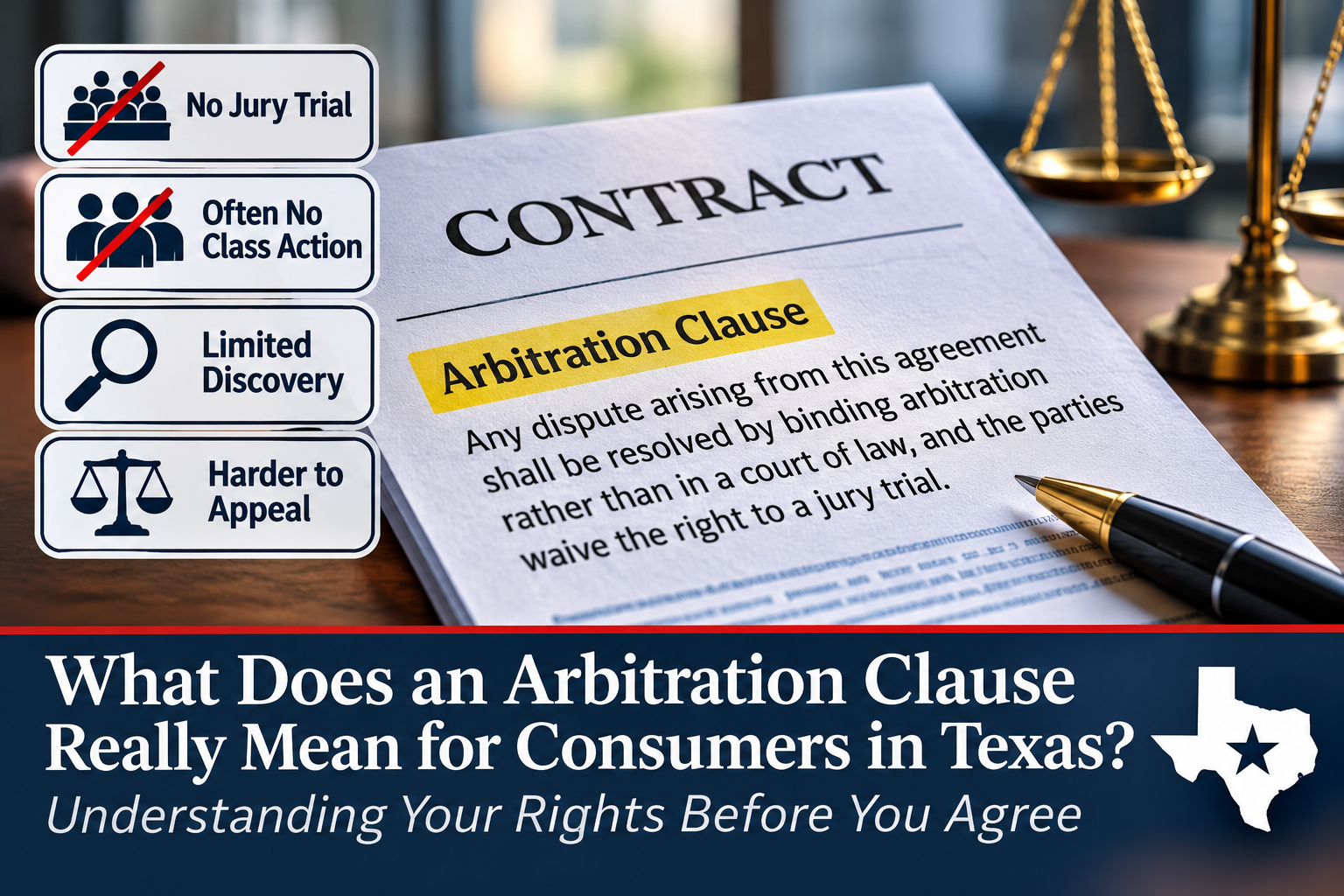
Perhaps the most significant consequence is that covered disputes generally will not be decided by a jury.
In ordinary civil litigation, a party may be entitled to request a jury trial when the applicable legal requirements are satisfied.
In arbitration, the arbitrator decides the dispute.
For consumers who believe their case would be particularly compelling to a jury, this difference may be significant.
The Right to Ordinary Court Discovery
Civil litigation ordinarily provides mechanisms for obtaining documents, taking depositions, serving interrogatories, and requesting admissions.
Texas litigants are familiar with discovery under the Texas Rules of Civil Procedure.
Arbitration may permit discovery, but its scope depends on the arbitration agreement, governing rules, applicable law, and arbitrator's orders.
Some proceedings allow substantial discovery. Others sharply limit depositions, document requests, or other investigative procedures.
This distinction can matter when the evidence necessary to prove a claim is primarily in the business's possession.
The Right to Broad Appellate Review
A party dissatisfied with a trial court judgment may have access to appellate review, subject to applicable rules and deadlines.
Arbitration awards are considerably more difficult to overturn.
Under the FAA, courts may vacate arbitration awards on limited statutory grounds, including certain forms of corruption, evident partiality, serious procedural misconduct, or an arbitrator exceeding authorized powers.
A disagreement with the arbitrator's factual findings or interpretation of the law ordinarily is not enough.
A consumer can lose an arbitration because of what the consumer believes is a serious legal mistake and still have very limited recourse.
That is one of the most consequential differences between arbitration and litigation.
4. Can an Arbitration Clause Prevent a Class Action Lawsuit?
Yes. Many consumer arbitration agreements contain class-action waivers requiring disputes to be pursued individually.
Consider a company that improperly charges 100,000 customers an additional $20.
The total disputed amount is $2 million, but each consumer's individual loss is relatively small.
A class action may permit those claims to be aggregated into a single proceeding, subject to the requirements for class certification.
An arbitration agreement containing an enforceable class-action waiver may instead require each consumer to pursue an individual claim.
The United States Supreme Court addressed this issue in AT&T Mobility LLC v. Concepcion, 563 U.S. 333 (2011).
The Court held that the FAA preempted a California rule that would have invalidated certain class-action waivers in consumer arbitration agreements.
The practical consequence is substantial.
When the value of an individual claim is small, pursuing arbitration may not seem worthwhile, even if the consumer has a legitimate grievance.
That does not make every class-action waiver enforceable under every circumstance. However, consumers should understand that these provisions can substantially limit collective litigation.
5. Is Arbitration Always Better for Businesses?
Not necessarily.
Businesses frequently prefer arbitration because it can provide procedural flexibility, reduce certain litigation expenses, and avoid jury trials.
Arbitration may also provide greater privacy than public court proceedings, although confidentiality is not automatic and depends on the applicable rules and agreements.
Nevertheless, arbitration can create disadvantages for businesses.
Arbitrator compensation and administrative fees may be substantial. Certain consumer arbitration programs require businesses to bear most administrative costs.
Additionally, some businesses have faced coordinated filings of numerous individual arbitration demands.
Where thousands of consumers pursue separate claims, the combined administrative burden may be considerable.
A contractual provision designed to avoid class litigation can therefore create substantial costs of its own.
Arbitration is not necessarily inexpensive, and it is not invariably favorable to the party that drafted the agreement.
6. Can a Consumer Challenge an Arbitration Clause?
Yes.
An arbitration agreement is a contract, and its enforceability may be challenged on legally recognized grounds.
Potential issues include:
- Lack of agreement: The consumer never actually agreed to the arbitration provision.
- Unconscionability: The agreement or its terms are so unfair under applicable law that enforcement is improper.
- Fraud or duress: The agreement was obtained through conduct sufficient to invalidate contractual consent.
- Scope: The particular dispute falls outside the arbitration clause.
- Waiver or default: A party's conduct may have relinquished its right to insist on arbitration.
- Statutory exceptions: Certain disputes may be protected from predispute arbitration requirements by federal law.
However, these arguments are highly fact-dependent.
A consumer's failure to read a contract generally does not, standing alone, invalidate the agreement.
Similarly, the fact that a business drafted the agreement or presented it on a take-it-or-leave-it basis does not automatically render the arbitration clause unenforceable.
Courts also distinguish challenges to the arbitration agreement itself from challenges to the broader contract.
In some circumstances, the arbitrator rather than the court may be authorized to decide particular questions of arbitrability.
Consequently, challenging arbitration requires careful attention to the contract language, the governing law, and the nature of the objection.
7. What Happens If a Consumer Files a Lawsuit Despite an Arbitration Clause?
Suppose a Texas consumer purchases an expensive appliance that repeatedly malfunctions.
The consumer believes the seller misrepresented the appliance's quality and files a lawsuit asserting breach of warranty and potentially violations of the Texas Deceptive Trade Practices–Consumer Protection Act.
The seller responds by filing a motion to compel arbitration.
The court must determine the relevant questions concerning the existence and enforceability of the arbitration agreement and whether the dispute falls within its scope, except to the extent a valid delegation provision assigns particular questions to the arbitrator.
If the dispute is subject to enforceable arbitration requirements, the court may compel arbitration and stay the judicial proceedings.
The consumer may then have to pursue the dispute through the contractually specified arbitration process.
Importantly, the consumer's substantive claims do not necessarily disappear.
The consumer may still pursue legally available damages, attorney's fees, or other remedies, depending on the claims and enforceable contractual provisions.
The critical difference is where and how those claims must be presented.
8. Can Arbitration Clauses Eliminate Consumer Protection Laws?
Generally, arbitration agreements cannot simply erase substantive statutory rights.
For example, a consumer with a valid claim under the Texas Deceptive Trade Practices Act does not automatically lose that claim merely because the parties agreed to arbitration.
The consumer may instead be required to present the DTPA claim to an arbitrator.
The distinction between procedural and substantive rights is important.
A business may be able to require arbitration while remaining subject to the underlying laws governing its conduct.
However, agreements sometimes contain additional provisions addressing damage limitations, attorney's fees, filing deadlines, or available remedies.
Those provisions must be evaluated separately.
An arbitration clause should not be confused with a complete release of liability.
9. Are There Disputes That Cannot Be Forced Into Predispute Arbitration?
Yes. Federal law recognizes important exceptions.
For example, the Ending Forced Arbitration of Sexual Assault and Sexual Harassment Act of 2021, codified at 9 U.S.C. §§ 401–402, generally allows a person alleging a covered sexual assault or sexual harassment dispute to elect not to be bound by a predispute arbitration agreement or joint-action waiver with respect to that dispute.
Other federal statutes may impose additional limitations in particular contexts.
These protections illustrate that the enforceability of arbitration agreements is not unlimited.
The type of claim matters, and consumers should not assume every dispute is automatically subject to arbitration merely because an agreement contains an arbitration provision.
10. What Should Consumers Look for Before Signing?
Consumers reviewing contracts should pay particular attention to provisions titled "Arbitration," "Dispute Resolution," "Binding Arbitration," or "Waiver of Jury Trial."
Several questions deserve consideration.
Who selects the arbitrator?
The agreement may identify an arbitration organization or establish a selection procedure.
Where must the arbitration take place?
An agreement requiring proceedings in a distant location may impose practical burdens, although applicable law or consumer arbitration rules may limit such requirements.
Who pays the arbitration fees?
Filing fees, administrative expenses, and arbitrator compensation can affect the practical cost of pursuing a claim.
Is there a class-action waiver?
The consumer may be required to pursue claims individually.
Is there an opt-out provision?
Some agreements permit consumers to reject arbitration by sending written notice within a specified period.
What claims are covered?
Some provisions apply only to disputes arising directly from the contract. Others use broader language.
Does the agreement permit small claims court proceedings?
Certain consumer agreements expressly preserve access to small claims court for qualifying disputes.
Reading these provisions before a dispute arises may be considerably easier than challenging them after litigation has begun.
11. Is Arbitration Actually Fair to Consumers?
The answer depends on the particular agreement and dispute.
Arbitration can offer legitimate advantages.
Proceedings may be faster, more flexible, and less formal than litigation. Consumers may benefit from simplified procedures and lower filing costs under certain arbitration programs.
At the same time, arbitration may restrict discovery, eliminate jury trials, limit appellate review, and prevent collective litigation.
These limitations may be especially important where a consumer is pursuing a complicated claim against a business possessing most of the relevant evidence.
The fundamental concern is not necessarily that arbitrators are biased or that arbitration always produces unfair results.
Rather, the consumer may have agreed to an entirely different system of dispute resolution without understanding the practical consequences.
And once a dispute arises, the opportunity to negotiate those procedures may have passed.
12. Can a Texas Attorney Help With an Arbitration Dispute?
Yes.
An attorney can review the agreement, determine whether arbitration is required, evaluate possible challenges to enforceability, and represent the consumer in arbitration or related court proceedings.
Legal assistance may also be important when the business seeks to compel arbitration after a lawsuit has already been filed.
In some cases, the central dispute concerns whether the arbitration clause is enforceable.
In others, the arbitration requirement is clear, and the more important task is preparing and presenting the underlying claim effectively.
Consumers should also recognize that arbitration proceedings can involve significant legal work, particularly where complicated contractual, statutory, or evidentiary issues are involved.
Conclusion: An Arbitration Clause Is More Than Fine Print
Arbitration clauses are among the most consequential provisions in modern consumer contracts.
They may determine whether a dispute is heard by a judge, jury, or private arbitrator; how evidence is obtained; whether claims may be pursued collectively; and how difficult it will be to challenge an unfavorable decision.
Arbitration is not inherently improper, and it can provide an efficient means of resolving legitimate disputes.
But consumers should understand that agreeing to arbitration is a meaningful legal decision, even when the provision appears in a routine online transaction or standard-form contract.
The right to pursue a claim and the right to pursue that claim in court are not necessarily the same thing.
Understanding that difference can help Texas consumers make informed decisions before signing an agreement and evaluate their options when a dispute arises.
Speak With a Texas Civil Litigation Attorney
If you are involved in a consumer dispute, have been presented with an arbitration agreement, or are facing a motion to compel arbitration, David C. Barsalou, Attorney at Law, PLLC, can assist in evaluating the contractual provisions and applicable Texas and federal law.
Visit barsalou-law.com to learn more about the firm's civil litigation and contract dispute services.
Disclaimer: This article provides general legal information and does not constitute legal advice. The enforceability of an arbitration agreement depends on its specific language, the underlying dispute, and applicable law.
At David C. Barsalou, Attorney at Law, PLLC, we help clients navigate business, family, tax, estate planning, and real estate matters ranging from document drafting to litigation with clarity and confidence. If you’d like guidance on your situation, schedule a consultation today. Call us at (713) 397-4678, email barsalou.law@gmail.com, or reach us through our Contact Page. We’re here to help you take the next step.