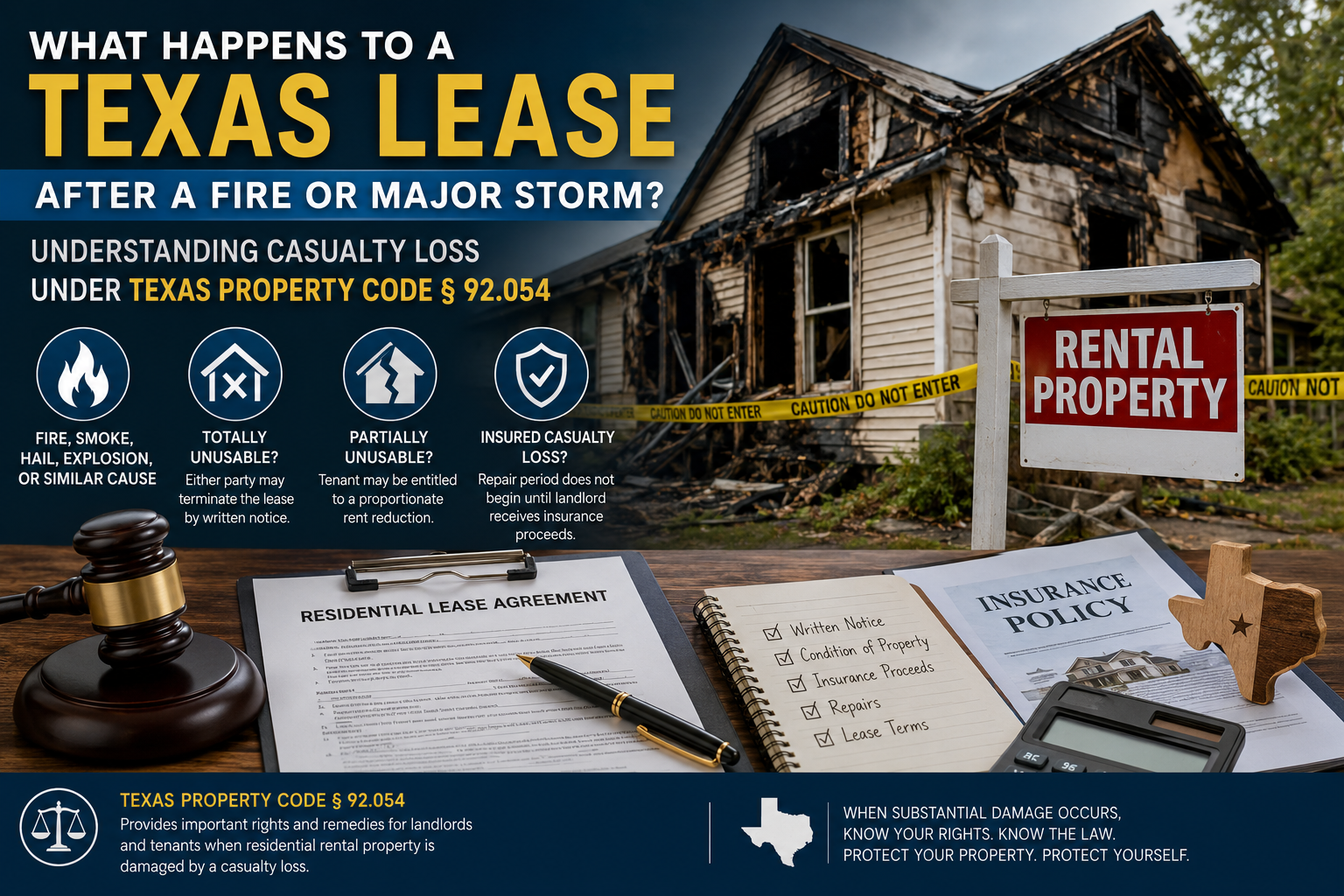
A fire damages a Texas apartment.
A hurricane tears part of the roof off a rental house. Smoke makes several rooms unusable. Hail causes extensive damage. An explosion damages a building even though neither the landlord nor the tenant did anything wrong.
What happens to the lease?
Many landlords and tenants assume that ordinary repair rules provide the entire answer. Texas law, however, contains a specific provision governing casualty losses in residential rental property.
Texas Property Code § 92.054 addresses casualty losses and distinguishes between rental premises that are totally unusable and premises that are only partially unusable.
That distinction can determine whether the lease may be terminated, whether rent can be reduced, and when the landlord's time to repair actually begins.
What Is a Casualty Loss Under Texas Landlord-Tenant Law?
Texas Property Code § 92.054 does not provide an exhaustive definition of every possible casualty. Instead, subsection (a) refers to an insured casualty loss:
"such as fire, smoke, hail, explosion, or a similar cause."
The statute therefore expressly contemplates several sudden events that can substantially damage residential rental property.
A casualty-loss problem is different from an ordinary maintenance problem.
A leaking faucet, broken appliance, deteriorated plumbing line, or malfunctioning air conditioner may implicate Texas's general repair-and-remedy statutes. A residence suddenly damaged by fire, smoke, hail, an explosion, or a similar event can trigger the special rules contained in § 92.054.
An Insured Casualty Can Change the Landlord's Repair Deadline
One of the most technical provisions in § 92.054 appears in subsection (a).
It states:
"If a condition results from an insured casualty loss, such as fire, smoke, hail, explosion, or a similar cause, the period for repair does not begin until the landlord receives the insurance proceeds."
This can make an enormous practical difference.
Texas Property Code Chapter 92 ordinarily imposes duties concerning conditions that materially affect the physical health or safety of an ordinary tenant. But when the condition results from an insured casualty loss, § 92.054(a) modifies when the repair period begins.
The statutory language does not merely say that waiting for insurance proceeds is something a court may consider in deciding whether a landlord acted reasonably. It expressly provides that the period for repair does not begin until the landlord receives the insurance proceeds.
Accordingly, a tenant should not automatically assume that the normal repair timetable applies in exactly the same manner after an insured fire, hailstorm, explosion, or similar casualty.
What If the Rental Property Is Totally Unusable?
Section 92.054(b) addresses the most serious situation.
The statute applies when, after the casualty loss, the rental premises are:
"as a practical matter totally unusable for residential purposes"
and the casualty was not caused by the negligence or fault of the tenant, a member of the tenant's family, or a guest or invitee.
When those requirements are satisfied, either the landlord or the tenant may terminate the lease by giving written notice to the other party at any time before the repairs are completed.
That is an important point.
The termination right is not exclusively a tenant remedy. A landlord may also terminate the lease when the statutory conditions are satisfied.
Imagine that a house suffers a major fire. The structure remains standing, but there is extensive smoke damage, portions of the electrical system are unsafe, and the residence cannot practically be occupied.
If the casualty was not caused by the tenant or the people for whom the statute makes the tenant responsible, § 92.054(b) may permit either side to end the lease rather than requiring the parties to remain contractually tied together throughout a lengthy reconstruction.
"Totally Unusable" Does Not Necessarily Mean Completely Destroyed
The wording chosen by the Legislature is significant.
Section 92.054(b) does not require the building to have burned to the ground. Instead, the statute asks whether the premises are "as a practical matter totally unusable for residential purposes."
That language focuses on practical residential use.
A structure can physically exist while nevertheless being unusable as a residence. Severe electrical damage, loss of essential plumbing, extensive smoke contamination, structural instability, or some combination of serious conditions could create a dispute over whether the premises have crossed the statutory line.
Whether particular premises are totally unusable will necessarily depend on the actual condition of the property.
The Tenant's Fault Matters
The statutory termination right is subject to another important limitation.
Section 92.054(b) applies only if the casualty loss was not caused by the negligence or fault of:
- the tenant;
- a member of the tenant's family; or
- a guest or invitee of the tenant.
That means the source of the casualty can become legally important.
A lightning strike that starts a fire presents a very different issue from a fire allegedly caused by a tenant's negligent conduct. Likewise, a casualty caused by a guest may affect the tenant's ability to rely upon the statutory termination provision.
When fault is disputed, determining the cause of the casualty may become an important part of the landlord-tenant dispute.
What Happens to Rent After the Lease Is Terminated?
If a lease is properly terminated under § 92.054(b), the statute specifically addresses the tenant's financial rights.
The tenant is entitled to:
"a pro rata refund of rent from the date the tenant moves out"
as well as a refund of any security deposit otherwise required by law.
Suppose, for example, a tenant has already paid rent through the end of the month but a qualifying casualty makes the premises totally unusable and the tenant moves out halfway through the month.
If the lease is properly terminated under the statute, § 92.054(b) provides for a pro rata rent refund from the date the tenant moves out.
The security deposit remains subject to the other applicable provisions of Texas law.
What If the Property Is Only Partially Unusable?
This is where § 92.054 becomes particularly interesting.
Not every casualty makes an entire rental property unusable.
Suppose a fire damages one bedroom but leaves the remainder of a house habitable. A storm might make one portion of an apartment unusable while leaving other portions functional.
Section 92.054(c) addresses that situation.
If the rental premises are partially unusable for residential purposes, and the casualty was not caused by the negligence or fault of the tenant, the tenant's family member, or the tenant's guest or invitee, the statute provides that the tenant is entitled to:
"reduction in the rent in an amount proportionate to the extent the premises are unusable because of the casualty"
But there is an important catch.
A Tenant Generally Cannot Simply Decide How Much Rent to Withhold
Section 92.054(c) states that the proportional rent reduction is available:
"only on judgment of a county or district court."
That language matters.
A tenant who believes that 30 percent of an apartment is unusable should not simply assume that Texas law automatically authorizes the tenant to deduct 30 percent from the next rent payment.
The statute contemplates a judicial determination of the proportional reduction.
There is, however, an important contractual exception: the landlord and tenant may agree otherwise in a written lease.
Accordingly, the lease itself should always be reviewed before deciding what rights or procedures apply following a casualty.
Total and Partial Unusability Produce Very Different Remedies
The distinction can be summarized fairly simply.
If the premises are totally unusable as a practical matter, § 92.054(b) can permit either party to terminate the lease by written notice before repairs are completed, assuming the statutory fault requirement is satisfied.
If the premises are merely partially unusable, § 92.054(c) instead provides for a proportionate reduction in rent, generally requiring a judgment from a county or district court unless the written lease provides otherwise.
That distinction can produce significant disputes.
A tenant may view a badly damaged property as effectively uninhabitable and seek to terminate the lease. A landlord may contend that only one portion of the premises is affected and that the property remains usable for residential purposes.
The factual characterization of the damage can therefore determine the legal remedy.
Timing Matters If Either Side Wants to Terminate
Section 92.054(b) also contains an easily overlooked timing requirement.
The landlord or tenant may terminate:
"any time before repairs are completed."
Once repairs are completed, the statutory termination mechanism contained in subsection (b) is no longer written to operate in the same way.
A party dealing with severely damaged rental property therefore should not assume that the decision can be postponed indefinitely.
Written notice, the condition of the property, the progress of repairs, insurance issues, and the terms of the lease can all become important.
Casualty Losses Can Involve More Than One Area of Law
A serious casualty can create several separate legal issues at once.
For example, a residential fire may raise questions involving:
- termination of the lease;
- rent obligations;
- security deposits;
- landlord repair duties;
- renters insurance;
- property insurance;
- damage to the tenant's personal property;
- negligence;
- liability for the cause of the fire; and
- possession of the premises.
Section 92.054 answers some important landlord-tenant questions, but it does not necessarily determine who must pay for every item of damaged property or who is ultimately liable for causing the casualty.
Those questions may depend upon the lease, insurance policies, the source of the damage, and other Texas law.
Why Written Documentation Matters After a Casualty
Both landlords and tenants should document the condition of the premises after a serious casualty.
Photographs, videos, repair estimates, insurance communications, inspection reports, notices between the parties, and records showing when the tenant moved out can become important if the parties later disagree.
The date on which insurance proceeds were received can also matter because § 92.054(a) expressly connects receipt of those proceeds with the beginning of the repair period for an insured casualty.
Likewise, because subsection (b) requires written noticeto terminate a totally unusable lease, an informal telephone conversation may not accomplish what one of the parties believes it accomplished.
The Lease Still Matters
Texas Property Code § 92.054 provides statutory rules, but the written lease remains important.
This is especially clear under subsection (c), which expressly provides that a landlord and tenant may agree otherwise in a written lease regarding the treatment of partially unusable premises.
The lease may also contain provisions addressing casualty damage, insurance, notice, tenant obligations, restoration, or other related subjects.
For that reason, a casualty-loss dispute should generally be analyzed by reading the statute and the actual lease together rather than relying on either document in isolation.
The Bottom Line
Texas residential leases do not simply continue unchanged after every fire, storm, or other serious casualty.
Under Texas Property Code § 92.054, an insured casualty can delay the beginning of the statutory repair period until the landlord receives insurance proceeds. If the premises become, as a practical matter, totally unusable for residential purposes through no qualifying fault of the tenant or the tenant's family or guests, either the landlord or tenant may be able to terminate the lease by written notice before repairs are completed.
If the premises are only partially unusable, the result is different. Texas law provides for a proportionate rent reduction, but generally only through a judgment of a county or district court unless the parties have agreed otherwise in a written lease.
For both landlords and tenants, the distinction between totally unusable and partially unusable property can therefore determine whether the legal issue is termination of the lease or reduction of the rent.
When substantial casualty damage occurs, the condition of the property, cause of the damage, insurance status, timing of repairs, written notices, and language of the lease should all be reviewed carefully before either party decides what to do next.
At David C. Barsalou, Attorney at Law, PLLC, we help clients navigate business, family, tax, estate planning, and real estate matters ranging from document drafting to litigation with clarity and confidence. If you’d like guidance on your situation, schedule a consultation today. Call us at (713) 397-4678, email barsalou.law@gmail.com, or reach us through our Contact Page. We’re here to help you take the next step.