When someone dies owing money, the debt does not necessarily disappear.
Credit cards, personal loans, unpaid invoices, medical bills, and other unsecured obligations may become claims against the deceased person's estate.
But Texas probate law does not necessarily allow creditors to wait indefinitely before demanding payment.
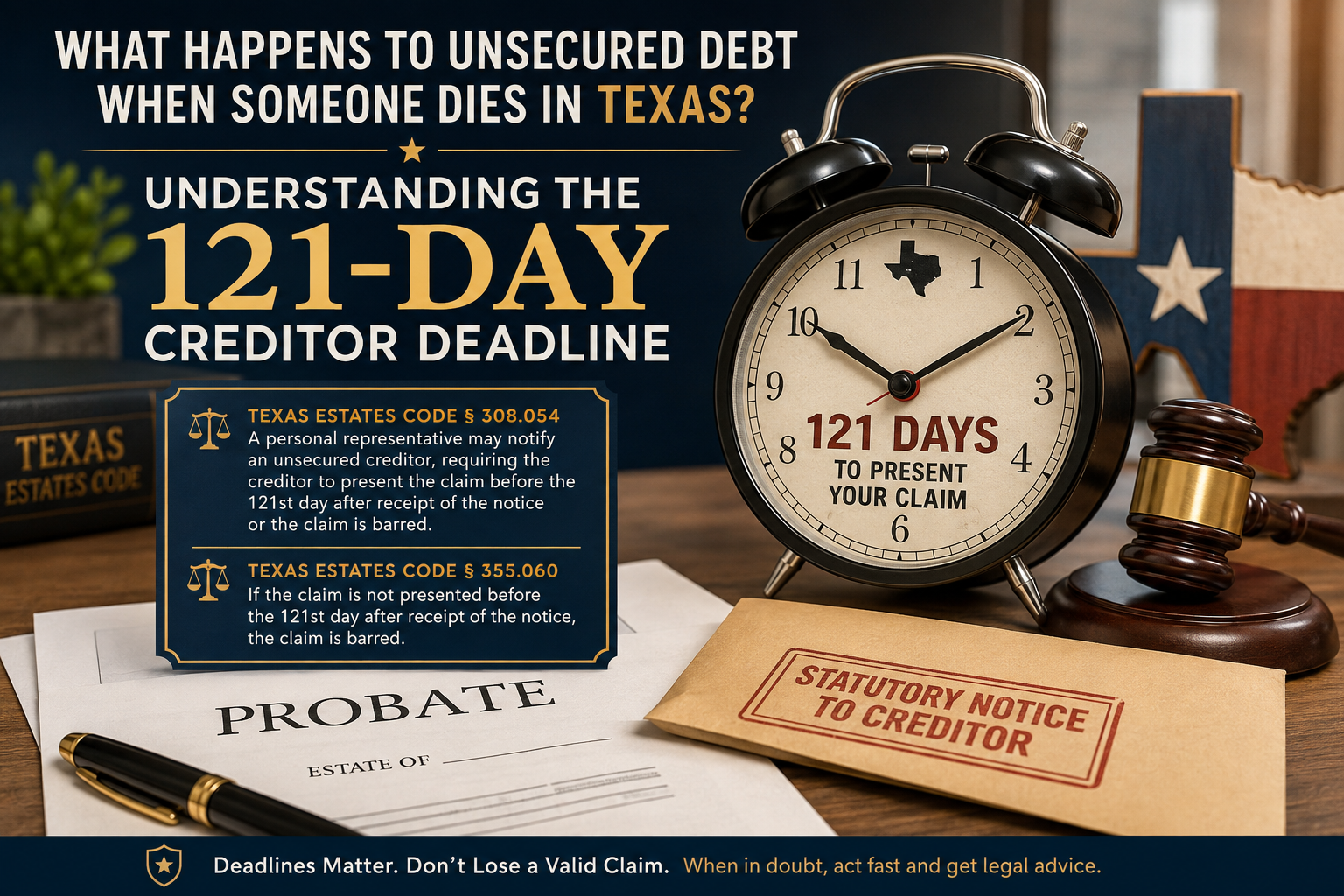
In some circumstances, the personal representative of a Texas estate can send an unsecured creditor a special statutory notice that starts a 121-day deadline.
If the creditor fails to properly present its claim before that deadline expires, the claim can be barred.
This makes Texas Estates Code §§ 308.054 and 355.060important both to executors trying to administer estates and to creditors trying to collect legitimate debts.
What Is an Unsecured Creditor?
A creditor is generally someone to whom the deceased person owed money.
Some debts are secured by particular property.
For example, a mortgage is ordinarily secured by real estate, while certain vehicle loans are secured by the vehicle.
An unsecured debt, by contrast, does not give the creditor a security interest in particular property merely because the debt exists.
Common examples may include:
- credit-card balances;
- many personal loans;
- unpaid professional or business invoices;
- certain medical bills; and
- other contractual debts that are not secured by collateral.
Texas probate law treats secured and unsecured claims differently in several important respects.
Texas Requires General Notice to Creditors
Texas Estates Code § 308.051 requires a personal representative, within one month after receiving letters testamentary or letters of administration, to provide general notice requiring persons with claims against the estate to present those claims within the period prescribed by law.
The statute generally requires publication in a newspaper of general circulation in the county where the letters were issued.
This publication requirement provides general notice that an estate administration has begun.
But Texas law gives a personal representative another potentially powerful option for dealing with particular unsecured creditors.
An Executor Can Send an Unsecured Creditor a Special Notice
Texas Estates Code § 308.054(a) provides:
“At any time before an estate administration is closed, a personal representative may give notice by a qualified delivery method to an unsecured creditor who has a claim for money against the estate.”
Unlike some mandatory notices in probate administration, this notice is permissive.
That distinction matters.
The personal representative may use the statute strategically to require a known unsecured creditor to either come forward with its claim or risk losing it.
The Creditor Gets 121 Days
The most important part of § 308.054 appears in subsection (b).
The notice must expressly state that the creditor must:
“present the claim before the 121st day after the date of the receipt of the notice or the claim is barred”
assuming the claim has not already been barred by the generally applicable statute of limitations.
The notice must also contain certain information, including the date the personal representative's letters were issued and the address to which the claim may be presented.
This creates an unusually concrete probate deadline.
It is not simply a letter asking:
“Do you believe the estate owes you money?”
It is effectively a statutory demand:
Present your claim within the prescribed period or potentially lose it.
What Happens If the Creditor Ignores the Notice?
Texas Estates Code § 355.060 answers that question directly.
It provides:
“If a personal representative gives a notice permitted by Section 308.054 to an unsecured creditor for money and the creditor's claim is not presented before the 121st day after the date of receipt of the notice, the claim is barred.”
That is a serious consequence.
A creditor may have documentation showing that the deceased person genuinely owed money. The creditor may have invoices, account statements, a contract, or other evidence of the debt.
But probate law imposes procedural requirements in addition to requiring a creditor to establish the underlying debt.
A valid debt can therefore encounter a separate problem if the creditor fails to comply with a statutory claims deadline.
Why Would an Executor Send the Notice?
Estate administration becomes difficult when nobody knows which debts will ultimately be asserted.
Suppose an executor identifies several old credit-card accounts, an unpaid personal loan, and an outstanding invoice.
Without resolution of those potential claims, it may be difficult to determine how much property can safely be distributed to beneficiaries.
Section 308.054 gives the personal representative a mechanism for forcing the issue.
The representative can essentially require the unsecured creditor to make a decision:
Present the claim within the statutory period, or face the possibility that the claim will be barred.
That can help move an estate toward final administration rather than leaving potential debts unresolved indefinitely.
Presenting a Claim Is More Than Sending a Bill
Creditors should not assume that an ordinary collection letter necessarily satisfies every requirement of Texas probate law.
Texas Estates Code Chapter 355 contains detailed rules governing presentment of claims, including requirements concerning authenticated claims.
For example, § 355.004 generally requires a claim for money against an estate to be supported by an affidavit stating, among other things, that the claim is just and that all legal offsets, payments, and credits known to the affiant have been allowed.
The exact procedure can also depend upon the type of administration involved.
Independent administrations are subject to additional provisions in Texas Estates Code Chapter 403 concerning claims and notices to independent executors.
For that reason, a creditor receiving probate correspondence should pay close attention to both the substance of the notice and the type of estate administration involved.
Independent Administration Has Its Own Claims Provisions
Independent administration is common in Texas because it allows an executor to administer much of an estate without repeatedly obtaining court approval.
But independence from routine court supervision does not mean creditors can simply ignore probate procedures.
Texas Estates Code § 403.055 provides that an unsecured creditor who receives notice under § 308.054 must give the independent executor notice of the nature and amount of the claim before the 121st day after receiving the statutory notice or the claim is barred.
Section 403.056 then specifies methods by which the required notice may be given.
This is one reason creditors should not assume that the same collection procedure applies in every Texas estate.
What If the Executor Rejects the Claim?
Timely presentment does not necessarily mean the estate must pay the claim.
The personal representative may dispute whether the debt exists, challenge the amount claimed, contend that payments or offsets were omitted, or raise another defense.
In a dependent administration, Texas Estates Code § 355.051 generally requires a personal representative to allow or reject an authenticated claim, or a portion of it, within 30 days after it is presented or deposited with the clerk as provided by law.
A claim that is properly presented can therefore still become disputed probate litigation.
The claims process determines whether a creditor has properly asserted the debt. It does not automatically establish that every asserted debt is valid.
Ordinary Statutes of Limitations Still Matter
The 121-day provision should not be mistaken for a way to revive an already dead claim.
Section 308.054 itself recognizes the effect of the general statutes of limitations.
If the creditor's claim was already legally barred before the probate notice was sent, receiving the notice does not ordinarily breathe new life into it.
Conversely, creditors should not assume that an ordinary limitations period means they can safely ignore a probate notice until that longer period expires.
Probate law may create additional deadlines that must be satisfied.
Not Every Family Member Becomes Personally Responsible for the Debt
Another common misconception is that a person's children or other relatives automatically inherit the deceased person's debts.
Ordinarily, a creditor's claim is asserted against the estate, not transformed merely by death into the personal debt of the decedent's children or beneficiaries.
There can be important exceptions and complications—for example, another person may already be independently liable as a co-borrower, guarantor, or joint account holder.
Estate assets and distributions can also be affected by valid creditor claims.
But simply being someone's child or beneficiary does not, by itself, mean that person personally signed up for every unsecured debt the decedent incurred.
A Simple Example
Suppose Maria dies owing $9,000 on an unsecured personal loan.
An executor is appointed to administer her Texas estate.
The executor identifies the lender and sends a notice complying with Texas Estates Code § 308.054.
The lender receives the notice.
At that point, the lender should not simply place the letter in its ordinary collection queue and assume that it can pursue the debt whenever convenient.
The statutory clock is running.
If the creditor fails to properly present its claim before the 121st day after receiving the notice, § 355.060 provides that the claim is barred.
If the creditor timely presents the claim, however, that does not necessarily mean the creditor immediately receives $9,000. The validity of the claim, the estate's available assets, the classification and priority of claims, and other probate rules may still affect whether and how much the creditor ultimately receives.
Why This Rule Matters
The Texas probate system has to balance competing interests.
Creditors should have an opportunity to collect legitimate debts.
Beneficiaries should not receive estate property that is properly needed to satisfy valid claims.
But estates also need to end.
Executors cannot administer property indefinitely because a creditor might someday decide to come forward.
Texas Estates Code § 308.054 provides one mechanism for creating finality. A personal representative can put an unsecured creditor on formal notice and force the creditor to act within a defined period.
For creditors, the lesson is equally straightforward:
Do not ignore a formal notice from a Texas estate simply because you believe you have plenty of time to collect the debt.
Probate deadlines can operate independently of the timetable a creditor ordinarily associates with collection.
Conclusion
When someone dies owing unsecured debt in Texas, the creditor may still have a valid claim against the estate.
But having a valid debt and preserving the right to collect it are not necessarily the same thing.
Under Texas Estates Code § 308.054, a personal representative may send qualifying notice to an unsecured creditor requiring the creditor to present its claim before the 121st day after receipt.
And Texas Estates Code § 355.060 supplies the consequence:
If the creditor fails to timely present the claim after receiving the statutory notice, the claim is barred.
For executors, this procedure can help identify and resolve outstanding liabilities so an estate can eventually be distributed and closed.
For creditors, it is a reminder that correspondence from a probate estate should never be treated as ordinary collection mail.
This article is for general informational purposes only and does not constitute legal advice. Texas probate claims can involve different procedures depending on the nature of the debt, the form of administration, and the particular facts of the estate.
At David C. Barsalou, Attorney at Law, PLLC, we help clients navigate business, family, tax, estate planning, and real estate matters ranging from document drafting to litigation with clarity and confidence. If you’d like guidance on your situation, schedule a consultation today. Call us at (713) 397-4678, email barsalou.law@gmail.com, or reach us through our Contact Page. We’re here to help you take the next step.
