Probate can last longer than anyone expects.
An executor may begin administering an estate only to die before the administration is completed. An executor may resign. The court may remove the executor. A person named as successor executor in the will may refuse to serve. Sometimes a will simply names one executor and says nothing about what happens if that person cannot finish the job.
That raises an unusually technical probate question:
Can a Texas estate remain under independent administration after the original independent executor is gone?
In many cases, yes.
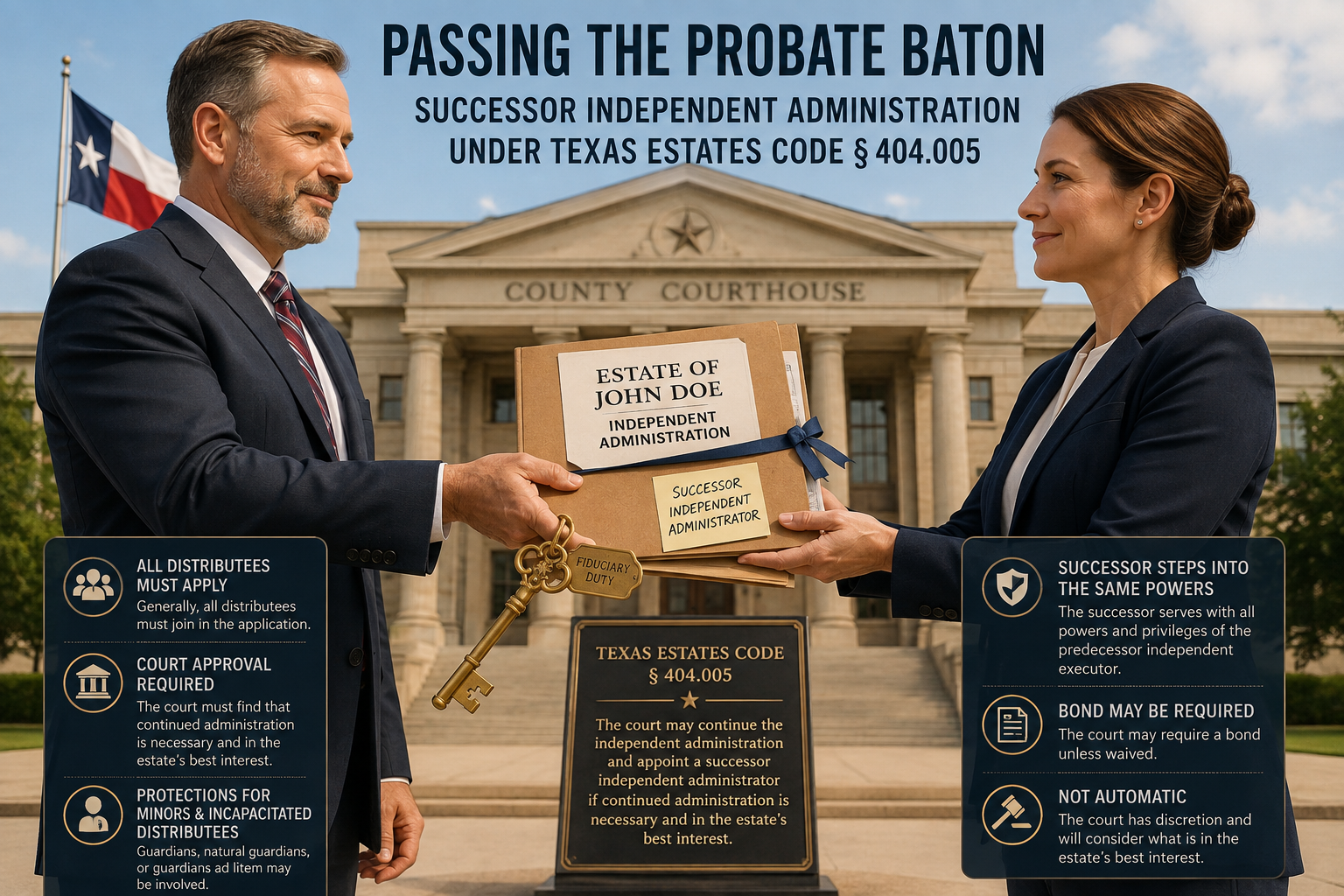
Texas Estates Code § 404.005 creates a procedure through which a probate court may appoint a successor independent administratorand permit the estate to continue operating under independent administration.
The distinction matters. Independent administration is designed to minimize continuing court supervision. Losing the original executor does not necessarily mean that the estate must suddenly become a dependent administration requiring substantially greater court involvement.
What Is Independent Administration in Texas?
Texas probate law strongly accommodates independent administration.
In an independent administration, the personal representative can generally perform many ordinary acts of estate administration without repeatedly obtaining probate-court approval. That can make administration considerably more efficient, particularly when the estate contains real property, financial accounts, business interests, debts, or other assets requiring continuing management.
But the independence belongs to the administration, not necessarily forever to one particular human being.
Texas Estates Code Chapter 404 expressly addresses accountings, removal of independent executors, and succession when an independent executor can no longer serve. The chapter includes separate provisions governing removal, administrators succeeding independent executors, and court-appointed successor independent administrators.
That statutory structure becomes important when the person originally entrusted with the estate cannot complete the administration.
Texas Estates Code § 404.005: The Successor Independent Administrator
Texas Estates Code § 404.005(a) addresses a fairly specific situation: a testator's will names an independent executor, that executor qualifies, and the executor subsequently fails for some reason to continue serving or is removed for cause.
The statute provides, in relevant part:
“all of the distributees of the decedent as of the filing of the application for an order continuing independent administration may apply to the probate court”
for appointment of a qualified person, firm, or corporation as successor independent administrator. Tex. Est. Code § 404.005(a).
There are several important pieces hidden inside that language.
First, this is not merely a matter of somebody volunteering to become the new executor.
Second, the statute focuses on the distributees of the estate.
Third, the requested relief is not merely appointment of a new representative. The application asks the court to continue the independent administration.
That distinction is crucial.
What If the Will Already Names a Successor Executor?
The first place to look is always the will.
Section 404.005 becomes particularly important where the will does not name a successor independent executor, or where each named successor fails to qualify or indicates that he or she is unable or unwilling to serve.
Suppose, for example, a will says:
“I appoint my sister Jane as Independent Executor of my estate, to serve without bond.”
Jane qualifies and begins administering the estate. Six months later, Jane dies.
If the will never identified an alternate executor, the beneficiaries are not necessarily forced into a completely different form of administration. Section 404.005 potentially provides a mechanism for continuing independent administration under a new representative.
All Distributees Generally Must Participate
One of the most technically significant features of § 404.005(a) is its reference to all of the distributees of the decedent as of the filing of the application.
That requirement can turn what appears to be a routine substitution into a more complicated probate problem.
Imagine an estate with four beneficiaries. Three want the decedent's daughter to become successor independent administrator. The fourth objects.
That is not necessarily equivalent to an application in which all distributees have joined.
Consequently, identifying the distributees correctly can become one of the most important steps in preparing the application.
The problem becomes even more complicated if a distributee has died, is a minor, is incapacitated, or takes an interest through a testamentary trust.
The Legislature anticipated many of those situations.
What Happens If a Beneficiary Is a Minor or Incapacitated?
Section 404.005 contains unusually detailed provisions concerning distributees who cannot simply sign an application themselves.
For an incapacitated distributee, the guardian of the person may generally sign the application on the distributee's behalf. If the incapacitated distributee does not have a guardian of the person, the probate court may appoint a guardian ad litem when necessary to protect that person's interests.
The statute also addresses minors. If a minor distributee has no guardian of the person, a natural guardian may under specified circumstances sign on the minor's behalf, provided there is no conflict of interest.
This is an excellent example of why seemingly straightforward probate applications sometimes become procedurally complicated.
The question is not simply:
Who should replace the executor?
The court may also need to determine who has legal authority to consent to the continuation of independent administration on behalf of each distributee.
The Probate Court Still Has an Important Role
Even unanimous agreement among distributees does not make appointment automatic.
Section 404.005(a) requires the probate court to determine that continued administration of the estate is necessary. If it is, the statute provides that the court shall continue the independent administration and appoint the person, firm, or corporation designated in the application unless the court finds that doing so would not be in the estate's best interest.
This creates two separate issues.
There must still be a reason for the estate to remain under administration, and the proposed successor must be appropriate.
For example, an estate might still contain property that needs to be sold, unresolved debts, pending tax matters, litigation, business interests, or assets that have not yet been distributed.
By contrast, if essentially everything has already been accomplished, the practical question may be whether the estate should simply be closed rather than whether another administrator should be appointed.
The Successor Can Receive the Predecessor's Independent Powers
The significance of § 404.005 becomes especially apparent once the successor is appointed.
The statute provides that:
“The successor independent administrator shall serve with all of the powers and privileges granted to the successor's predecessor independent executor.”
Tex. Est. Code § 404.005(a).
That is powerful language.
The Legislature did not merely create an estate caretaker with limited authority. The statute allows the successor independent administrator to step into an independent administration with the powers and privileges previously possessed by the independent executor.
This can preserve much of the administrative efficiency that the decedent presumably intended when the will originally provided for independent administration.
Do Not Confuse § 404.005 With an Ordinary Successor Administration
The distinction between ordinary administration and independent administration is not merely semantic.
Texas appellate authority has specifically recognized the importance of using the correct statutory mechanism.
In In the Estate of Rickey Ray Allen, the Eighth Court of Appeals considered an attempted appointment of a successor in an independent administration. The court concluded that § 404.005—not the more general provisions of Chapter 361—controlled the appointment of a successor independent administrator who was not named in the will. Because the statutory requirements had not been followed, the appellate court concluded that the probate court abused its discretion in making the appointment.
That case illustrates an important procedural principle:
Probate courts have substantial authority, but the statutory route used to exercise that authority still matters.
Calling someone a “successor executor” in an order does not necessarily cure failure to satisfy the statute governing the appointment.
What If the Original Executor Was Removed?
Section 404.005 also interacts directly with Texas law governing removal of an independent executor.
Texas Estates Code § 404.0036 provides that an order removing an independent executor must state the cause for removal and direct the disposition of assets remaining in the removed executor's name or control. The order also requires surrender and cancellation of the executor's letters.
The statute then expressly provides:
“the court may, on application, appoint a successor independent administrator as provided by Section 404.005.”
Tex. Est. Code § 404.0036(b).
Thus, removal does not itself necessarily terminate independent administration.
The court can remove the individual fiduciary while permitting the estate's independent administration to continue under a properly appointed successor.
That distinction can be extremely important where the problem is the executor rather than the structure of the administration itself.
Will the Successor Independent Administrator Need a Bond?
Possibly.
Section 404.005(h) provides that when a successor independent administrator is appointed, the administrator generally must provide a bond in an amount the judge finds adequate unless the probate court waives the bond on application for waiver.
This can surprise beneficiaries.
The original will may have expressly allowed the original independent executor to serve without bond. But the replacement of that executor through § 404.005 introduces its own statutory bond provision.
Accordingly, counsel seeking appointment of a successor should consider the bond issue when preparing the application rather than assuming that the original executor's no-bond status automatically resolves the question.
What About an Administrator With the Will Annexed?
Texas Estates Code § 404.004 addresses a related but distinct situation involving an administrator with the will annexed who succeeds an independent executor.
The provision is particularly technical where the will granted the independent executor authority to borrow money or mortgage estate property.
Under § 404.004, a court may, following the statutory application, citation, and hearing process, authorize the administrator to exercise specified powers that had belonged to the independent executor when the statutory requirements are satisfied.
The statute even permits the court, under appropriate circumstances, to authorize borrowing and the pledging or mortgaging of estate assets.
This illustrates why succession in probate is not simply about changing the name on the letters.
The powers of the successor matter just as much as the identity of the successor.
A Practical Example
Assume a Texas resident's will leaves an estate equally to his three adult children and appoints his longtime friend as independent executor.
The executor qualifies, obtains letters testamentary, pays several creditors, and begins preparing a piece of commercial real estate for sale.
Before the property is sold, the executor unexpectedly dies.
The will contains no alternate executor.
The estate still needs administration because the commercial property remains unsold and additional estate expenses remain unpaid.
If all three distributees agree on a qualified replacement, § 404.005 may allow them to apply for appointment of that person as successor independent administrator and ask the probate court to continue the independent administration.
If the statutory requirements are satisfied and the court finds continued administration necessary, the estate may therefore continue without necessarily converting into a traditional dependent administration.
Why This Matters in Texas Probate
The death, resignation, or removal of an executor can initially look catastrophic.
It does not have to be.
Texas probate law contains mechanisms designed to preserve continuity. But those mechanisms have technical requirements concerning who must apply, who qualifies as a distributee, whether continued administration remains necessary, whether the proposed successor is appropriate, and whether a bond will be required.
The distinction between a successor personal representative generally and a successor independent administrator under Texas Estates Code § 404.005 can also have major practical consequences.
The larger lesson is simple: the disappearance of the original independent executor does not necessarily end the independent administration.
Sometimes Texas law allows the estate to replace the driver without replacing the vehicle.
Need Help With a Texas Probate Estate?
Problems involving independent executors, successor administrators, unfinished estate administration, beneficiary disputes, and probate procedure can become complicated quickly. The correct procedure often depends on the language of the will, the status of the existing administration, the identity of the distributees, and the work that remains to be completed.
A Texas probate attorney can review the estate and determine whether appointment of a successor independent administrator may be available and what procedural steps are necessary.
This article is for general informational purposes only and does not constitute legal advice. Probate procedures can vary depending on the facts of the estate and the court in which the proceeding is pending.
At David C. Barsalou, Attorney at Law, PLLC, we help clients navigate business, family, tax, estate planning, and real estate matters ranging from document drafting to litigation with clarity and confidence. If you’d like guidance on your situation, schedule a consultation today. Call us at (713) 397-4678, email barsalou.law@gmail.com, or reach us through our Contact Page. We’re here to help you take the next step.