When someone dies, probate is often described as a process of collecting the deceased person's property, paying debts, and distributing whatever remains.
But Texas law gives certain surviving family members protections that can operate before the ordinary distribution of the estate.
One of the less familiar protections is called an allowance in lieu of exempt property.
The name sounds technical. The basic idea is not.
Texas law identifies certain property that may be set aside for the benefit of a surviving spouse and certain children. But what happens if the deceased person simply did not own some of that property?
In some circumstances, Texas law substitutes money for the missing exempt property.
And the potential allowance can be substantial.
Texas Estates Code § 353.051 Requires Certain Property to Be Set Aside
The starting point is Texas Estates Code § 353.051.
Subject to the statute's procedural provisions, the probate court generally must set aside the homestead for the use and benefit of the decedent's surviving spouse and minor children. The statute also addresses other exempt property described by Texas Property Code § 42.002(a), for the benefit of qualifying surviving family members. (Texas Statutes)
That other exempt property can include ordinary household and personal property protected under Texas exemption law.
Texas Property Code Chapter 42 provides substantial protection for personal property from execution and identifies categories of property that Texas generally treats as exempt. (Texas Statutes)
In probate, however, an obvious practical problem can arise:
What if the decedent did not actually own the property that the law would otherwise set aside?
That is where the allowance in lieu of exempt property becomes important.
Texas Estates Code § 353.053 Allows Money Instead
Texas Estates Code § 353.053 addresses exactly that situation.
The statute provides:
“If all or any of the specific articles of exempt property described by Section 353.051(a) are not among the decedent's effects, the court shall make, in lieu of the articles not among the effects, a reasonable allowance.”
Tex. Est. Code § 353.053(a). (Texas Statutes)
In other words, the law does not necessarily say:
The property isn't there, so too bad.
Instead, the court may be required to provide a reasonable monetary allowance in place of the missing exempt property.
That distinction can matter considerably in an estate containing cash, investments, or other assets but relatively little qualifying exempt property.
How Much Can the Allowance Be?
This is where the statute becomes especially interesting.
Texas Estates Code § 353.053(b) provides:
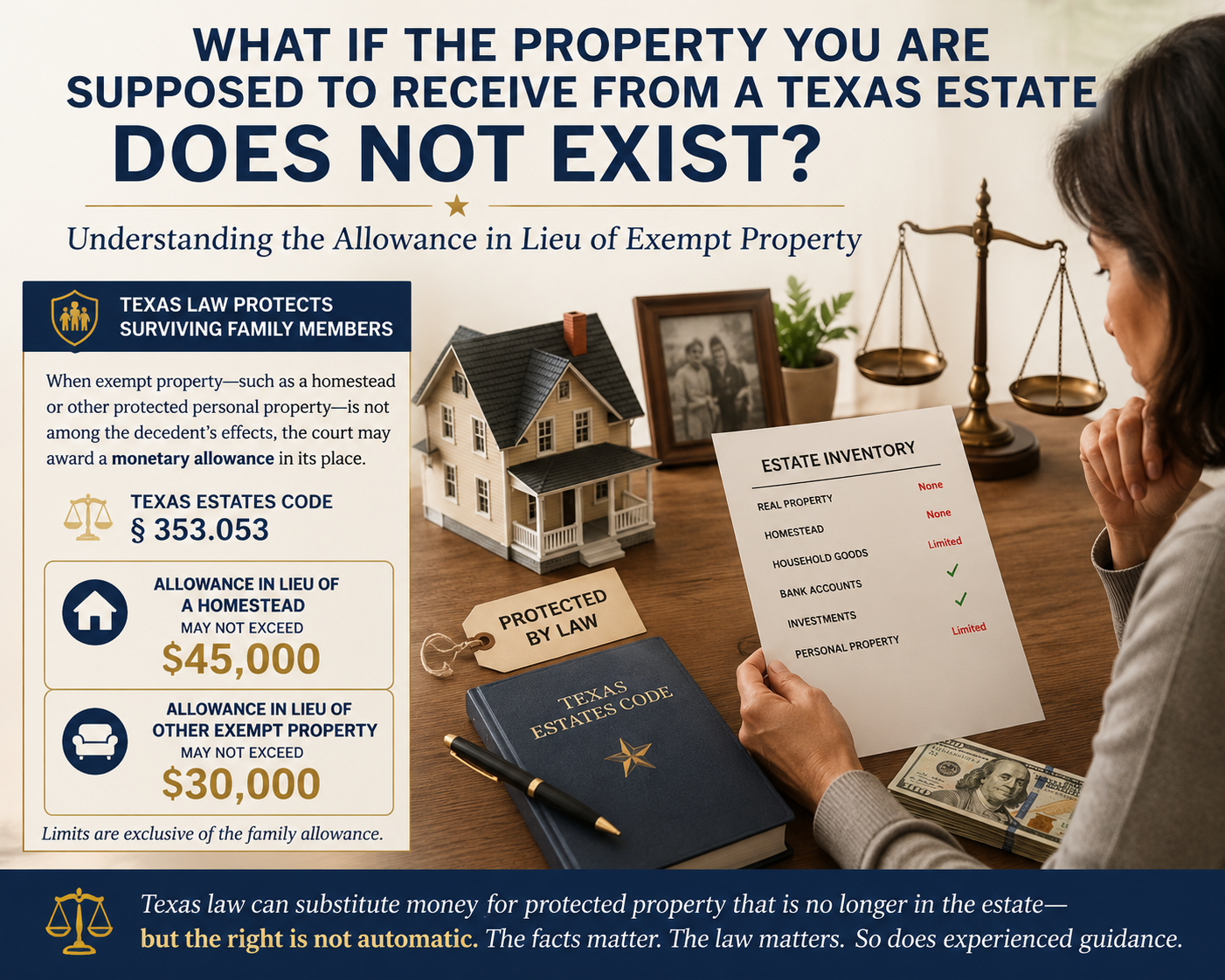
“The allowance in lieu of a homestead may not exceed $45,000, and the allowance in lieu of other exempt property may not exceed $30,000.”
Tex. Est. Code § 353.053(b). (Texas Statutes)
Those are maximum amounts, not automatic awards.
The statute requires a reasonable allowance. The appropriate amount therefore depends upon what qualifying exempt property is absent and the circumstances governed by the statute.
But the statutory ceilings are significant:
up to $45,000 in lieu of a homestead and up to $30,000 in lieu of other exempt property.
That can make this provision much more important than its obscure name suggests.
This Is Different From the Texas Probate Family Allowance
The allowance in lieu of exempt property should not be confused with the family allowance.
They are separate statutory protections.
In fact, § 353.053 expressly states that its limits are:
“excluding the family allowance for the support of the surviving spouse, minor children, and adult incapacitated children provided by Subchapter C.”
Tex. Est. Code § 353.053(b). (Texas Statutes)
That distinction matters.
The family allowance is intended to provide support for qualifying family members following the decedent's death.
The allowance in lieu of exempt property serves a different function: it substitutes a monetary allowance when property that could otherwise be set aside as exempt property is not actually among the decedent's effects.
Depending upon the estate, both concepts may therefore need to be considered.
Who Can Benefit From Exempt Property?
The statute does not simply provide an unrestricted cash payment to every heir or beneficiary.
Section 353.051 identifies particular protected family members.
The homestead is set aside for the use and benefit of the surviving spouse and minor children.
Other qualifying exempt property may be set aside for the decedent's:
- surviving spouse and minor children;
- unmarried adult children remaining with the decedent's family; and
- other adult children who are incapacitated.
Tex. Est. Code § 353.051(a). (Texas Statutes)
That is an important reminder that probate rights do not always correspond neatly to who receives property under the will.
Texas probate law independently protects certain surviving family members.
What Happens If There Is a Surviving Spouse and Children?
Texas Estates Code § 353.054 contains rules governing how an allowance in lieu of exempt property is paid.
For example, if there is a surviving spouse and no children—or if all of the decedent's children are also children of the surviving spouse—the executor or administrator generally pays the entire allowance to the surviving spouse.
The statute contains additional allocation rules when the decedent has children who are not also children of the surviving spouse. Tex. Est. Code § 353.054. (Texas Statutes)
That can become particularly relevant in blended-family estates.
A surviving spouse and children from a prior relationship may have interests that cannot simply be treated as though everyone occupies the same legal position.
The Allowance Can Matter Even When the Estate Plan Says Something Else
One of the recurring surprises in Texas probate law is that reading the will does not necessarily tell you everything that will happen to the estate.
Texas law recognizes protections for surviving spouses and certain children that operate alongside the decedent's estate plan.
Exempt-property protections are part of that system.
The Texas Estates Code itself defines “exempt property” to include not only qualifying property in the estate but also “any allowance paid instead of that property.” Tex. Est. Code § 22.013. (Texas Statutes)
So the allowance is not merely an informal payment that an executor may decide to make. It is built into the statutory concept of exempt property.
A Simple Example
Suppose a married Texas resident dies.
The estate contains substantial funds in a bank account but does not contain a qualifying homestead. The surviving spouse assumes that because there is no house to set aside, the homestead protection simply disappears.
That assumption may be wrong.
Texas Estates Code § 353.053 expressly contemplates an allowance when qualifying exempt property is absent and permits an allowance in lieu of a homestead of as much as $45,000. (Texas Statutes)
The precise entitlement and amount would depend upon the facts and applicable probate procedures, but the absence of the physical property does not necessarily mean the statutory protection vanishes with it.
Why This Can Matter in a Small Estate
An allowance of several thousand dollars may be relatively minor in a multimillion-dollar estate.
It can be enormously important in a modest estate.
Imagine an estate consisting principally of $70,000 in cash and a few ordinary possessions.
Whether a qualifying surviving family member has a statutory claim to an allowance in lieu of exempt property could materially affect what remains available for creditors or eventual beneficiaries.
Texas law even permits liability associated with these allowances to reach certain property that passed outside probate through a transfer on death deed when the probate estate is insufficient. Texas Estates Code § 114.106 provides that, under specified circumstances, the personal representative may enforce liability against TODD property for estate claims, administration expenses, taxes, an allowance in lieu of exempt property, or a family allowance. (Texas Statutes)
That illustrates how seriously the Estates Code treats these protections.
Executors Should Not Assume That “There Is No Property” Ends the Inquiry
An executor examining an estate may naturally inventory what physically exists:
House.
Cars.
Furniture.
Cash.
Investment accounts.
Personal belongings.
But exempt-property analysis requires another question:
Is property missing for which Texas law provides an allowance instead?
That question can be especially important where the decedent rented rather than owned a home, had sold substantial personal property before death, or left an estate composed primarily of liquid assets.
Simply distributing the cash according to the will without considering statutory probate protections can overlook rights created independently by the testamentary plan.
Beneficiaries Should Also Understand That the Will Is Not Always the Whole Story
Suppose a will leaves the entire estate to several beneficiaries.
Those beneficiaries may understandably assume that the executor should pay legitimate debts and expenses and then divide everything remaining according to the will.
But probate contains an intermediate layer of statutory protections.
Exempt property and allowances for qualifying surviving family members can affect what property is actually available for ordinary testamentary distribution.
This is one reason why the mathematical calculation:
estate assets − debts = beneficiary distributions
can be much too simple.
Probate law determines what must happen between those steps.
The Bottom Line
Texas law provides significant protections for surviving spouses and certain children during probate.
One of the least familiar is the allowance in lieu of exempt property.
Under Texas Estates Code § 353.053, when qualifying exempt property is not among the decedent's effects, the court must make a reasonable allowance in its place. The statute currently caps an allowance in lieu of a homestead at $45,000 and an allowance in lieu of other exempt property at $30,000. (Texas Statutes)
Those protections are separate from the family allowance and can materially affect the administration of an estate.
For executors, surviving spouses, children, creditors, and beneficiaries alike, the important lesson is simple:
What a deceased person physically owned on the date of death is not always the end of the probate analysis. Sometimes Texas law substitutes money for protected property that is no longer there.
This article is for general informational purposes only and does not constitute legal advice. Probate rights depend on the particular facts of the estate, the identity of the surviving family members, the nature of the property, and the applicable provisions of Texas law.
At David C. Barsalou, Attorney at Law, PLLC, we help clients navigate business, family, tax, estate planning, and real estate matters ranging from document drafting to litigation with clarity and confidence. If you’d like guidance on your situation, schedule a consultation today. Call us at (713) 397-4678, email barsalou.law@gmail.com, or reach us through our Contact Page. We’re here to help you take the next step.