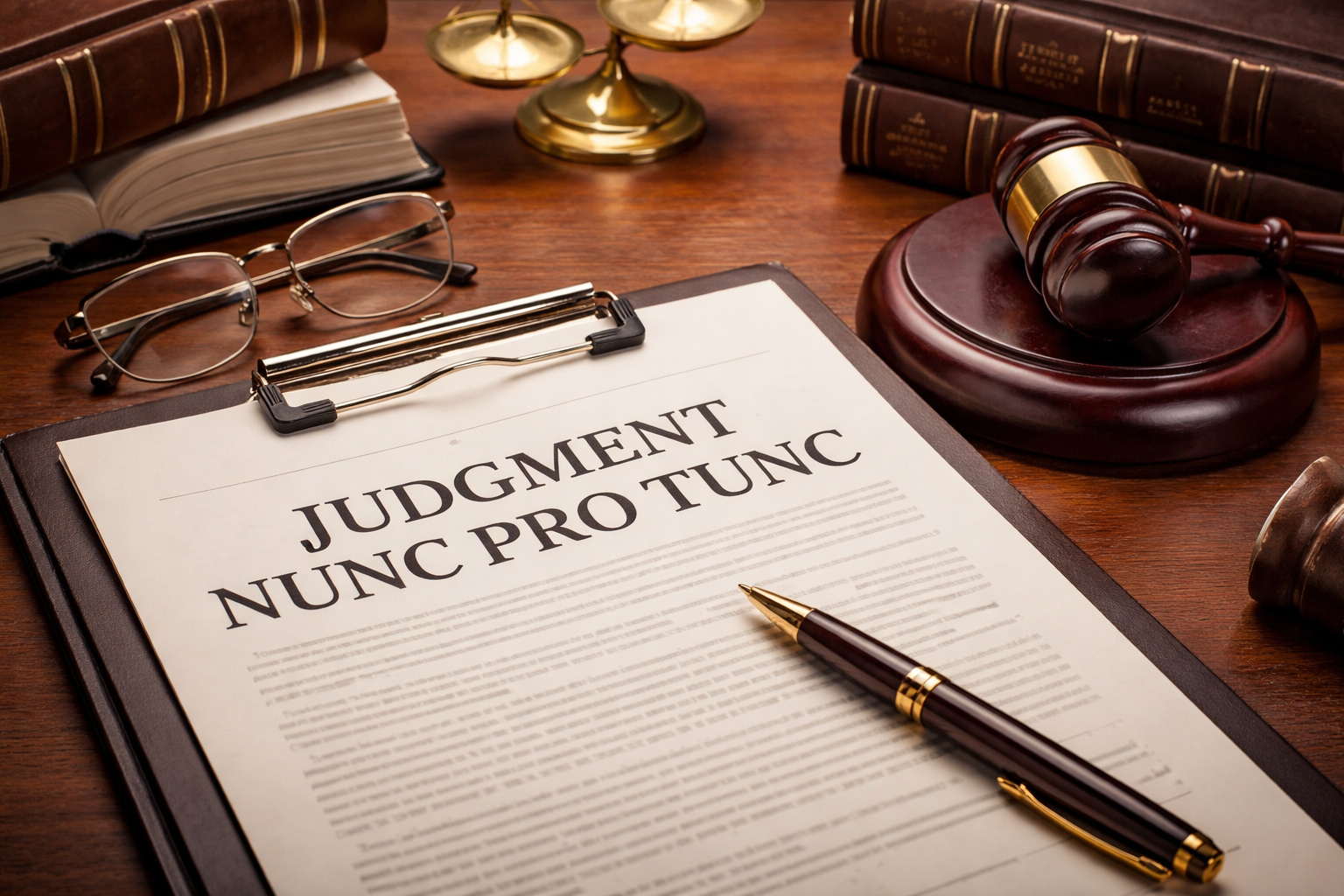
Texas courts strive for finality in judgments. But what happens when a signed judgment contains a mistake?
In certain limited circumstances, a Texas court can correct a judgment after its plenary power expires through a procedural tool called a Judgment Nunc Pro Tunc.
This is not a “do-over.” It is a surgical correction mechanism.
Understanding the difference can make or break a case.
The Governing Law: Texas Rule of Civil Procedure 316
The authority for a judgment nunc pro tunc comes from Texas Rule of Civil Procedure 316, which provides:
“Mistakes in the record of any judgment may be corrected by the judge in open court according to the truth or justice of the case after notice of the application therefor has been given to the parties interested in such judgment.”
— Tex. R. Civ. P. 316
Additionally, Texas Rule of Civil Procedure 329b(f)states:
“After the expiration of the time within which the trial court has plenary power, the judgment cannot be set aside by the trial court except by bill of review for sufficient cause, filed within the time allowed by law; provided, however, that the trial court may at any time correct a clerical error in the record of a judgment and render judgment nunc pro tunc under Rule 316.”
This means:
- Substantive changes → Not allowed after plenary power
- Clerical corrections → Allowed anytime
That distinction is everything.
What Is “Plenary Power” in Texas?
Under Tex. R. Civ. P. 329b(d):
“The trial court, regardless of whether an appeal has been perfected, has plenary power to grant a new trial or to vacate, modify, correct, or reform the judgment within thirty days after the judgment is signed.”
Once that 30-day period (and any properly extended period) expires, the court generally loses jurisdiction to change the judgment — except for clerical errors.
Clerical Error vs. Judicial Error
This is the battleground.
A court can correct:
✔ A mathematical mistake
✔ A typo in a party’s name
✔ Incorrect interest calculation
✔ Failure to include relief that was actually granted in open court
A court cannot correct:
✘ A change of mind
✘ Adding new damages not awarded
✘ Rewriting findings
✘ Reconsidering the merits
Texas courts consistently hold that:
A clerical error is one that does not result from judicial reasoning or determination.
If the alleged error required judicial reasoning, it is a judicial error, and the remedy is appeal or bill of review — not nunc pro tunc.
Why This Matters in Real Life
In practice, I most often see nunc pro tunc issues arise in:
- Post-judgment interest miscalculations
- Incorrect legal descriptions in real property cases
- Abstracts of judgment reflecting wrong amounts
- Divorce decrees missing language actually pronounced
- Default judgments with arithmetic errors
In creditor-debtor litigation (which is common in Harris County and Montgomery County), a small clerical mistake can impair:
- Abstracting a judgment lien
- Garnishment
- Turnover proceedings
- Execution
If the amount is wrong, collection becomes complicated.
Procedure: How to Obtain a Judgment Nunc Pro Tunc
- File a Motion for Judgment Nunc Pro Tunc
- Provide notice to all parties
- Set a hearing
- Present proof that the error is clerical
Often this includes:
- The reporter’s record
- Docket sheet
- Court’s oral pronouncement
- Documentary proof
The judge must determine what the judgment actually was, not what it should have been.
Important Appellate Implications
A judgment nunc pro tunc can reset certain appellate deadlines — but only as to the corrected portion.
This can create procedural traps.
For example:
- If the correction is clerical → appeal may run from nunc pro tunc signing
- If the correction is substantive → appellate courts may declare it void
These nuances frequently surface in contested divorce litigation and business disputes.
Real Estate Impact: Legal Descriptions Matter
If a property description is wrong in a final judgment involving:
- Partition
- Foreclosure
- Quiet title
- Vendor’s lien
- Boundary dispute
A nunc pro tunc may be essential to protect title.
Title companies will not insure a judgment containing obvious inconsistencies.
In Kingwood-area real estate disputes, precision is everything.
When Nunc Pro Tunc Is NOT the Right Tool
If the judgment is legally wrong — not merely clerically flawed — your remedies are:
- Motion for new trial (if within plenary power)
- Appeal
- Restricted appeal
- Bill of review
Attempting to shoehorn a judicial error into a nunc pro tunc motion can waste time and damage credibility
Final Takeaway
A Judgment Nunc Pro Tunc is a narrow but powerful procedural mechanism in Texas civil litigation.
It exists to make the written record reflect the truth of what the court already decided — nothing more.
If you are dealing with:
- A judgment that contains errors
- Collection efforts stalled by inaccuracies
- Title problems caused by a defective decree
- A confusing post-judgment situation
It may be fixable — but only if handled correctly.
Need Help with a Judgment Error in Texas?
David C. Barsalou is a Texas attorney serving clients in:
- Kingwood
- Houston
- Montgomery County
- Harris County
If you believe a judgment contains an error, timely analysis is critical.
At David C. Barsalou, Attorney at Law, PLLC, we help clients navigate business, family, tax, estate planning, and real estate matters ranging from document drafting to litigation with clarity and confidence. If you’d like guidance on your situation, schedule a consultation today. Call us at (713) 397-4678, email barsalou.law@gmail.com, or reach us through our Contact Page. We’re here to help you take the next step.