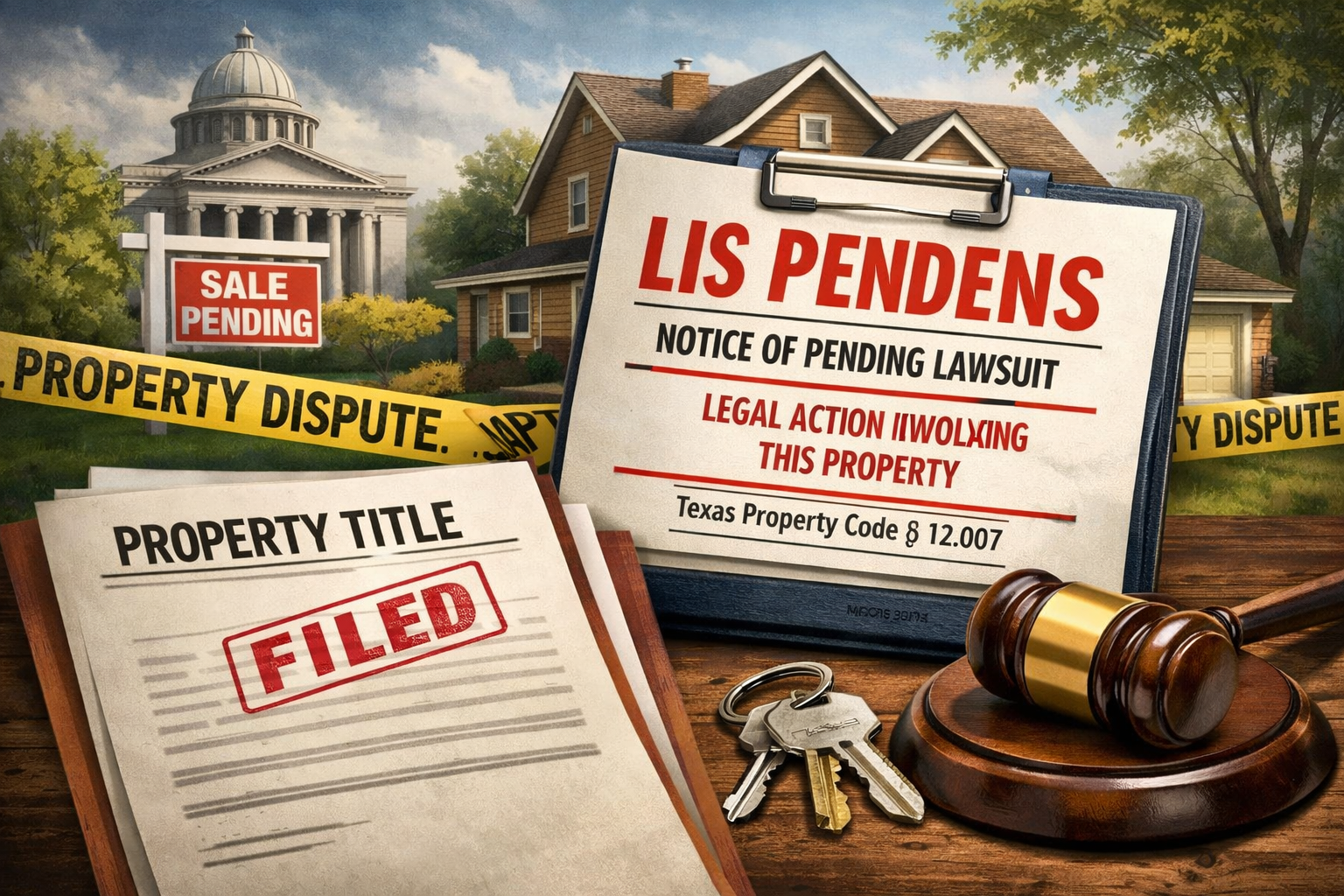
A lis pendens is a formal notice filed in the county property records stating that a lawsuit has been filed which affects ownership or title to real property. The term literally means “a suit pending.”
In Texas, lis pendens filings are governed by Texas Property Code § 12.007.
Once recorded, a lis pendens puts the public — including buyers, lenders, and title companies — on notice that the property is tied up in litigation.
Does a Lis Pendens Create a Lien?
No.
This is one of the most common misconceptions.
A lis pendens does not create a lien, does not prove ownership, and does not decide who wins the lawsuit. Instead, it functions as a warning label attached to the property’s title.
However, despite not being a lien, it can have a very real practical effect:
Most title companies will refuse to insure a transaction involving property subject to a lis pendens.
When Is a Lis Pendens Allowed?
Texas law limits lis pendens filings to lawsuits that directly affect title or possession of real property.
Under Texas Property Code § 12.007(a), a lis pendens is proper only when the lawsuit involves:
- Title to real property
- An ownership interest
- The right to possession
- Enforcement of a lien or encumbrance
You cannot file a lis pendens simply because someone owes you money.
Can a Lis Pendens Be Abused?
Yes — and courts take abuse seriously.
Because lis pendens filings can effectively stall a sale, Texas law provides remedies when they are misused. Under Texas Property Code § 12.0071, a court may:
- Expunge an improper lis pendens
- Award attorneys’ fees and costs to the property owner
- Impose sanctions if the filing was groundless or made in bad faith
This commonly arises in:
- Divorce disputes
- Family inheritance fights
- Failed real estate deals
- Investor disputes
How Is a Lis Pendens Removed?
A lis pendens can be removed in several ways:
- Dismissal or resolution of the underlying lawsuit
- Court-ordered expungement
- Posting a bond, in limited circumstances
Simply filing a motion is not enough — the court must determine whether the underlying claim actually affects the property.
Why This Matters to Homeowners and Buyers
If you’re buying property and see a lis pendens:
- It doesn’t automatically mean fraud
- It does mean delay and legal uncertainty
If you’re a property owner:
- An improper lis pendens can be challenged quickly
- Waiting can cost you real money and lost transactions
Final Takeaway
A lis pendens is a procedural notice, not a judgment — but it carries real-world weight. Texas law tightly restricts when it can be used, and courts do not tolerate it as a pressure tactic.
If a lawsuit touches real estate, the filing strategy matters just as much as the claims themselves.
At David C. Barsalou, Attorney at Law, PLLC, we help clients navigate business, family, tax, estate planning, and real estate matters ranging from document drafting to litigation with clarity and confidence. If you’d like guidance on your situation, schedule a consultation today. Call us at (713) 397-4678, email barsalou.law@gmail.com, or reach us through our Contact Page. We’re here to help you take the next step.