What Is “Hotchpotch” in Texas Probate?
Few legal doctrines have a stranger name than hotchpotch. Despite sounding like something from a medieval cookbook, hotchpotch remains an important concept in Texas probate law.
The doctrine arises when a person dies without a willand one heir received a substantial lifetime gift that was intended to count against that heir’s future inheritance. Texas law calls such gifts advancements. When advancements exist, courts may use a process known as hotchpotch to determine each heir’s proper share of the estate.
Although the doctrine is rarely discussed outside probate circles, it can significantly affect how an estate is divided among children and other heirs.
The Basic Idea
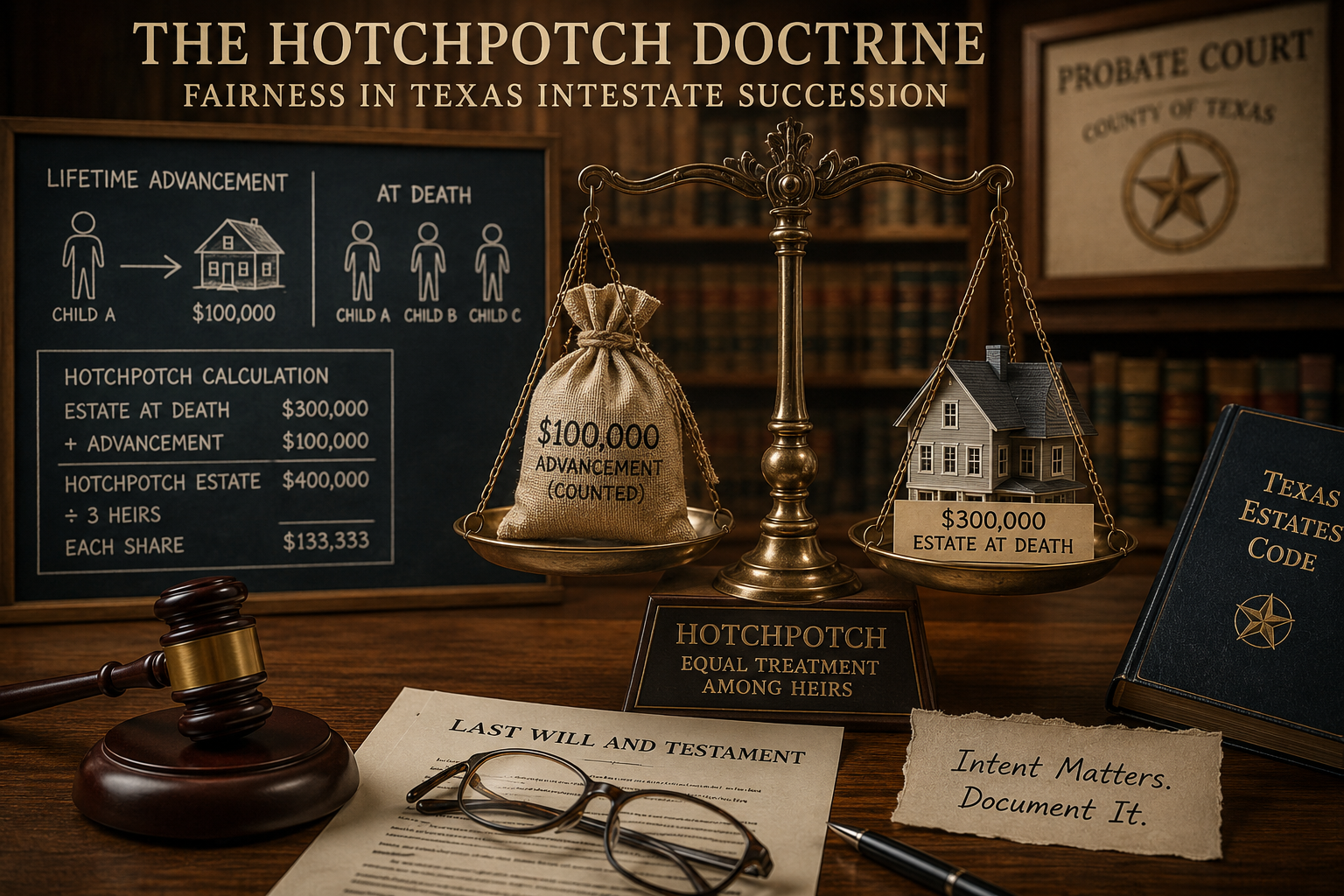
Imagine a father has three children and dies intestate (without a will).
During his lifetime, he gave:
- Child A: $100,000
- Child B: Nothing
- Child C: Nothing
At death, he leaves an estate worth $300,000.
If the $100,000 gift qualifies as an advancement, Texas law does not simply ignore it. Instead, the advancement is brought into a hypothetical accounting process known as hotchpotch.
The law essentially asks:
"What would the estate have looked like if the advancement were still part of it?"
The answer determines each heir's fair share.
Texas Law on Advancements
Texas Estates Code § 201.151 provides:
"If a person dies intestate as to all or part of the person's estate, property that the decedent gave during the decedent's lifetime to an heir is treated as an advancement against the heir's share of the estate only if" certain statutory requirements are satisfied.
The statute then requires written evidence showing the transfer was intended to be an advancement.
Texas Estates Code § 201.151 states that an advancement exists only if:
- The decedent declared in a contemporaneous writing that the gift was an advancement or should be deducted from the heir's share; or
- The heir acknowledged in writing that the gift was an advancement or should be deducted from the heir's share.
This requirement prevents family members from claiming after death that ordinary gifts were actually advances on inheritance.
How the Hotchpotch Calculation Works
Texas Estates Code § 201.153 provides:
"If an advancement is made, the advancement shall be considered part of the decedent's estate in computing the division and distribution of the estate under this chapter."
This is the heart of hotchpotch.
Using the earlier example:
- Estate at death: $300,000
- Advancement: $100,000
Hotchpotch estate:
$300,000 + $100,000 = $400,000
Each of the three children would theoretically receive one-third:
$400,000 ÷ 3 = $133,333.33
Because Child A already received $100,000, Child A receives only approximately $33,333.33 from the probate estate.
Children B and C each receive approximately $133,333.33.
The result is that all three children ultimately receive roughly equal shares.
What If the Advancement Exceeds the Heir's Share?
Another unusual feature of Texas law is that the heir generally does not have to return excess funds.
Texas Estates Code § 201.153 provides that an heir is not required to refund any portion of an advancement that exceeds the heir's eventual intestate share.
For example:
- Estate at death: $60,000
- Advancement: $200,000
- Three heirs
The heir who received the advancement may simply receive nothing further from the estate. Texas law generally does not require repayment of the excess amount.
Why Probate Disputes Arise
Advancement cases often generate family conflict because parents frequently help one child more than others during life.
Examples include:
- Down payments on homes.
- Funding a business venture.
- Paying off significant debts.
- Purchasing vehicles.
- Paying educational expenses.
After death, siblings may disagree about whether the assistance was:
- A gift;
- A loan; or
- An advancement against inheritance.
Because Texas law requires specific writings, many disputes can be resolved by examining the documentation created when the transfer occurred.
Why the Doctrine Matters
The hotchpotch doctrine reflects an old principle of fairness. Texas courts attempt to honor a parent's documented intent while ensuring that one heir does not receive both a substantial lifetime advancement and a full intestate share.
For families, the lesson is simple: if a parent intends a large lifetime transfer to count against a future inheritance, that intent should be documented clearly and in writing.
Otherwise, what was intended as an equalizing gift may instead become the source of expensive probate litigation.
Final Thoughts
Hotchpotch may have one of the strangest names in Texas law, but the doctrine serves an important purpose. When a person dies without a will, Texas Estates Code provisions governing advancements ensure that certain lifetime transfers are considered when dividing the estate among heirs. Proper documentation can prevent disputes, preserve family relationships, and help courts distribute estates according to the decedent's actual intentions.
As with many probate issues, a few carefully drafted documents during life can save heirs substantial time, expense, and conflict after death.
At David C. Barsalou, Attorney at Law, PLLC, we help clients navigate business, family, tax, estate planning, and real estate matters ranging from document drafting to litigation with clarity and confidence. If you’d like guidance on your situation, schedule a consultation today. Call us at (713) 397-4678, email barsalou.law@gmail.com, or reach us through our Contact Page. We’re here to help you take the next step.