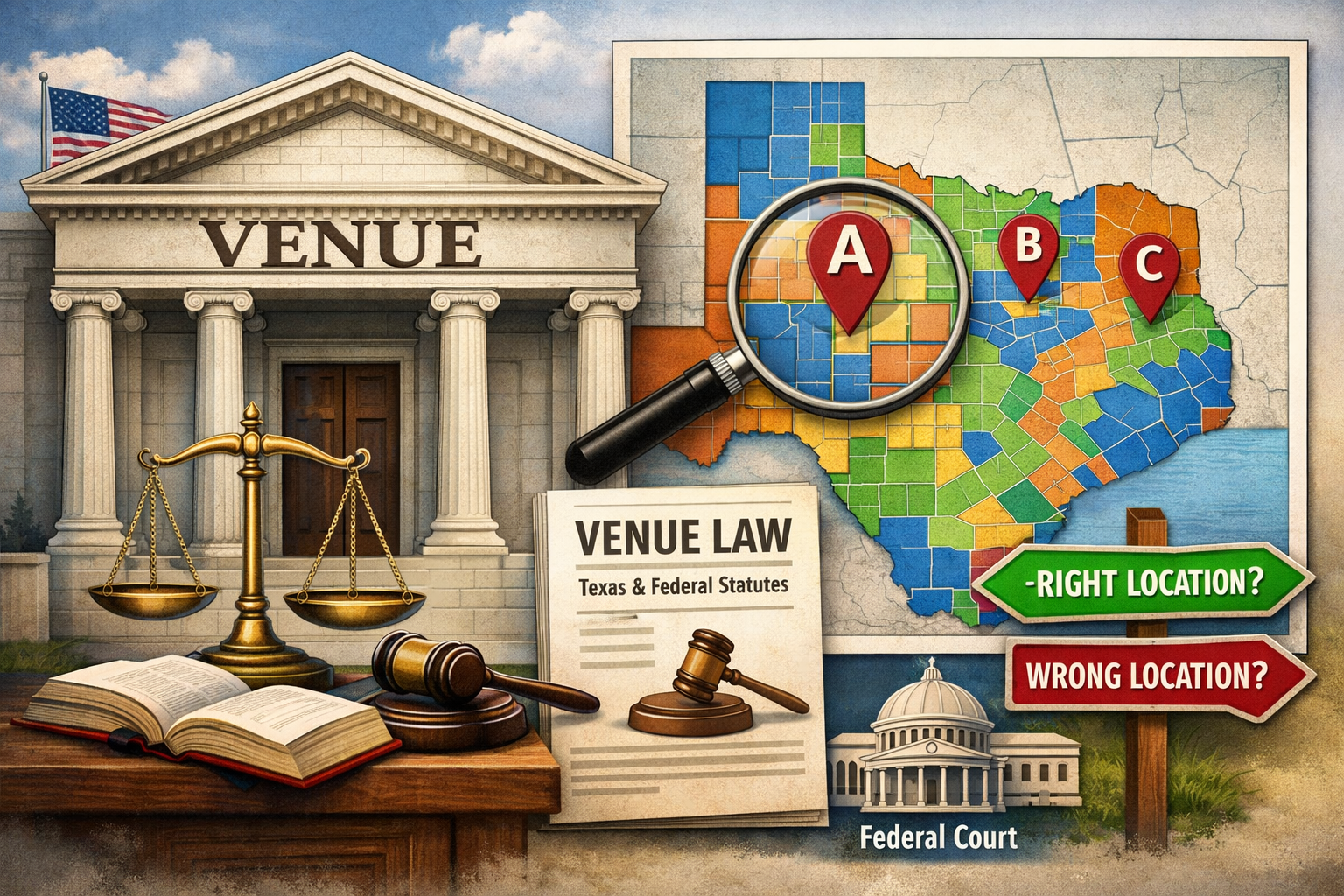
When filing a lawsuit in Texas, one of the first questions is deceptively simple: where should the case be filed?
A plaintiff generally cannot simply choose any Texas county. The law of venue determines the county in which a lawsuit may—or sometimes must—be brought. And although venue may sound like a minor procedural issue, filing in the wrong county can trigger a motion to transfer venue, additional expense, delay, and potentially significant strategic consequences.
Texas venue law can become particularly important in contract disputes, business litigation, real-estate cases, and other civil lawsuits involving parties or events spread across multiple counties.
This article explains what venue means in Texas, how the general venue statute works, when special venue rules control, and how a defendant can challenge a plaintiff's choice of county.
What Does "Venue" Mean in a Texas Lawsuit?
Venue is the law governing the geographic location where a lawsuit may be heard.
In a Texas state-court lawsuit, venue usually concerns the proper county for the case.
Venue should not be confused with jurisdiction.
Jurisdiction concerns a court's legal authority to hear a particular type of case or exercise authority over a party. Venue generally asks a different question: assuming the Texas courts have jurisdiction, which county is the proper place for this particular lawsuit?
A court can therefore possess jurisdiction over a dispute even though the plaintiff filed the lawsuit in an improper venue.
What Is the General Venue Rule in Texas?
The starting point for most Texas civil lawsuits is Texas Civil Practice and Remedies Code § 15.002.
Subject to other applicable venue statutes, § 15.002(a) provides that lawsuits generally shall be brought:
"(1) in the county in which all or a substantial part of the events or omissions giving rise to the claim occurred;
(2) in the county of defendant's residence at the time the cause of action accrued if defendant is a natural person;
(3) in the county of the defendant's principal office in this state, if the defendant is not a natural person; or
(4) if Subdivisions (1), (2), and (3) do not apply, in the county in which the plaintiff resided at the time of the accrual of the cause of action."
This means that more than one Texas county can sometimes constitute proper venue.
For example, suppose a defendant resides in Montgomery County but allegedly breaches a contract through conduct occurring substantially in Harris County. Depending upon the facts and any other applicable venue provisions, the plaintiff may have more than one potentially proper county in which to bring the lawsuit.
The question is therefore not always, "Which single county is correct?" It may instead be, "Is the county selected by the plaintiff one of the counties in which Texas law permits the lawsuit to proceed?"
What Does "A Substantial Part of the Events" Mean?
One of the most important phrases in § 15.002 is "all or a substantial part of the events or omissions giving rise to the claim."
This language makes the underlying facts important.
In a contract dispute, for example, relevant venue facts could potentially concern where agreements were negotiated or performed, where required acts were supposed to occur, or where the conduct underlying the asserted breach occurred. In a tort case, the location of the allegedly wrongful conduct and resulting events may be important.
Venue therefore cannot necessarily be determined simply by looking at the parties' mailing addresses.
The particular claims and the events or omissions giving rise to those claims matter.
What Is a Company's "Principal Office" for Texas Venue Purposes?
Section 15.002 also allows venue, in appropriate circumstances, in the county of a non-natural-person defendant's principal office in Texas.
Texas Civil Practice and Remedies Code § 15.001 defines "principal office" as:
"a principal office of the corporation, unincorporated association, or partnership in this state in which the decision makers for the organization within this state conduct the daily affairs of the organization."
The statute further states that the mere presence of an agency or representative does not establish a principal office.
That distinction can matter considerably in business litigation. A company may conduct business in many Texas counties without each location qualifying as its "principal office" for venue purposes.
General Venue Rules Do Not Always Control
Section 15.002 is a general venue statute.
Texas law contains numerous additional provisions addressing particular types of cases. Some are mandatory, while others provide additional permissible venues.
That means a lawyer analyzing venue should not stop after reading § 15.002. The nature of the lawsuit must also be examined to determine whether another statute controls.
What Is Mandatory Venue in Texas?
A mandatory venue provision requires certain types of lawsuits to be brought in a particular county.
One important example involves certain disputes concerning real property.
Under Texas Civil Practice and Remedies Code § 15.011, actions for recovery of real property or an estate or interest in real property, partition of real property, removal of encumbrances from title to real property, recovery of damages to real property, or quieting title generally must be brought in the county in which all or part of the property is located.
Other statutes establish special venue requirements for other types of proceedings.
The distinction between general and mandatory venue is important because a plaintiff cannot necessarily rely upon the general venue choices in § 15.002 when a mandatory provision governs the particular lawsuit.
What Is Permissive Venue?
Texas law also contains permissive venue provisions.
Instead of requiring that a lawsuit be filed in one particular county, a permissive venue statute may give a plaintiff an additional county in which the action may properly be brought.
Accordingly, Texas venue analysis can involve several steps:
- Determine whether a mandatory venue statute applies.
- Determine whether a permissive venue provision applies.
- Analyze the general venue rule under § 15.002 when applicable.
- Examine the specific facts connecting the parties and claims to the proposed county.
That analysis can become surprisingly technical when several statutes or multiple defendants are involved.
How Does a Defendant Challenge Venue in Texas?
A defendant who believes that a lawsuit was filed in an improper Texas county generally challenges venue through a motion to transfer venue.
Texas Rule of Civil Procedure 86 governs the motion.
Rule 86 makes timing especially important. An objection to improper venue is waived if it is not raised by a written motion filed before or concurrently with any other plea, pleading, or motion, subject to the rule's exception for a special appearance under Rule 120a.
In practical terms, a defendant who has been sued in an allegedly improper county should evaluate venue before simply filing an answer or other responsive pleading without addressing it.
A motion to transfer venue must identify the legal and factual grounds supporting transfer and request transfer to a specified county of proper or mandatory venue.
Who Has to Prove Proper Venue?
Texas Rule of Civil Procedure 87 establishes procedures for determining a motion to transfer venue.
Venue disputes can involve the plaintiff's pleaded venue facts, the defendant's challenges, affidavits, discovery, and other evidence permitted under the rules.
The precise burden depends on the procedural posture and the asserted venue grounds. As a practical matter, however, a plaintiff should be prepared to identify the facts connecting the lawsuit to the county selected, while a defendant challenging venue should specifically identify why that county is improper and where the case should instead be transferred.
This is one reason venue should be considered when the lawsuit is drafted—not for the first time after the defendant files a motion to transfer.
What Happens If the Court Grants a Motion to Transfer Venue?
If the court sustains a motion to transfer venue, the case does not ordinarily start over from scratch.
Instead, the lawsuit is transferred to the appropriate county in accordance with the applicable procedural rules.
But that does not mean an incorrect venue selection is harmless.
A venue fight can require additional briefing, evidence, hearings, attorney time, and expense before the parties even reach the substantive dispute. It can also delay progress on the underlying lawsuit.
Choosing venue carefully at the outset can therefore avoid unnecessary procedural litigation.
Can the Parties Choose Venue in a Contract?
Contracts frequently contain forum-selection or venue provisions stating where disputes relating to the agreement must be litigated.
But contractual language does not exist in a vacuum.
Whether a particular provision is enforceable—and whether it controls a particular dispute—depends on the language of the contract, the nature of the lawsuit, and applicable state or federal law. Texas also has specific statutory provisions addressing venue agreements in certain major transactions.
Accordingly, the presence of a sentence saying that disputes "shall be brought" in a particular county should be analyzed alongside Texas venue statutes rather than assumed automatically to resolve the issue.
Is Venue the Same in Federal Court?
No.
Venue in federal civil litigation is governed primarily by federal statutes rather than Chapter 15 of the Texas Civil Practice and Remedies Code.
Under 28 U.S.C. § 1391(b), a federal civil action generally may be brought in:
- a judicial district in which any defendant resides, if all defendants are residents of the state in which that district is located;
- a judicial district in which a substantial part of the events or omissions giving rise to the claim occurred, or where a substantial part of property involved in the action is situated; or
- if no district otherwise qualifies, a judicial district in which a defendant is subject to the court's personal jurisdiction with respect to the action.
Federal law also provides mechanisms for transferring cases between federal districts.
For example, 28 U.S.C. § 1404(a) permits a federal district court, for the convenience of parties and witnesses and in the interest of justice, to transfer a civil action to another district or division where it might have been brought or to one to which all parties have consented.
Federal venue analysis is therefore distinct from Texas state-court venue analysis, even though some of the underlying concepts sound similar.
Example: Which Texas County Is the Proper Venue?
Consider a hypothetical business dispute.
A corporation has its principal Texas office in Harris County. An individual defendant lives in Montgomery County. The transaction involves substantial events occurring in Fort Bend County.
Which county is proper?
Potentially more than one.
The answer may depend upon:
- which defendants are sued;
- where the substantial events or omissions underlying the claims occurred;
- where an entity maintains its statutory "principal office";
- whether a mandatory or permissive venue statute applies;
- what causes of action are asserted; and
- whether an enforceable contractual provision affects the analysis.
This illustrates why venue questions that initially appear straightforward can become complicated once the actual facts and claims are examined.
Frequently Asked Questions About Texas Venue
Can I sue someone in the Texas county where I live?
Not necessarily. A plaintiff's residence is not automatically sufficient to establish venue. Under the general venue statute, the plaintiff's county of residence operates as a fallback only under circumstances specified in § 15.002(a)(4). Other venue provisions may also apply.
Can I sue a company anywhere it does business?
Not necessarily. For purposes of the general venue rule concerning a defendant's principal office, merely having an agent, representative, customer, or business activity in a county does not necessarily make that county the company's principal office.
What happens if a lawsuit is filed in the wrong Texas county?
The defendant may be able to seek transfer to a proper county by filing a timely motion to transfer venue under Texas Rule of Civil Procedure 86.
Can a defendant waive improper venue?
Yes. Rule 86 imposes specific timing requirements, and an objection to improper venue can be waived if it is not properly and timely raised.
Can more than one county be a proper venue?
Yes. In many cases, the general or permissive venue statutes can make more than one county proper. Mandatory venue statutes, however, can require litigation in a particular county.
Is venue the same thing as jurisdiction?
No. Jurisdiction concerns the court's legal authority. Venue concerns the geographic location in which the lawsuit may or must proceed.
Why Venue Should Be Evaluated Early
Venue is easy to overlook because it does not address whether the plaintiff ultimately wins or loses the underlying claim.
But procedurally, it can matter from the beginning.
A plaintiff should evaluate venue before filing the petition. A defendant should evaluate venue immediately after being served because Texas procedural rules impose an early deadline for objecting to improper venue.
The analysis can be particularly important in commercial disputes, contract litigation, real-estate lawsuits, and cases involving parties or conduct located in several Texas counties.
Conclusion
Venue determines where a Texas lawsuit may or must be filed.
For many civil cases, Texas Civil Practice and Remedies Code § 15.002 provides the starting point by looking to the location of substantial events, an individual defendant's residence, or an entity defendant's principal office. But mandatory and permissive venue statutes can alter the analysis, and defendants must comply with Texas procedural rules when challenging an allegedly improper venue.
The practical lesson is straightforward: venue should be analyzed at the beginning of a case.
For plaintiffs, that means determining the statutory basis for filing in the selected county before filing suit. For defendants, it means examining venue before filing a response that could waive the objection.
Because the correct venue can depend on the particular claims, parties, property, contractual provisions, and procedural history involved, parties facing a Texas venue issue may benefit from obtaining legal advice based on the facts of their particular case.
This article is for general informational purposes only and does not constitute legal advice.
At David C. Barsalou, Attorney at Law, PLLC, we help clients navigate business, family, tax, estate planning, and real estate matters ranging from document drafting to litigation with clarity and confidence. If you’d like guidance on your situation, schedule a consultation today. Call us at (713) 397-4678, email barsalou.law@gmail.com, or reach us through our Contact Page. We’re here to help you take the next step.