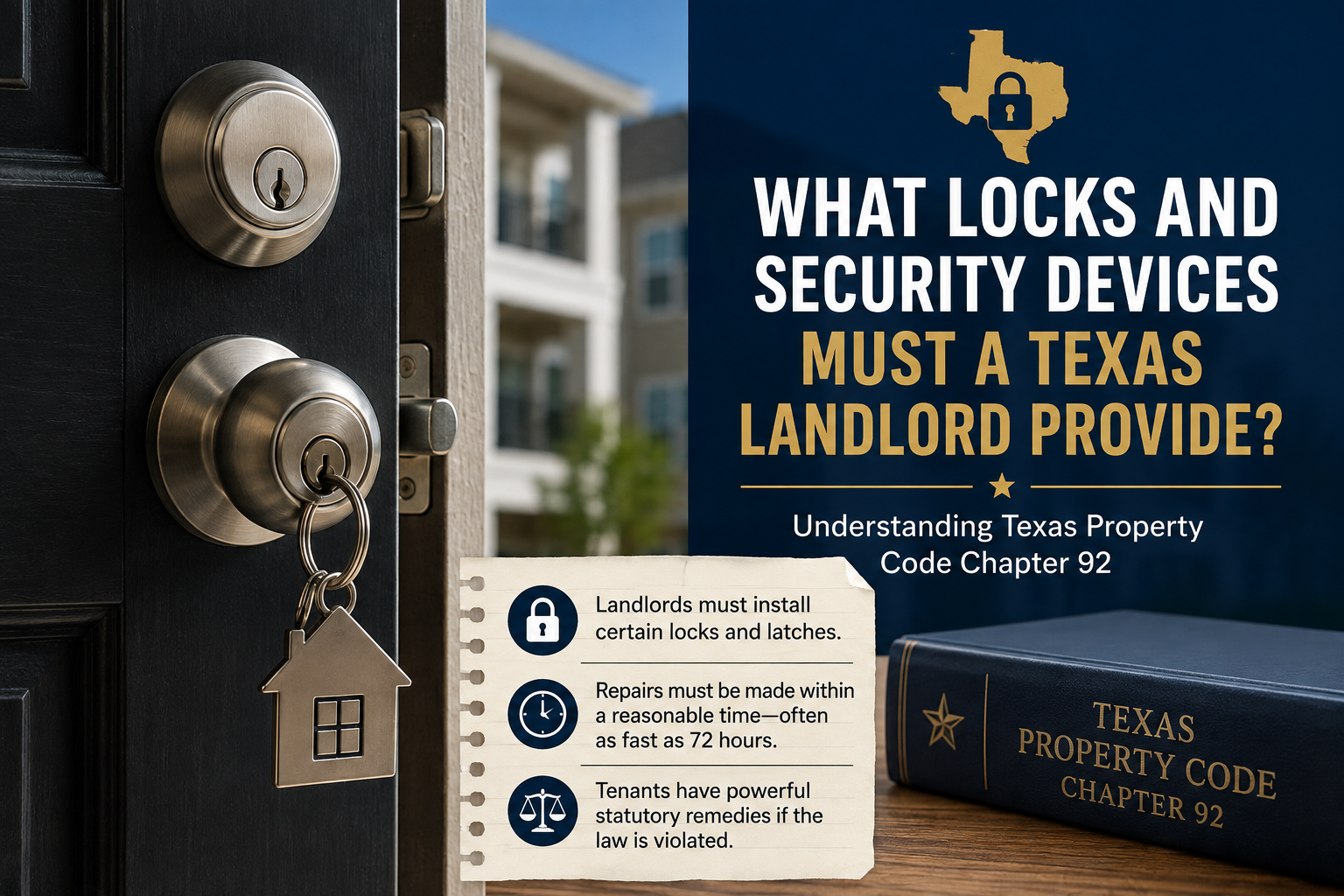
When you rent a house or apartment in Texas, you probably assume the exterior doors and windows will have functioning locks. What many tenants—and even some landlords—may not realize is that Texas law gets surprisingly specific about residential security devices.
The Texas Property Code does not simply impose a vague obligation to provide a “secure” rental property. Subchapter D of Chapter 92 identifies particular security devices that must generally be installed in residential rental dwellings, establishes rules for repairing and rekeying those devices, and gives tenants potentially significant remedies when a landlord fails to comply.
For both landlords and tenants, these provisions are worth understanding before a broken lock turns into a much larger dispute.
Texas Law Requires Certain Security Devices Even If the Tenant Never Asks
Texas Property Code § 92.153 establishes the starting point. Subject to statutory exceptions, a residential dwelling must contain certain security devices without the tenant having to request them.
The statute provides in part:
“a dwelling must be equipped with” a window latch on each exterior window and specified locks and security devices on exterior doors.
Tex. Prop. Code § 92.153. (Texas Statutes)
Depending on the type of door involved and the circumstances addressed by the statute, the required devices can include:
- window latches;
- doorknob locks or keyed dead bolts on exterior doors;
- sliding-door pin locks;
- sliding-door handle latches or security bars; and
- other statutorily required door-security devices.
This matters because the landlord's obligation under § 92.153 generally does not arise only after a tenant complains. The statute affirmatively places installation obligations on the landlord.
In other words, “the tenant never asked for a lock” is not necessarily an answer to a statutory security-device violation.
What If the Lock or Security Device Breaks?
Installation is only part of the landlord's responsibility.
Texas Property Code § 92.158 states:
“During the lease term and any renewal period, a landlord shall repair or replace a security device on request or notification by the tenant that the security device is inoperable or in need of repair or replacement.”
That language is important. Once an existing security device becomes inoperable or requires repair or replacement, the tenant's notice can trigger an affirmative statutory duty. (Texas Statutes)
A landlord therefore should not assume that a broken deadbolt, window latch, or sliding-door security device can simply wait indefinitely because the remainder of the rental property remains habitable.
Does the Tenant Have to Make the Request in Writing?
Not always.
Texas Property Code § 92.159 provides that a request or notice under the security-device subchapter may generally be oral.
There is an important exception: a written lease can require the notice or request to be in writing if that requirement is underlined or printed in boldface in the lease. (Texas Statutes)
As a practical matter, tenants may nevertheless want to document important security-related requests in writing. An email, tenant portal submission, or other written communication can create evidence of what was reported and when it was reported.
Landlords likewise benefit from maintaining records showing when a request was received and when the repair was completed.
How Quickly Does a Texas Landlord Have to Respond?
Texas law again gets unusually specific.
Under Texas Property Code § 92.161, a landlord generally must comply with a qualifying request to rekey, change, install, repair, or replace a security device within a reasonable time.
The statute creates a presumption that a reasonable time is:
“not later than the seventh day after the date the request is received by the landlord.”
But some security problems receive much faster treatment.
The presumptively reasonable period can fall to 72 hourswhen the tenant informs the landlord of certain recent security events, including an unauthorized entry or attempted entry into the tenant's dwelling, certain recent unauthorized entries elsewhere in a multiunit complex, or certain crimes of personal violence within the complex. Tex. Prop. Code § 92.161(c). (Texas Statutes)
That distinction makes sense. A sticking window latch and a broken lock following an attempted break-in may involve the same general statutory subject, but they present very different levels of urgency.
Who Has to Pay for the Repair?
For ordinary wear and tear, Texas Property Code § 92.162(a) states:
“A landlord may not require a tenant to pay for repair or replacement of a security device due to normal wear and tear.”
The statute does, however, contain circumstances in which a tenant may properly be charged.
For example, § 92.162(b) permits a charge under certain conditions when an underlined provision in the written lease authorizes it and the repair or replacement became necessary because of misuse or damage caused by the tenant, the tenant's family, an occupant, or a guest rather than ordinary wear and tear. (Texas Statutes)
That means responsibility for the bill may turn on whythe security device stopped working—not merely on the fact that the tenant was living there when it happened.
Can a Tenant Just Change the Locks?
Tenants should be cautious about doing this on their own.
Texas Property Code § 92.163 generally provides that a security device installed, changed, or rekeyed under the statutory subchapter becomes a fixture of the dwelling. It also generally prohibits a tenant from independently removing, changing, rekeying, replacing, or altering a security device without the landlord's permission, subject to specified statutory remedies. (Texas Statutes)
That is particularly important because tenants sometimes respond to a landlord's failure by simply hiring a locksmith and subtracting the expense from the next month's rent.
Texas law does provide repair-and-deduct remedies in certain security-device situations—but tenants should follow the applicable statutory requirements rather than assuming they can unilaterally modify the property and withhold part of the rent.
The Tenant's Remedies Can Be Significant
The security-device statutes have some teeth.
Under Texas Property Code § 92.165, when a landlord fails to comply with qualifying requests concerning rekeying, changing, adding, repairing, or replacing security devices, the tenant may have several statutory remedies.
Depending upon the circumstances and compliance with the statutory requirements, those remedies can include performing the work and deducting reasonable costs from rent, terminating the lease without court proceedings, or filing suit against the landlord.
Section 92.165 also authorizes specified judicial remedies that may include actual damages, a court order requiring compliance, court costs, attorney's fees in qualifying cases, and:
“a civil penalty of one month's rent plus $500.”
Punitive damages may also be available when the statutory requirements are satisfied and the landlord's failure to comply is intentional, malicious, or grossly negligent. (Texas Statutes)
These are substantial consequences for something that might initially appear to be a routine maintenance request.
Landlords Also Have Statutory Protections
The statute is not simply a strict-liability trap for landlords.
Chapter 92 contains detailed provisions governing notice, timing, payment obligations, permitted charges, defenses, and circumstances outside a landlord's control. For example, § 92.161 allows certain presumptions concerning response time to be rebutted when delay occurred despite the landlord's diligence because of circumstances identified by the statute. (Texas Statutes)
Likewise, § 92.1641 provides specified defenses to liability concerning installation or rekeying when, among other things, required rent or authorized costs have not been paid under the circumstances described by the statute. (Texas Statutes)
A security-device dispute therefore should not be analyzed by taking one sentence from Chapter 92 in isolation.
Practical Advice for Texas Landlords
For landlords and property managers, security devices are a good area for preventive compliance.
Before a tenant takes possession, landlords should verify that required locks, latches, and other security devices are present and functioning. During the tenancy, security-related repair requests should be documented and addressed promptly.
This is particularly important when the tenant reports an attempted break-in or another event that may trigger the shorter statutory response period.
A relatively inexpensive lock repair can become considerably more expensive if an ignored request creates statutory damages, lease-termination rights, or litigation.
Practical Advice for Texas Tenants
Tenants should promptly report broken or defective security devices.
Even when oral notice is legally sufficient, written documentation can help establish when the landlord received notice and exactly what condition was reported. Tenants should also photograph or otherwise document defective devices when appropriate.
Most importantly, tenants should not assume that every broken lock automatically permits them to stop paying rent, terminate the lease, or hire someone and deduct the cost. Texas Property Code Chapter 92 establishes particular procedures and remedies, and the facts matter.
The Bottom Line
Texas residential landlords have more specific security obligations than many people realize.
Chapter 92 of the Texas Property Code regulates not only whether certain locks and security devices must exist, but also when they must be repaired, how quickly landlords must respond, who may have to pay, and what remedies may be available when the law is violated.
For landlords, compliance can prevent a relatively small maintenance issue from becoming an expensive legal dispute.
For tenants, the statute provides meaningful protections—but those protections are strongest when the tenant understands and follows the statutory procedure.
Because landlord-tenant disputes are highly dependent on the lease, the type of property, the security device involved, the notice provided, and the surrounding circumstances, anyone facing a significant dispute should consider obtaining legal advice about the particular facts.
This article is for general informational purposes only and does not constitute legal advice.
At David C. Barsalou, Attorney at Law, PLLC, we help clients navigate business, family, tax, estate planning, and real estate matters ranging from document drafting to litigation with clarity and confidence. If you’d like guidance on your situation, schedule a consultation today. Call us at (713) 397-4678, email barsalou.law@gmail.com, or reach us through our Contact Page. We’re here to help you take the next step.
