Why Spelling Errors Sometimes Don’t Matter in Court
Legal documents are supposed to be precise. But what happens if a name is misspelled in a contract, lawsuit, deed, or judgment?
Surprisingly, Texas courts often treat minor spelling errors as legally insignificant under a doctrine called idem sonans. The phrase comes from Latin and means “sounding the same.”
Under this doctrine, if two names sound alike when pronounced, courts may treat them as legally identical—even if they are spelled differently.
This seemingly small rule can determine whether a lawsuit survives dismissal, whether a judgment lien attaches to property, or whether a recorded deed actually gives notice to the world.
The Legal Foundation: Why Courts Allow It
Texas courts generally prioritize substance over form, especially when the identity of a party is clear from the context of a document.
Procedural rules allow cases to continue even if a party’s name is slightly incorrect.
For example, Texas Rule of Civil Procedure 28 allows litigation to proceed when a party is incorrectly named but identifiable:
“Any partnership, unincorporated association, private corporation, or individual doing business under an assumed name may sue or be sued in its assumed or common name…”
— Tex. R. Civ. P. 28
This rule reflects a broader principle in Texas procedure: technical defects should not defeat otherwise valid claims.
Similarly, Texas recording law focuses on whether a recorded document provides notice, not whether every detail is perfectly spelled.
The Texas Property Code provides:
“A conveyance of real property… is void as to a creditor or to a subsequent purchaser for a valuable consideration without notice unless the instrument has been acknowledged, sworn to, or proved and filed for record as required by law.”
— Tex. Prop. Code § 13.001(a)
Because the statute focuses on notice, courts sometimes apply the idem sonans doctrine when determining whether a recording still provides sufficient notice despite a spelling error.
Common Situations Where Idem Sonans Appears
Although rarely discussed outside legal circles, the doctrine shows up in several real-world disputes.
1. Lawsuits with Slightly Incorrect Names
A petition might name:
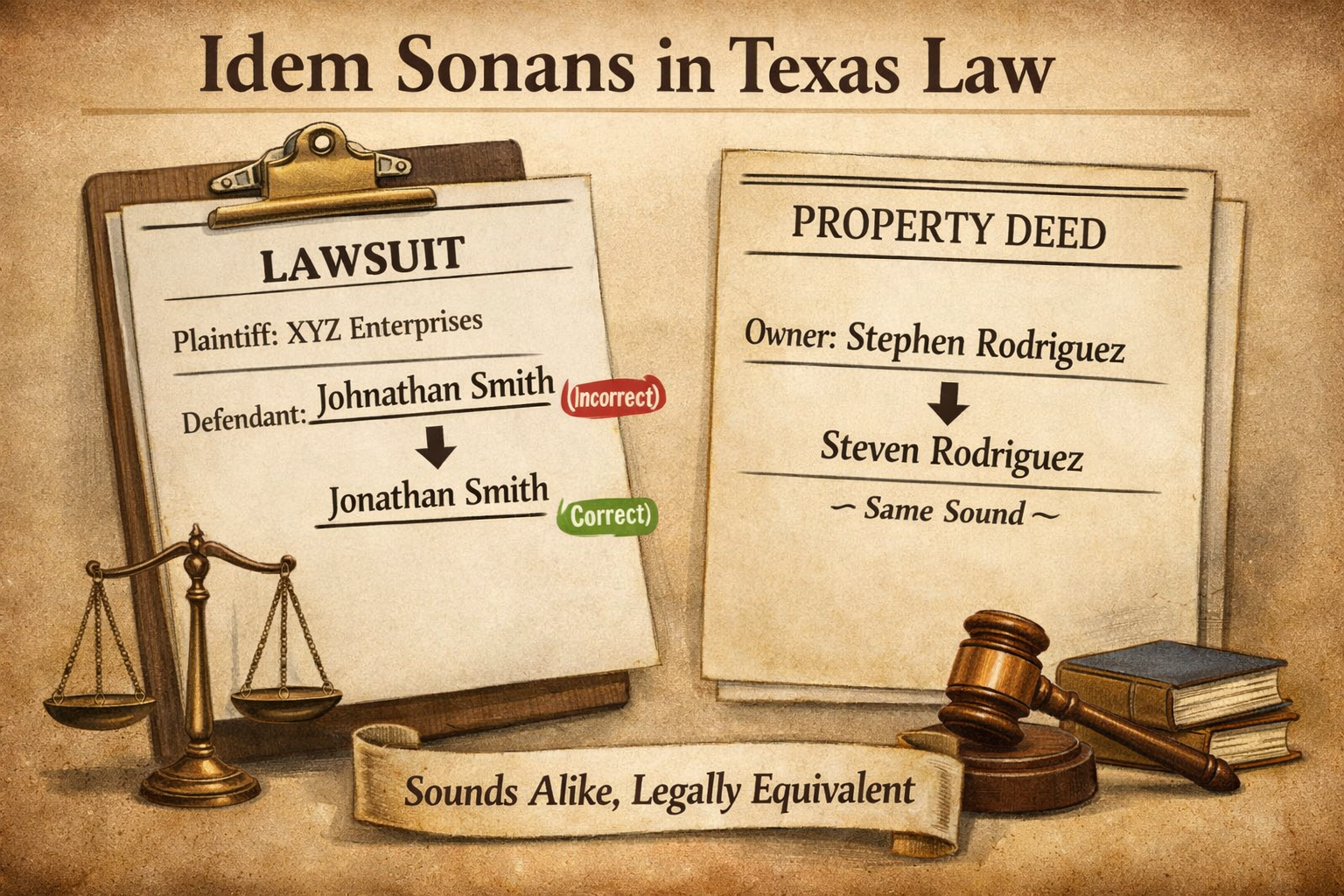
- “Johnathan Smith” instead of “Jonathan Smith”
- “McDonald” instead of “MacDonald”
If the defendant clearly knows he is the person being sued, courts may allow the case to proceed.
This prevents defendants from escaping liability because of trivial typographical errors.
2. Real Estate Recording Problems
The doctrine can also affect title disputes.
Example:
A deed might record the owner as:
- “Stephen Rodriguez”
But a later buyer searches for:
- “Steven Rodriguez”
If the names sound the same, courts may find the recorded document still provided constructive notice, meaning the later buyer cannot claim ignorance.
3. Judgment Liens and Asset Searches
Creditors searching property records sometimes encounter spelling variations.
For example:
- “Katherine Miller”
- “Catherine Miller”
If the names are phonetically identical, courts may determine that the judgment still effectively identifies the debtor.
When the Doctrine Does NOT Apply
The doctrine has limits. Courts generally reject it if:
- The names sound materially different
- The error creates genuine confusion about identity
- Multiple individuals could reasonably match the name
For example, the difference between “Smith” and “Smythe”might qualify, but “Smith” and “Johnson” obviously would not.
The core question is whether a reasonable person would recognize the two names as referring to the same individual.
Why This Matters in the Real World
For everyday Texans, the doctrine of idem sonans can quietly affect important legal rights.
It can determine:
- Whether a lawsuit survives a procedural challenge
- Whether a judgment lien attaches to property
- Whether a title defect exists in a real estate transaction
- Whether a creditor or buyer had legal notice
In other words, a single misplaced letter in a name does not always invalidate a legal document.
But in borderline cases, these disputes can become complex—and sometimes expensive to resolve.
Final Thoughts
The doctrine of idem sonans is one of those quirky legal rules that illustrates how courts balance technical precision with practical fairness.
The law recognizes that people misspell names, clerks make mistakes, and documents are imperfect. Rather than allowing minor typographical errors to defeat justice, courts often ask a simple question:
Does the name sound like the same person?
If the answer is yes, the document may still stand.
At David C. Barsalou, Attorney at Law, PLLC, we help clients navigate business, family, tax, estate planning, and real estate matters ranging from document drafting to litigation with clarity and confidence. If you’d like guidance on your situation, schedule a consultation today. Call us at (713) 397-4678, email barsalou.law@gmail.com, or reach us through our Contact Page. We’re here to help you take the next step.
