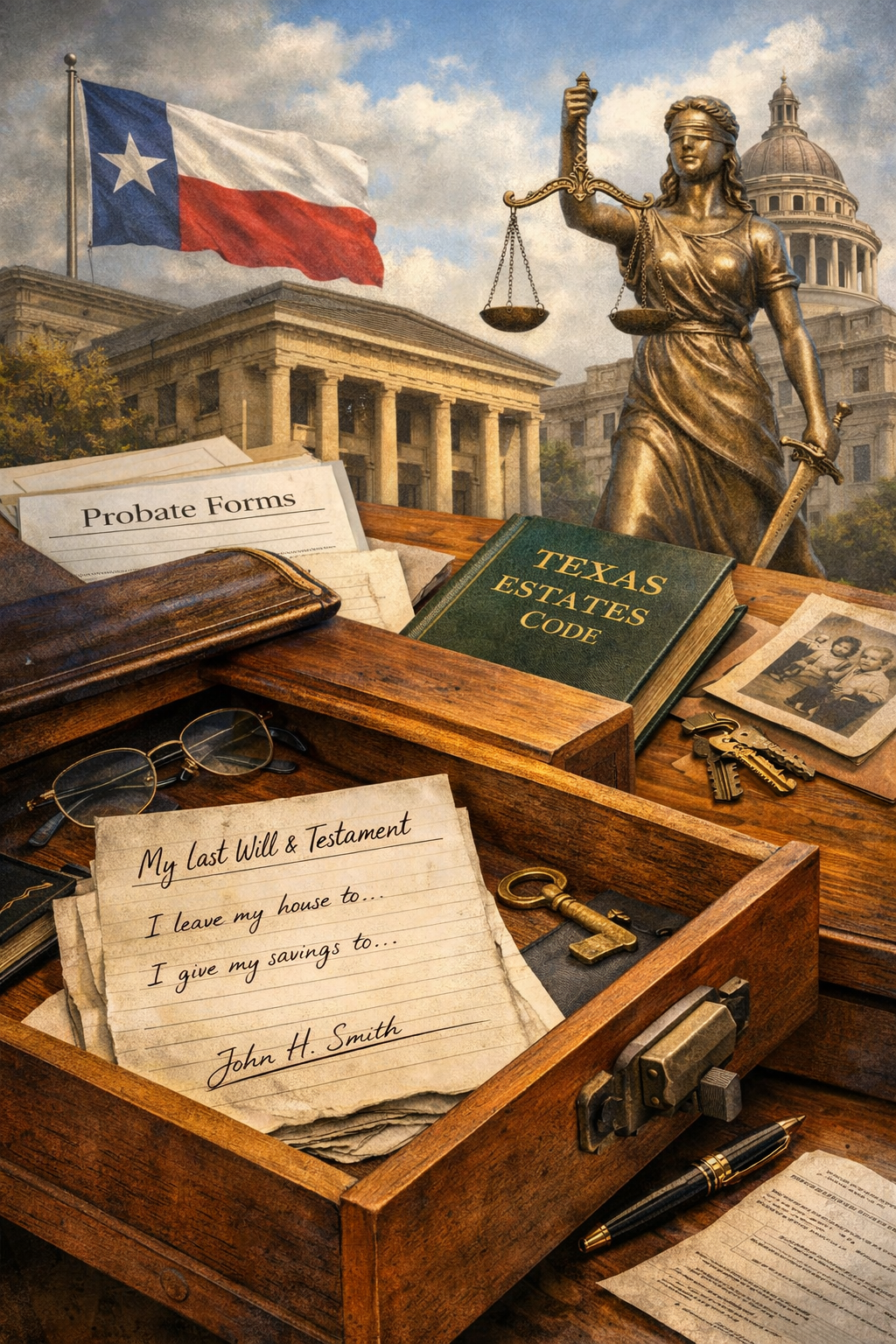
Most people imagine that a valid will lives in a lawyer’s vault or a bank safe deposit box.
In reality, many Texas estates begin with a far stranger discovery:
A handwritten note in a desk drawer.
A folded paper in a Bible.
A will taped inside a filing cabinet.
A photocopy found on a phone.
So the question becomes:
Can a “lost,” homemade, or hidden will actually be enforced in Texas?
In many cases, the answer is yes—but only if strict legal rules are followed.
This article explains how Texas courts handle handwritten and missing wills, what proof is required, and when families end up in expensive probate litigation.
1. Are Handwritten Wills Legal in Texas?
Yes. Texas recognizes holographic wills, which are wills written entirely in the testator’s handwriting.
Under the Texas Estates Code:
“A will written wholly in the handwriting of the testator is valid if signed by the testator.”
Tex. Estates Code § 251.052
Unlike formal typed wills, a holographic will:
- Does not require witnesses
- Does not require notarization
- Does not require an attorney
As long as it is:
✔ Entirely handwritten
✔ Signed by the deceased
✔ Shows testamentary intent
It can be legally valid.
2. Common Places Holographic Wills Are Found
In real probate cases, handwritten wills are often discovered:
- In nightstands
- In toolboxes
- Inside Bibles
- In glove compartments
- In desk drawers
- With tax records
- In email drafts (printed later)
Many Texans write these documents during illness, military deployment, divorce, or financial stress.
They are legally serious—even if written on notebook paper.
3. What If the Original Will Is Missing?
Sometimes families know a will existed—but cannot find the original.
Texas law allows probate of a lost will under certain conditions.
The Estates Code provides:
“A written will that cannot be produced in court may be admitted to probate if the proponent proves the cause of nonproduction.”
Tex. Estates Code § 256.156
To probate a missing will, the applicant must prove:
- The will was properly executed
- The contents of the will
- The will was not revoked
- Why the original cannot be located
This is often done through testimony, copies, emails, and attorney records.
4. Presumption of Revocation: The Biggest Legal Hurdle
If the original will cannot be found, Texas law creates a major presumption:
If the decedent had possession of the will and it disappeared, the court may presume it was revoked.
Courts assume:
“If they wanted it to apply, they would not have destroyed it.”
Overcoming this presumption requires strong evidence, such as:
- Proof the will was kept by a lawyer
- Evidence of house fires or floods
- Testimony of theft or misplacement
- Statements by the deceased near death
Without this proof, the estate may pass under intestacy laws instead.
5. Proving a Handwritten Will in Court
Even valid holographic wills must be proven.
Texas requires handwriting verification:
“A holographic will may be proved by two witnesses to the handwriting of the testator.”
Tex. Estates Code § 251.107
This usually involves:
- Friends
- Family members
- Coworkers
- Business associates
Who can testify: “Yes, that is his handwriting.”
If handwriting is disputed, forensic experts may be used.
6. Why These Cases Frequently Turn Into Lawsuits
Handwritten and lost wills are among the most litigated probate matters in Texas.
Common disputes include:
- Allegations of forgery
- Claims of undue influence
- Accusations of manipulation
- Questions about mental capacity
- Competing versions of wills
Because these documents lack formal safeguards, they invite challenges.
What begins as a “simple note” can turn into six-figure litigation.
7. What Happens If No Valid Will Is Proven?
If no valid will is admitted, Texas intestacy laws control.
Under the Estates Code, property passes based on:
- Marital status
- Children
- Parents
- Siblings
Not personal wishes.
Many families are shocked to learn that:
✔ Long-term partners receive nothing
✔ Stepchildren receive nothing
✔ Close friends receive nothing
Without a valid will, the statute decides.
8. Practical Lessons for Texans
From years of probate litigation, several lessons repeat:
For Individuals
- Don’t rely on “drawer wills”
- Store originals safely
- Tell someone where your will is
- Update after major life changes
For Families
- Do not discard handwritten papers
- Preserve all documents
- Photograph discoveries
- Consult counsel immediately
A single misplaced page can decide an entire estate.
9. When You Should Contact a Probate Attorney
You should speak with a lawyer if:
- A handwritten will was found
- The original will is missing
- Multiple versions exist
- Heirs are disputing validity
- Property transfers are stalled
Early legal guidance often prevents years of conflict.
Conclusion: Informal Wills Can Have Enormous Legal Consequences
In Texas, a will does not have to look “official” to be powerful.
A handwritten note in a drawer can:
- Transfer real estate
- Override family expectations
- Trigger lawsuits
- Control millions of dollars
But only if it meets strict statutory requirements.
Understanding these rules protects both families and estates from unnecessary chaos.
At David C. Barsalou, Attorney at Law, PLLC, we help clients navigate business, family, tax, estate planning, and real estate matters ranging from document drafting to litigation with clarity and confidence. If you’d like guidance on your situation, schedule a consultation today. Call us at (713) 397-4678, email barsalou.law@gmail.com, or reach us through our Contact Page. We’re here to help you take the next step.