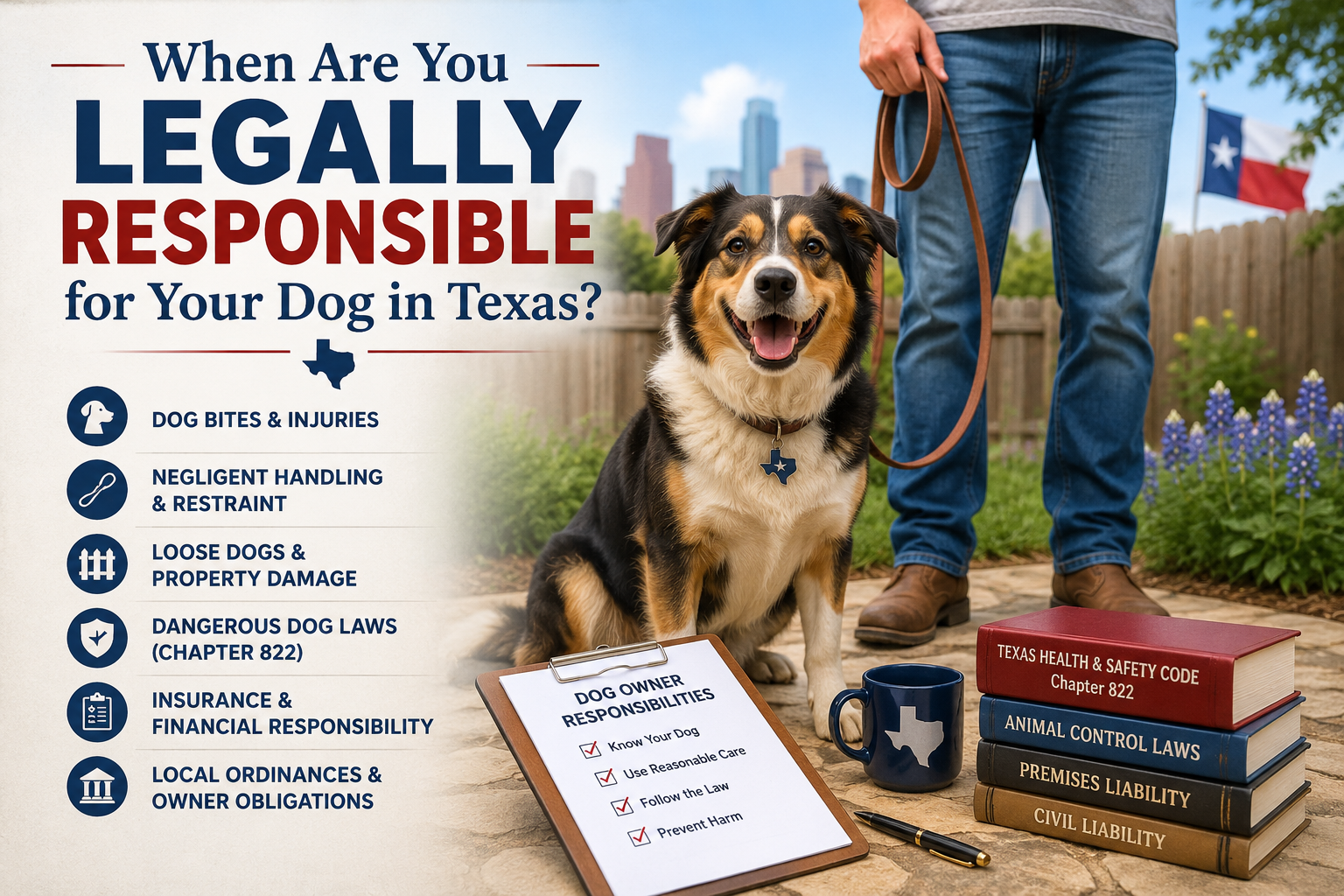
Dogs are part of millions of American households.
Most dogs will never seriously injure anyone. But even an ordinarily friendly dog can bite when frightened, escape through an open gate, knock someone to the ground, chase a bicyclist, or otherwise cause an accident.
When that happens, an obvious legal question follows:
Is the dog's owner responsible?
The answer under Texas law is not always as simple as people assume.
Texas does not impose automatic liability on a dog owner every time a dog causes an injury. Depending on the circumstances, however, an owner may potentially face liability under several different legal theories.
The dog's previous behavior may matter. So may the owner's knowledge, the way the dog was being handled or restrained, local animal-control ordinances, the conduct of the injured person, and exactly how the injury occurred.
Texas also has separate statutory provisions governing dogs legally considered "dangerous."
Understanding these distinctions can help dog owners—and people injured by dogs—understand when an unfortunate accident may become a legal problem.
Does Texas Have a "One-Bite Rule"?
People sometimes describe Texas as following a "one-bite rule."
That description can be misleading.
Texas common law recognizes a strict-liability theory when a domestic animal has dangerous characteristics and its owner knows or has reason to know about them.
The leading Texas Supreme Court case is Marshall v. Ranne, 511 S.W.2d 255 (Tex. 1974). Interestingly, that case did not involve a dog. It involved a vicious boar hog that repeatedly escaped onto a neighbor's property and eventually attacked him.
The Texas Supreme Court explained the distinction between liability involving an animal known to have dangerous propensities and liability based upon negligent handling of an animal. (vLex)
The principle has subsequently been applied in dog cases.
Accordingly, the law does not necessarily give every dog a literal "free first bite."
A previous bite can obviously provide powerful evidence that an owner knew the dog was dangerous. But a prior bite is not necessarily the only way dangerous tendencies can become apparent.
A dog's prior behavior and the owner's knowledge of that behavior can therefore become extremely important.
When Can a Dog Owner Be Strictly Liable?
Texas courts recognize that the owner of a domestic animal may face strict liability when the animal possesses dangerous or vicious characteristics that are abnormal for its class and the owner knows or has reason to know about those characteristics.
In the dog context, courts have described a strict-liability claim as involving evidence that:
- the dog had a vicious, dangerous, or mischievous nature;
- the owner actually or constructively knew about those characteristics; and
- the injury resulted from the dangerous propensity of which the owner had knowledge. (Justia Law)
Suppose, for example, that a dog has repeatedly attacked people, aggressively charged visitors, or previously bitten someone.
Those facts could potentially become evidence that the dog's owner knew or should have known that the animal presented a danger.
This is the origin of the popular "one-bite rule."
But the actual inquiry is generally about dangerous propensities and knowledge, not simply counting bites.
What If the Dog Has Never Bitten Anyone Before?
This is where the distinction between strict liability and negligencebecomes particularly important.
The absence of a previous bite does not necessarily mean that the owner can never be liable.
The Texas Supreme Court addressed this issue in Bushnell v. Mott, 254 S.W.3d 451 (Tex. 2008).
In that case, a woman arrived at another woman's home to deliver products. When the homeowner opened the door, three dogs rushed out and attacked the visitor.
The Texas Supreme Court distinguished strict liability for a vicious animal from liability for negligent handling of an animal that was not previously known to be vicious. The Court held that an owner can have a duty to exercise reasonable care once an attack begins even without prior knowledge that the dog had dangerous propensities. (Justia Law)
That distinction is important.
"My dog has never bitten anyone before" does not necessarily end the legal analysis.
What Is Negligent Handling of a Dog?
A negligence claim focuses on the owner's conduct rather than merely the dog's history.
Generally speaking, negligence involves a duty, breach of that duty, and an injury proximately caused by the breach.
Texas courts recognize that dog owners can, under appropriate circumstances, have a duty to exercise reasonable care to prevent their animals from injuring others. (Texas Courts)
The particular facts matter enormously.
For example, questions could arise concerning whether an owner:
- failed to properly restrain a dog under circumstances requiring restraint;
- allowed a dog to escape despite knowing of circumstances indicating that it could cause harm;
- failed to exercise reasonable control over the animal;
- opened a door or gate under circumstances creating a foreseeable risk; or
- failed to take reasonable action after seeing that the dog was attacking someone.
A negligence case therefore does not necessarily depend upon proving that the dog had previously bitten somebody.
Does the Dog Actually Have to Bite Someone?
No.
This is another reason it can be misleading to think of this entire area as simply "dog-bite law."
Dogs can cause injuries without biting anyone.
Imagine a large dog runs toward an elderly visitor and knocks the person down. Or a loose dog chases a bicyclist, causing the bicyclist to crash. A pedestrian might fall while trying to avoid a charging dog.
The important legal questions concern the applicable theory of liability, the owner's duties and knowledge, causation, and damages.
The fact that the dog's teeth never touched the injured person does not necessarily mean that no claim can exist.
What If Your Dog Gets Out of the Yard?
A dog escaping from its owner's property does not automatically make the owner liable for everything that subsequently happens.
But the circumstances surrounding the escape can matter.
Was the gate knowingly left open?
Was the fence obviously inadequate?
Had the dog repeatedly escaped before?
Was the owner aware that the dog tended to chase pedestrians, animals, bicycles, or vehicles?
Was there an applicable city or county ordinance requiring the dog to be restrained?
These kinds of facts may affect whether the owner's conduct was reasonable and whether the resulting injury was foreseeable.
Texas is a large state, and local animal-control laws can vary. Dog owners therefore should not assume that state law is the only law governing how their animals must be kept.
What If Your Dog Causes a Car or Bicycle Accident?
An animal-related injury does not have to look like a traditional animal attack.
Suppose a dog escapes from a yard and runs into a roadway. A driver swerves to avoid it and strikes another vehicle.
Or a dog begins chasing a cyclist, who loses control and suffers serious injuries.
Those situations can present questions of ordinary negligence and causation even though nobody was bitten.
The injured person would still have to establish the elements of the particular claim. Merely showing that a dog was somewhere near an accident does not automatically establish liability.
But an owner's failure to exercise legally required or reasonable control over an animal can potentially become important evidence.
What If Someone Provokes the Dog?
The conduct of the injured person can matter too.
Dog cases do not exist in a vacuum.
A person who intentionally antagonizes an animal, disregards warnings, trespasses, or otherwise contributes to the circumstances producing an injury may present a very different case from an invited guest unexpectedly attacked while walking to the front door.
The effect of the injured person's conduct depends on the legal theory asserted and the particular facts.
Texas also generally uses a proportionate-responsibility system in negligence cases, meaning that responsibility for an injury may potentially be divided among multiple responsible parties rather than treated as an all-or-nothing question.
Accordingly, determining that a dog owner acted negligently does not necessarily answer every question concerning liability or damages.
What Is a "Dangerous Dog" Under Texas Law?
Texas law also creates a separate statutory framework for certain dangerous dogs under Chapter 822 of the Texas Health and Safety Code.
This is important because being legally classified as the owner of a dangerous dog can create obligations beyond the ordinary rules governing civil lawsuits.
Chapter 822 establishes procedures through which animal-control authorities and courts can make dangerous-dog determinations.
Once an owner learns that the person owns a dangerous dog, Texas law generally requires the owner, within the statutory deadline, to take specific steps. (Texas Constitution and Statutes)
These include requirements concerning registration and restraint.
Does a Dangerous Dog Require Liability Insurance?
Texas Health and Safety Code § 822.042 generally requires an owner of a dangerous dog to obtain liability insurance coverage or demonstrate financial responsibility of at least $100,000 to cover damages resulting from an attack by the dangerous dog that causes bodily injury to a person.
The statute also generally requires the dog to be restrained on a leash in the immediate control of a person or kept in a secure enclosure, as well as compliance with applicable municipal or county regulations. (Texas Constitution and Statutes)
Failure to comply can have serious consequences.
Chapter 822 provides procedures for seizure and, under certain circumstances, destruction of a dangerous dog when the statutory requirements are not satisfied.
This statutory system is separate from the question of whether an injured person can recover civil damages from the owner.
Can Local Cities and Counties Have Their Own Dog Rules?
Yes.
This can be one of the most important practical issues in an animal-related dispute.
Texas statutes do not necessarily occupy the entire field of animal regulation. Municipalities and counties may have applicable animal-control rules concerning matters such as restraint, registration, dangerous animals, and related requirements.
Indeed, the state dangerous-dog statute expressly requires compliance with applicable municipal or county regulations as part of the obligations imposed upon owners of dangerous dogs. (Texas Constitution and Statutes)
Consequently, determining whether a dog owner violated the law may require examining more than the Texas statutes.
The ordinance applicable where the incident occurred may matter too.
What If Someone Else Was Watching the Dog?
Ownership is important, but it may not always be the end of the analysis.
A dog might be in the custody of:
- a family member;
- a friend;
- a pet sitter;
- a boarding facility;
- a dog walker; or
- another person temporarily responsible for controlling the animal.
Depending upon the circumstances, questions can arise concerning who possessed or controlled the dog, who knew about its behavior, who had the ability and responsibility to restrain it, and whose conduct actually caused the injury.
The mere fact that a person's name appears on veterinary records does not necessarily resolve every potential liability issue arising from another person's handling of the animal.
What If a Tenant's Dog Injures Someone?
Dog incidents can also create issues beyond the relationship between the dog's owner and the injured person.
Suppose a tenant keeps a dangerous dog at a rental property and the dog attacks someone.
Questions may arise concerning the tenant's responsibility, the landlord's knowledge, control over the premises, lease provisions, prior complaints, and the particular circumstances of the incident.
A landlord is not automatically liable simply because an injury occurs at rental property the landlord owns.
As with many premises-related disputes, control and knowledge can become extremely important.
The particular facts and applicable law must therefore be examined before assuming that either the tenant or landlord—or both—can be held responsible.
Can a Dog Owner Face Consequences Other Than a Civil Lawsuit?
Yes.
Civil liability is only one potential consequence of a serious dog incident.
Depending upon the circumstances, Texas statutes and local ordinances can provide for animal-control proceedings, registration requirements, restraint requirements, seizure, impoundment, and other consequences.
The state also regulates how dogs may be restrained outdoors. Texas Health and Safety Code Chapter 821, for example, imposes requirements concerning unattended outdoor restraints and prohibits certain methods of restraint. (Texas Constitution and Statutes)
Accordingly, a dog incident can potentially produce several different legal proceedings involving different standards and consequences.
A lawsuit seeking money damages is not the same thing as an animal-control proceeding concerning the dog itself.
What Damages Can Result From a Dog-Related Injury?
When a dog owner is legally liable for an injury, the damages depend upon the nature and extent of the loss and the applicable cause of action.
A serious attack can potentially involve substantial medical treatment, scarring, lost income, physical impairment, pain, and other damages recognized under Texas law.
Property damage may present a different measure of damages.
And some incidents that initially appear minor can become expensive quickly.
A dog bite that requires emergency treatment, for example, can lead to questions involving infection, vaccination history, follow-up care, scarring, and additional medical treatment.
The existence and amount of recoverable damages remain matters that must be established rather than presumed merely because an incident occurred.
Does Homeowners or Renters Insurance Cover Dog Liability?
Sometimes.
Many homeowners and renters insurance policies provide some form of personal liability coverage, but the existence and scope of coverage depend upon the actual policy.
Exclusions, limitations, policy definitions, the location of the incident, the nature of the conduct, and sometimes the animal's history can affect coverage.
An owner involved in a serious incident should therefore not simply assume either that insurance covers everything or that insurance provides no protection.
The policy itself needs to be reviewed.
An insurer should also generally be notified promptly of a claim or potential claim in accordance with the policy's requirements.
What Should a Dog Owner Do After a Serious Incident?
A serious dog incident should be treated seriously even if everyone involved initially appears calm.
Relevant evidence can disappear quickly.
Witnesses may forget what happened. Surveillance footage may be overwritten. Gates or fences may be repaired. Text messages may be deleted. The dog's vaccination and veterinary records may become important.
The incident may also trigger reporting or animal-control requirements.
For the owner, it can be particularly important to preserve relevant records, comply with lawful animal-control requirements, notify any applicable insurer, and avoid making careless statements about fault or the dog's history before understanding the legal consequences.
The injured person likewise has an interest in documenting the incident and obtaining appropriate medical care.
A Dog's History Matters—but So Does the Owner's Conduct
Texas dog-liability law cannot be reduced to the statement that every dog gets "one free bite."
A dog's previous dangerous behavior and the owner's knowledge of that behavior can be critical when strict liability is alleged.
But Texas law also recognizes negligence principles that can impose liability based upon how an animal was handled—even when the animal was not previously known to be vicious. The Texas Supreme Court made that distinction particularly clear in Bushnell v. Mott. (Justia Law)
And once a dog falls within Texas's statutory dangerous-dog framework, the owner can face specific registration, restraint, financial-responsibility, and local-compliance requirements. (Texas Constitution and Statutes)
The result therefore depends heavily upon the facts.
What did the dog do?
What did the owner know?
What precautions were taken?
Was the dog properly controlled?
Did anyone else contribute to the incident?
Were state statutes or local ordinances violated?
Those questions matter far more than simply asking whether the dog had ever bitten anyone before.
For Texas dog owners, the practical lesson is straightforward: owning an animal includes a responsibility to take reasonable precautions when circumstances indicate that the animal could injure someone.
And when a serious incident does occur, determining legal responsibility may require looking at common-law liability, negligence principles, state statutes, local ordinances, insurance coverage, and the particular facts surrounding the event.
At David C. Barsalou, Attorney at Law, PLLC, we help clients navigate business, family, tax, estate planning, and real estate matters ranging from document drafting to litigation with clarity and confidence. If you’d like guidance on your situation, schedule a consultation today. Call us at (713) 397-4678, email barsalou.law@gmail.com, or reach us through our Contact Page. We’re here to help you take the next step.