When Do You Actually Need a Board-Certified Lawyer in Texas—and What Board Certification Really Signals
If you are looking for a lawyer in Texas, you will almost certainly encounter the phrase “board certified.” In Texas, that label carries a specific meaning, is regulated, and often causes confusion for clients. Some people assume it is required. Others assume it guarantees superior results.
Neither assumption is quite right.
This post explains what board certification means under Texas law, when it truly matters, and when other factors may be just as important.
What Board Certification Means in Texas
In Texas, board certification is administered by the Texas Board of Legal Specialization (TBLS). It is a voluntary credentialthat recognizes lawyers who demonstrate substantial involvement and advanced proficiency in a specific area of law.
To become board certified in Texas, an attorney generally must:
- Devote a significant portion of their practice to a particular specialty
- Practice law for a minimum number of years
- Receive peer recommendations, often including judges and opposing counsel
- Pass a rigorous written examination in that specialty
- Complete ongoing continuing legal education beyond standard requirements
Board certification is not a license to practice law—it is a designation intended to signal specialization through repetition and experience.
What Board Certification Actually Signals to Texas Clients
In practical terms, board certification in Texas usually signals:
- High-volume experience in a narrow practice area
- Familiarity with Texas-specific statutes, procedures, and courts
- Repeated exposure to complex or contested matters
- Recognition by peers as someone who focuses heavily on that field
For example, a board-certified Texas family lawyer has likely handled a very large number of contested custody cases, enforcement actions, and trials within the Texas Family Code framework.
That kind of depth can matter—but not in every case.
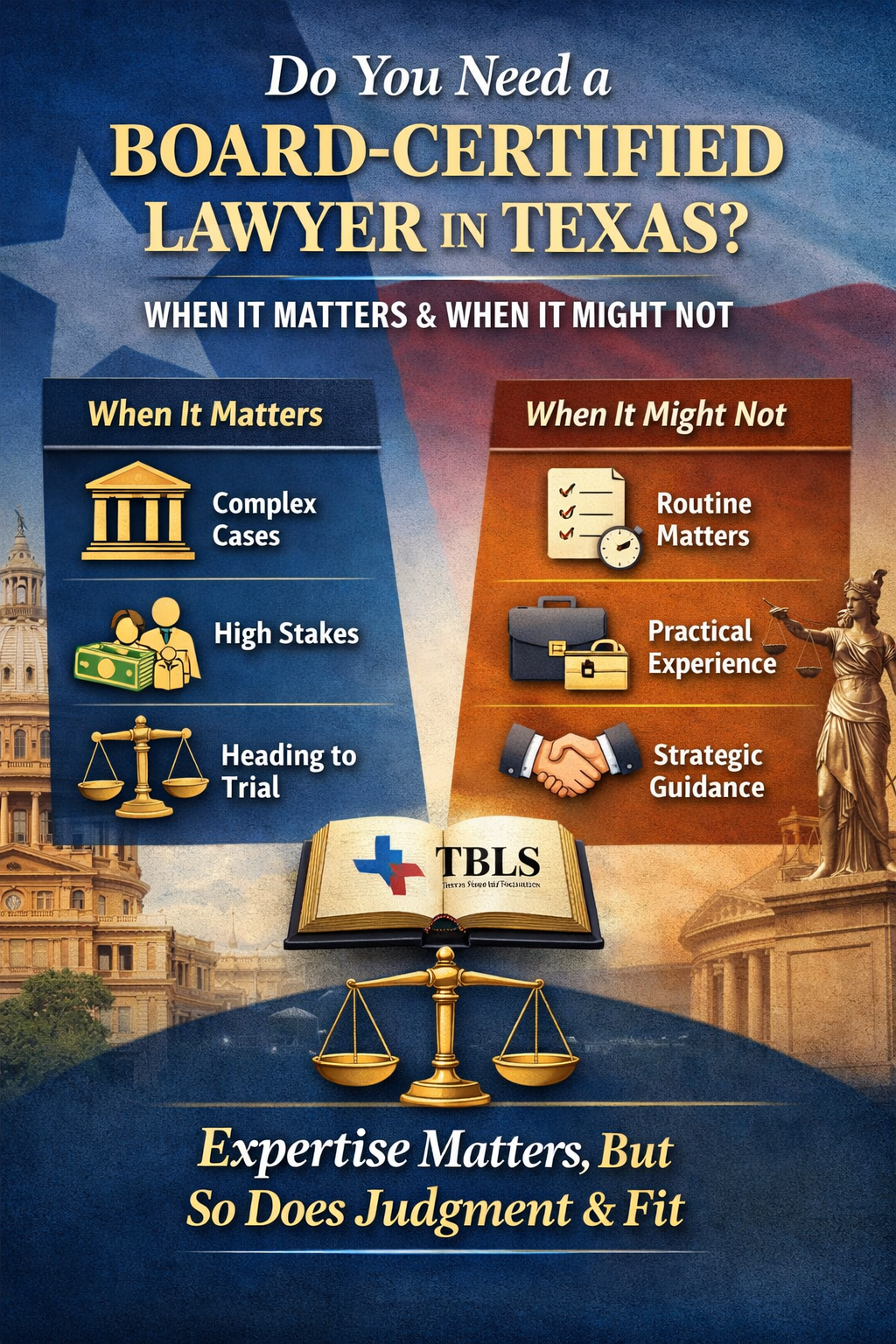
When a Board-Certified Lawyer Often Makes Sense in Texas
You should strongly consider a board-certified attorney when one or more of the following apply:
1. The Matter Is Highly Specialized Under Texas Law
Some areas of Texas law are particularly technical, such as:
- Contested child custody and enforcement litigation
- Complex property characterization disputes
- High-stakes tax controversies
- Medical or professional liability cases
These matters often involve strict procedural rules and Texas-specific doctrines where mistakes can be costly or irreversible.
2. The Stakes Are High
Board certification becomes more relevant when the outcome could:
- Substantially affect your financial future
- Permanently alter parental or property rights
- Trigger regulatory, tax, or professional consequences
In high-risk cases, specialization can reduce uncertainty.
3. The Case Is Headed Toward Trial
As a case moves closer to trial in a Texas court, precision becomes more important. Judges, evidentiary rules, and local practice norms begin to matter more than broad legal knowledge.
Specialized trial experience is often reflected—but not exclusively guaranteed—by board certification.
When Board Certification May Matter Less in Texas
Many excellent Texas lawyers are not board certified. You may not need a board-certified attorney when:
1. The Matter Is Routine or Procedural
Examples include:
- Uncontested matters
- Standard business or estate planning documents
- Advisory or compliance-focused work
In these situations, responsiveness, clarity, and practical judgment may be more important than formal specialization.
2. The Lawyer Has Deep, Relevant Experience Without Certification
Some Texas attorneys practice narrowly for decades without pursuing formal certification. Others bring related professional backgrounds—such as tax, accounting, or financial experience—that add substantial value beyond a credential.
Board certification is one pathway to expertise, not the only one.
3. Strategy and Judgment Are the Primary Issues
Many legal outcomes turn on:
- Strategic decision-making
- Risk assessment
- Clear communication with clients
- Knowing when not to escalate a dispute
These skills are not measured by an exam.
What Board Certification Does Not Mean
Even in Texas, board certification does not mean that a lawyer is:
- Automatically better for every case
- Guaranteed to obtain better results
- More ethical or more diligent
- Always the most cost-effective option
It is a meaningful signal—but it is only one factor among many.
A Note on Transparency and This Firm
Under Texas advertising rules, lawyers may advertise board certification only if certified by the Texas Board of Legal Specialization.
The attorney authoring this post is not board certified in any area of law.
Many Texas clients choose lawyers based on experience, responsiveness, analytical ability, and practical judgment, rather than credentials alone. Board certification can be an important consideration in certain cases, but it is not always the deciding factor—and it is not required to competently practice law in Texas.
The Bottom Line for Texas Clients
- Board certification in Texas is a real and regulated credential
- It matters most in complex, high-stakes, and technical cases
- It matters less in routine, advisory, or strategy-driven matters
- It should be evaluated alongside experience, fit, and judgment
The right lawyer for your situation is not defined by a single label, but by how well their experience aligns with the legal problem you actually have.
At David C. Barsalou, Attorney at Law, PLLC, we help clients navigate business, family, tax, estate planning, and real estate matters ranging from document drafting to litigation with clarity and confidence. If you’d like guidance on your situation, schedule a consultation today. Call us at (713) 397-4678, email barsalou.law@gmail.com, or reach us through our Contact Page. We’re here to help you take the next step.