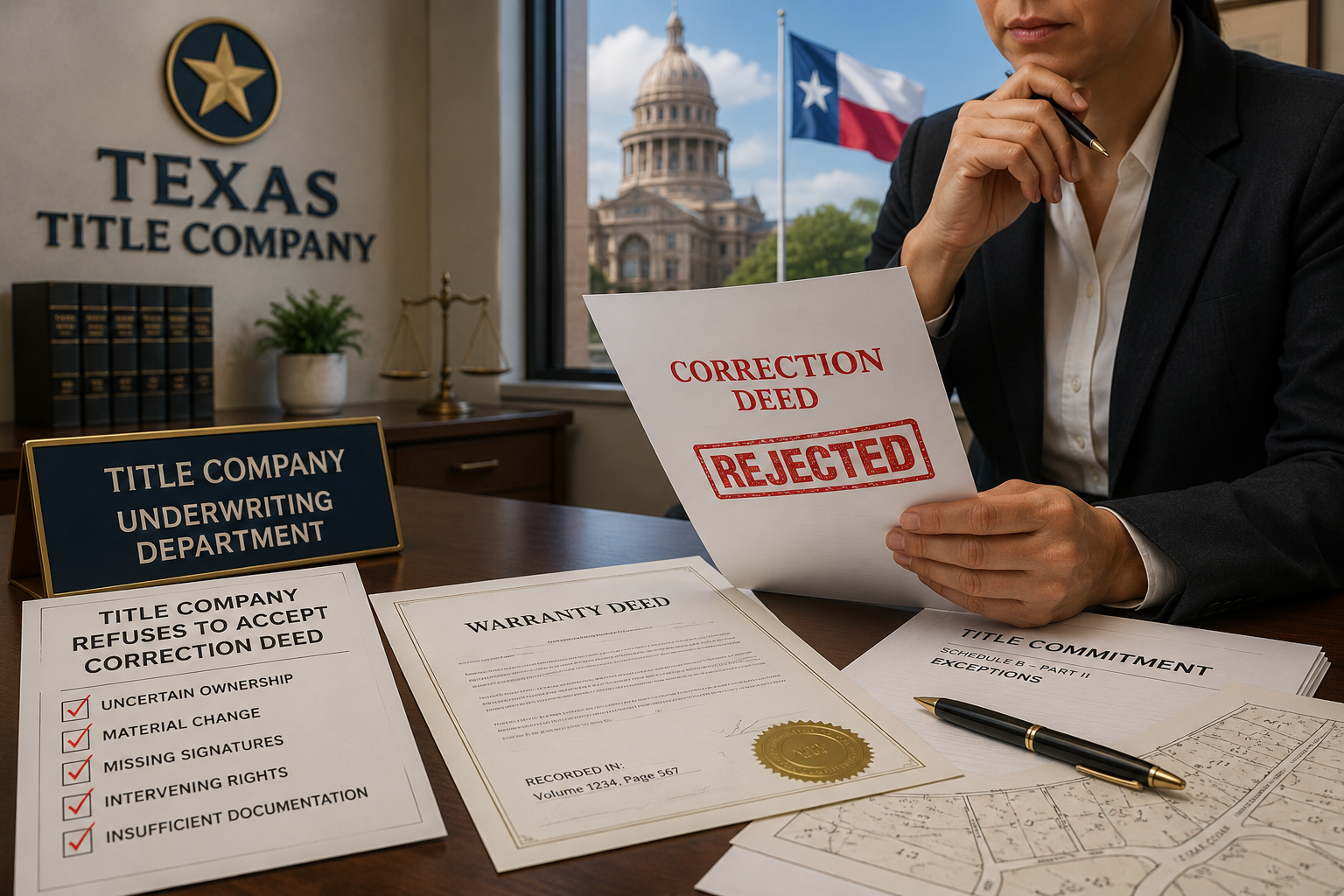
Few things are more frustrating than preparing to close on a Texas real estate transaction only to hear that the title company refuses to insure title because of a problem with a correction deed.
Many property owners assume that recording a correction instrument automatically fixes any mistake in a previously recorded deed. Unfortunately, that is not always true. Title companies are responsible for evaluating risks before issuing title insurance, and they may refuse to rely on a correction instrument that does not satisfy Texas law or leaves ownership questions unresolved.
Understanding why a title company may reject a correction deed can help property owners avoid delays, failed closings, and expensive litigation.
What Is a Correction Instrument?
Texas law authorizes the use of correction instruments to remedy certain errors in previously recorded conveyances.
Texas Property Code § 5.027 provides in part:
"A person who has personal knowledge of facts relevant to the correction of a recorded original instrument of conveyance may prepare or execute a correction instrument to correct the original instrument."
The Texas Property Code also distinguishes between corrections involving nonmaterial errors and those involving material changes to the original conveyance.
A Title Company's Job Is Different From a Court's
A common misunderstanding is that a title company decides whether someone legally owns property.
That is not the title company's role.
Instead, the title company evaluates whether it is willing to insure title against future claims. If there is uncertainty about ownership or the validity of a correction instrument, the company may simply decline to insure the transaction until the issue is resolved.
In other words, the title company is managing risk—not deciding legal rights.
Common Reasons a Title Company May Reject a Correction Deed
1. The Correction Changes Ownership
One of the biggest red flags occurs when a correction instrument appears to add, remove, or substitute owners.
For example:
- adding another grantee;
- removing a co-owner;
- changing ownership percentages; or
- substituting a different parcel of land.
These changes may affect substantive property rights and often require compliance with the procedures governing material corrections or, in some circumstances, judicial relief.
2. Not Everyone Required Signed the Instrument
A title company may question whether every person whose interests are affected properly executed the correction instrument.
If one owner's signature is missing—or there is uncertainty about authority to sign—the company may refuse to insure the transaction until the issue is resolved.
3. The Original Mistake Is Not Clearly Clerical
Some errors are obviously typographical.
Others are not.
Suppose the legal description changes from one lot to another entirely. Was that simply a drafting mistake, or did the parties intentionally convey different property?
If the answer is unclear, a title company may require additional documentation or litigation before issuing a policy.
4. Third-Party Rights Have Arisen
Real estate rarely stays unchanged.
Since the original deed was recorded:
- mortgages may have been filed;
- judgment liens may have attached;
- additional purchasers may have acquired interests;
- mineral interests may have been conveyed; or
- heirs may now claim ownership.
Even if everyone agrees a mistake occurred, intervening rights can complicate the analysis considerably.
5. The Correction Instrument Creates New Questions
Ironically, some correction instruments create more uncertainty than the original deed.
Examples include:
- inconsistent legal descriptions;
- conflicting execution dates;
- unexplained changes;
- missing acknowledgments; or
- references to documents that cannot be located.
Rather than curing the title defect, these issues may create additional exceptions to title coverage.
Why Title Companies Tend to Be Conservative
Title insurance protects buyers and lenders against covered defects in title.
If a title company insures ownership that later proves defective, it may be responsible for substantial financial losses.
For that reason, title companies often require clear documentation before accepting correction instruments that affect ownership rights.
Their cautious approach is generally intended to reduce future claims—not to frustrate buyers or sellers.
Sometimes Litigation Is the Only Practical Solution
Not every title defect can be resolved through a correction instrument.
Depending on the circumstances, the appropriate remedy may involve:
- deed reformation;
- a suit to quiet title;
- a trespass-to-try-title action;
- probate proceedings;
- heirship proceedings; or
- another judicial determination of ownership.
Once a court enters a final judgment resolving the dispute, title companies are often in a much stronger position to insure the property.
Practical Tips Before Recording a Correction Instrument
Before recording a correction deed:
- determine whether the error is material or nonmaterial;
- confirm that the appropriate parties have signed;
- compare the correction to the original conveyance;
- discuss the issue with the title company handling the transaction; and
- avoid assuming that simply recording another deed automatically cures every title defect.
Addressing these issues early can prevent costly delays when a property is sold or refinanced.
Final Thoughts
A correction instrument can be an effective way to resolve many recording mistakes under Texas law, but it is not a universal solution. Title companies must evaluate whether a correction instrument actually eliminates uncertainty or creates additional risk. Understanding the difference can help property owners, buyers, and sellers complete real estate transactions more efficiently while avoiding unexpected title problems.
At David C. Barsalou, Attorney at Law, PLLC, we help clients navigate business, family, tax, estate planning, and real estate matters ranging from document drafting to litigation with clarity and confidence. If you’d like guidance on your situation, schedule a consultation today. Call us at (713) 397-4678, email barsalou.law@gmail.com, or reach us through our Contact Page. We’re here to help you take the next step.